 뒤로
뒤로Genomes and Genomics: Key Concepts and Problem-Solving Guidance
스터디 가이드 - 스마트 노트
 자료에 맞춘 맞춤형 노트, 핵심 정의, 예시, 맥락을 확장해 제공합니다.
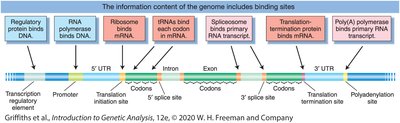
Q6. In Figure 14-11, how are the positions of codons determined?
Background
Topic: Genome Annotation and Gene Structure
This question is about how codons—the three-nucleotide sequences that code for amino acids—are identified within a gene's DNA sequence during genome annotation.
Key Terms and Concepts:
Codon: A sequence of three nucleotides in mRNA that specifies an amino acid or stop signal during translation.
Exon: A region of a gene that is expressed and codes for protein.
Open Reading Frame (ORF): A continuous stretch of codons that begins with a start codon and ends at a stop codon.
Step-by-Step Guidance
Examine the annotated gene structure to identify exons, as codons are only found within exons.
Locate the translation initiation site (start codon, usually ATG in DNA or AUG in mRNA).
From the start codon, divide the nucleotide sequence into consecutive triplets (codons) until you reach a stop codon.
Ensure that the reading frame is maintained throughout the exon regions.
Try solving on your own before revealing the answer!
Final Answer:
The positions of codons are determined by identifying the start codon at the translation initiation site and then reading the nucleotide sequence in sets of three (triplets) within the exons, maintaining the correct reading frame until a stop codon is reached. This process is guided by the annotated features in the gene, such as exons and translation start/stop sites.
Q7. In Figure 14-11, how are the positions of transcriptional regulatory elements determined?
Background
Topic: Gene Regulation and Genome Annotation
This question focuses on how regulatory elements, such as promoters and enhancers, are identified in the genome.
Key Terms and Concepts:
Transcriptional Regulatory Elements: DNA sequences that control the transcription of genes (e.g., promoters, enhancers, silencers).
Promoter: A region upstream of the gene where RNA polymerase binds to initiate transcription.
Transcription Factor Binding Sites: Specific DNA sequences recognized by regulatory proteins.
Step-by-Step Guidance
Identify regions upstream (5') of the gene, especially near the transcription start site, as likely locations for promoters and regulatory elements.
Look for conserved DNA motifs or sequences known to bind transcription factors.
Use experimental data (e.g., DNase I hypersensitivity, ChIP-seq) or computational predictions to pinpoint regulatory element positions.
Try solving on your own before revealing the answer!
Final Answer:
The positions of transcriptional regulatory elements are determined by identifying conserved DNA motifs and experimentally validated binding sites, typically located upstream of the gene (such as promoters), as well as within or near the gene for enhancers and silencers. These are annotated based on sequence analysis and experimental evidence.
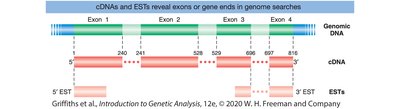
Q8. In Figure 14-12, expressed sequence tags (ESTs) are aligned with genomic sequence. How are ESTs helpful in genome annotation?
Background
Topic: Genome Annotation and Transcript Mapping
This question is about the use of ESTs—short cDNA sequences derived from mRNA—in identifying gene structures within the genome.
Key Terms and Concepts:
Expressed Sequence Tag (EST): A short sub-sequence of a cDNA sequence that represents a portion of an expressed gene.
Genome Annotation: The process of identifying gene locations and structures in a genome sequence.
Exon-Intron Structure: The arrangement of coding (exon) and non-coding (intron) regions in a gene.
Step-by-Step Guidance
Align EST sequences to the genomic DNA to identify regions that are transcribed (exons).
Use the boundaries of EST alignments to infer exon-intron junctions.
Combine multiple ESTs to reconstruct the full transcript structure and support gene predictions.
Try solving on your own before revealing the answer!
Final Answer:
ESTs are helpful in genome annotation because they provide direct evidence of transcribed regions (exons) and help define exon-intron boundaries by aligning to the genomic sequence. This supports the identification and annotation of genes and their structures.
Q9. In Figure 14-12, cDNA sequences are aligned with genomic sequence. How are cDNA sequences helpful in genome annotation? Are cDNAs more important for bacterial or eukaryotic genome annotations?
Background
Topic: Genome Annotation and Transcript Evidence
This question addresses the role of cDNA (complementary DNA) in identifying gene structures and the differences in its importance between bacteria and eukaryotes.
Key Terms and Concepts:
cDNA: DNA synthesized from an mRNA template; represents the coding sequence of a gene without introns.
Genome Annotation: Identifying gene locations and structures in the genome.
Exon-Intron Structure: Eukaryotic genes have introns and exons; bacterial genes typically do not.
Step-by-Step Guidance
Align cDNA sequences to the genomic DNA to identify exons and exon-intron boundaries.
Use cDNA to confirm which regions of the genome are transcribed and spliced into mature mRNA.
Consider that cDNA is especially valuable in eukaryotes, where genes are interrupted by introns, making annotation more complex.
Try solving on your own before revealing the answer!
Final Answer:
cDNA sequences are helpful in genome annotation because they reveal the exact exon structure of genes by aligning to the genome and showing which regions are transcribed and spliced. cDNAs are more important for eukaryotic genome annotation, as eukaryotic genes contain introns that are absent in the mature mRNA and cDNA, whereas bacterial genes generally lack introns.
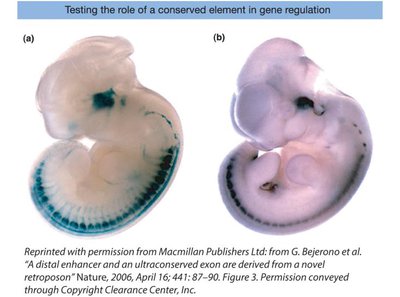
Q10. Based on Figure 14-16 and the features of ultraconserved elements, what would you predict you’d observe if you injected a reporter-gene construct of the rat ortholog of the ISL1 ultraconserved element into fertilized mouse oocytes and examined reporter gene expression in the developing embryo?
Background
Topic: Functional Genomics and Regulatory Elements
This question explores the function of ultraconserved elements—DNA sequences that are highly conserved across species—and their role in gene regulation, as tested by reporter gene assays in embryos.
Key Terms and Concepts:
Ultraconserved Element: A DNA sequence that is identical across different species, suggesting an important regulatory function.
Reporter Gene Assay: An experimental technique where a gene encoding an easily detectable product is placed under the control of a regulatory sequence to test its activity.
Ortholog: Genes in different species that evolved from a common ancestral gene.
Step-by-Step Guidance
Understand that ultraconserved elements are likely to have similar regulatory functions across species due to their high conservation.
Predict that the rat ISL1 ultraconserved element will drive reporter gene expression in a pattern similar to the mouse ISL1 element.
Consider that expression will be observed in tissues or regions where ISL1 is normally active during mouse embryonic development.
Try solving on your own before revealing the answer!
Final Answer:
You would predict that the reporter gene would be expressed in the same embryonic tissues or regions as the endogenous ISL1 gene, indicating that the rat ultraconserved element can functionally substitute for the mouse element in regulating gene expression during development.
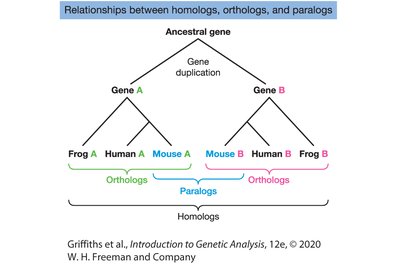
Q11. Based on Figure 14-17, did the duplication that created the A and B genes occur before or after speciation of the common ancestor of frogs, humans and mice?
Background
Topic: Gene Duplication and Evolutionary Relationships
This question is about interpreting gene trees to determine the timing of gene duplication events relative to species divergence (speciation).
Key Terms and Concepts:
Gene Duplication: The process by which a region of DNA is copied and both copies are retained in the genome.
Speciation: The evolutionary process by which populations evolve to become distinct species.
Orthologs and Paralogs: Orthologs are genes in different species that evolved from a common ancestral gene; paralogs are genes related by duplication within a genome.
Step-by-Step Guidance
Examine the gene tree to see if both A and B genes are present in all three species (frog, human, mouse).
If both genes are present in all species, the duplication must have occurred before the species diverged.
If only one gene is present in some species, the duplication may have occurred after speciation.
Try solving on your own before revealing the answer!
Final Answer:
The duplication that created the A and B genes occurred before the speciation of the common ancestor of frogs, humans, and mice, as both gene copies are present in all three lineages.
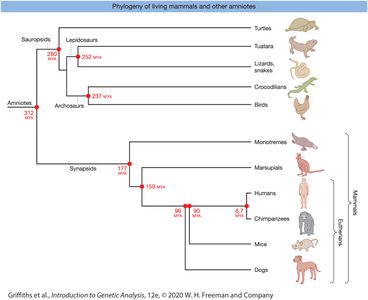
Q12. Based on Figure 14-18, are humans more closely related to mice or to dogs?
Background
Topic: Phylogenetics and Evolutionary Relationships
This question asks you to interpret a phylogenetic tree to determine evolutionary relationships among mammals.
Key Terms and Concepts:
Phylogenetic Tree: A diagram showing evolutionary relationships among species.
Common Ancestor: The most recent ancestral species from which two or more species evolved.
Step-by-Step Guidance
Locate humans, mice, and dogs on the phylogenetic tree.
Trace the branches to find the most recent common ancestor shared by humans and mice, and by humans and dogs.
Compare the branch points to determine which pair shares a more recent common ancestor.
Try solving on your own before revealing the answer!
Final Answer:
Humans are more closely related to mice than to dogs, as humans and mice share a more recent common ancestor on the phylogenetic tree.
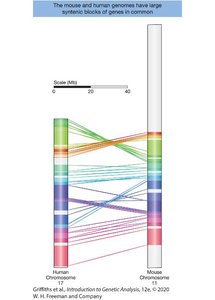
Q13. Figure 14-20 shows syntenic regions of mouse chromosome 11 and human chromosome 17. What do these syntenic regions reveal about the genome of the last common ancestor of mice and humans?
Background
Topic: Comparative Genomics and Synteny
This question is about interpreting synteny—conserved blocks of genes between species—to infer features of ancestral genomes.
Key Terms and Concepts:
Synteny: The conservation of blocks of gene order between different species.
Comparative Genomics: The study of similarities and differences in the genomes of different species.
Step-by-Step Guidance
Examine the syntenic blocks between mouse chromosome 11 and human chromosome 17.
Note that large regions of gene order are conserved between the two species.
Infer that these conserved regions reflect the organization of the genome in their last common ancestor.
Try solving on your own before revealing the answer!
Final Answer:
The syntenic regions reveal that large blocks of gene order have been conserved since the last common ancestor of mice and humans, indicating that their ancestral genome contained similar arrangements of these genes.
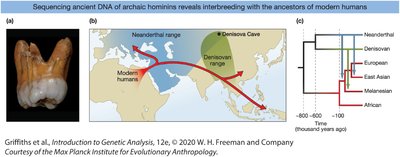
Q14. Based on Figure 14-22, what percent of Denisovan ancestry do you predict would be found in modern Western Europeans?
Background
Topic: Human Evolution and Ancient DNA
This question involves interpreting data on ancient hominin interbreeding and the distribution of Denisovan ancestry in modern human populations.
Key Terms and Concepts:
Denisovan: An extinct species or subspecies of archaic humans.
Ancestry Proportion: The percentage of genetic material inherited from a particular ancestral group.
Step-by-Step Guidance
Examine the figure to see which modern populations have Denisovan ancestry.
Identify the populations with significant Denisovan ancestry (e.g., Melanesians, East Asians).
Compare the Denisovan ancestry in Western Europeans to these other populations.
Try solving on your own before revealing the answer!
Final Answer:
Modern Western Europeans are predicted to have little to no Denisovan ancestry, as the figure shows Denisovan genetic contributions are primarily found in Melanesian and some East Asian populations, but not in Western Europeans.
Sample Question 1. Comparison of genome sequences between members of different species can be used to: (SELECT ALL THAT APPLY)
Background
Topic: Comparative Genomics
This question tests your understanding of the applications of comparing genome sequences across species.
Key Terms and Concepts:
Open Reading Frame (ORF): A sequence of DNA that could potentially encode a protein.
Codon Bias: The non-random usage of synonymous codons in a genome.
Meiotic Nondisjunction: The failure of chromosomes to separate properly during meiosis.
Step-by-Step Guidance
Consider how comparative genomics can provide evidence for gene structure and function (e.g., confirming ORFs as real exons).
Think about how sequence comparison can help identify disease-causing mutations.
Evaluate whether comparative genomics can detect chromosomal abnormalities or codon usage patterns.
Try solving on your own before revealing the answer!
Final Answer:
Correct answers: a) provide evidence that predicted open reading frames represent real exons; b) identify mutations causing disease; e) identify cases of abnormal chromosome inheritance. Comparative genomics is not typically used to identify meiotic nondisjunction or codon bias directly.
Sample Question 2. Comparison of genome sequences between members of different species can be used to: (SELECT ALL THAT APPLY)
Background
Topic: Comparative Genomics
This question is similar to the previous one, focusing on the uses of genome sequence comparison.
Key Terms and Concepts:
Transposable Element: A DNA sequence that can change its position within the genome.
Gene Expression: The process by which information from a gene is used to synthesize a functional gene product.
Step-by-Step Guidance
Assess which options involve identifying genes, mutations, or structural changes that can be revealed by comparing genomes.
Consider whether gene expression levels or new transposable element insertions can be determined by cross-species comparison.
Try solving on your own before revealing the answer!
Final Answer:
Correct answers: a) identify genes associated with disease; d) identify cases of abnormal chromosome inheritance; e) provide evidence that predicted open reading frames represent real exons. Comparative genomics does not directly determine gene expression levels or new transposable element insertions.
Sample Question 3. In a BLAST search of the Drosophila genome database, you find four non-overlapping open reading frames that range in size from 100 bp to 300 bp and are all located within a 3 kb region of the genome. You notice that the genome annotation shows two expressed sequence tags (ESTs), that were derived from a Drosophila muscle cDNA library, that map to this region. Which of the following questions will you be able to answer definitively with this information? SELECT ALL THAT APPLY.
Background
Topic: Genome Annotation and Transcript Evidence
This question tests your ability to interpret BLAST results and EST mapping to answer questions about gene expression and structure.
Key Terms and Concepts:
BLAST: A tool for comparing an input sequence against a database to find regions of similarity.
EST: Short cDNA sequence representing expressed genes.
Step-by-Step Guidance
Determine if the presence of ESTs from muscle cDNA confirms gene expression in muscle tissue.
Assess whether EST mapping can reveal the exact intron/exon boundaries or the full protein sequence.
Consider if the location of the gene within the genome can be determined from the data.
Try solving on your own before revealing the answer!
Final Answer:
Correct answers: a) Whether the gene is expressed in muscle tissue; c) The location of the gene within the genome. The ESTs confirm expression in muscle and map the gene's location, but do not provide full intron/exon boundaries or the complete protein sequence.
