 뒤로
뒤로Non-Coding RNAs and Their Integrated Networks: A Genetics Study Guide
스터디 가이드 - 스마트 노트
 자료에 맞춘 맞춤형 노트, 핵심 정의, 예시, 맥락을 확장해 제공합니다.
Introduction to Non-Coding RNAs (ncRNAs)
Overview of ncRNAs in Eukaryotic Genomes
Eukaryotic genomes are extensively transcribed, producing both protein-coding and non-coding RNAs (ncRNAs). While messenger RNAs (mRNAs) have been the primary focus of genetic research, ncRNAs are now recognized as essential regulators of gene expression and cellular processes. Advances in sequencing technologies and bioinformatics have revealed the diversity and complexity of ncRNAs, which participate in gene regulation, development, disease, and stress responses.
ncRNAs: RNA molecules that do not encode proteins but regulate gene expression at multiple levels.
Key roles: Tumor suppression, oncogenesis, stress response, and developmental regulation.
Major databases: Rfam, NONCODE, miRbase, circBase.
Classification of ncRNAs
Types and Functions of ncRNAs
ncRNAs are classified based on their expression patterns and regulatory roles. They are divided into housekeeping ncRNAs, which are constitutively expressed and essential for basic cellular functions, and regulatory ncRNAs, which modulate gene expression at various levels.
Housekeeping ncRNAs: rRNA, tRNA, snRNA, snoRNA, telomerase RNA, tRF, tiRNA.
Regulatory ncRNAs: miRNA, siRNA, piRNA, eRNA, lncRNA, circRNA, Y RNA.
Type | Abbreviation | Full Name | Size |
|---|---|---|---|
Housekeeping ncRNAs | rRNA | Ribosomal RNA | 120–4,500 nt |
Housekeeping ncRNAs | tRNA | Transfer RNA | 76–90 nt |
Housekeeping ncRNAs | snRNA | Small nuclear RNA | 100–300 nt |
Housekeeping ncRNAs | snoRNA | Small nucleolar RNA | 60–400 nt |
Housekeeping ncRNAs | TERC | Telomerase RNA | / |
Housekeeping ncRNAs | tRF | tRNA-Derived Fragments | 16–28 nt |
Housekeeping ncRNAs | tiRNA | tRNA halves | 29–50 nt |
Regulatory ncRNAs | miRNA | MicroRNA | 21–23 nt |
Regulatory ncRNAs | siRNA | Small interfering RNA | 20–25 nt |
Regulatory ncRNAs | piRNA | Piwi-interacting RNA | 26–32 nt |
Regulatory ncRNAs | eRNA | Enhancer RNA | 50–2,000 nt |
Regulatory ncRNAs | lncRNA | Long non-coding RNA | >200 nt |
Regulatory ncRNAs | circRNA | Circular RNA | 100–10,000 nt |
Regulatory ncRNAs | Y RNA | Y RNA | / |
Origins and Biogenesis of ncRNAs
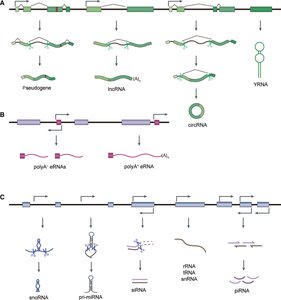
ncRNAs are transcribed from various genomic regions, including protein-coding genes, enhancers, introns, and transposon elements. Their biogenesis involves complex processing and modification events.
Pseudogenes, lncRNAs, circRNAs: Derived from exons of protein-coding genes.
eRNAs: Transcribed from enhancer regions.
snoRNAs, miRNAs: Encoded by intronic sequences.
siRNAs: Produced from transposon elements.
rRNAs, tRNAs, snRNAs: Transcribed from separate genes.
piRNAs, miRNAs: Derived from intergenic regions.
Housekeeping ncRNAs
Functions and Regulatory Roles
Housekeeping ncRNAs are essential for cell viability and are constitutively expressed. They participate in fundamental processes such as protein synthesis, RNA splicing, and RNA modification.
rRNAs and tRNAs: Central to translation and protein synthesis.
snRNAs: Involved in RNA splicing.
snoRNAs: Guide RNA modifications.
tRFs and tiRNAs: Derived from tRNAs, can inhibit translation under stress.
sno-derived RNAs: Small RNAs derived from snoRNAs, with regulatory functions.
Regulatory ncRNAs
Small and Long Regulatory ncRNAs
Regulatory ncRNAs are classified by size: small ncRNAs (<200 nt) and long ncRNAs (>200 nt). They regulate gene expression at epigenetic, transcriptional, and post-transcriptional levels.
miRNAs: Generated from hairpin loop structures, mediate gene silencing post-transcriptionally.
siRNAs: Double-stranded RNAs, key in RNA interference; can be exogenous or endogenous.
piRNAs: Animal-specific, processed independently of Dicer, defend against transposons in germ cells.
lncRNAs: Diverse functions, classified by genomic location (intergenic, intronic, sense, antisense, bidirectional) and regulatory effect (cis/trans).
eRNAs: Transcribed from enhancers, often unstable and non-polyadenylated.
circRNAs: Covalently closed loops, act as miRNA sponges and regulate splicing/transcription.
ncRNA Interactions
ncRNAs Interact with mRNAs
ncRNAs regulate mRNA expression through direct interactions, often resulting in gene silencing or activation. Experimental methods such as PAR-CLIP, HITS-CLIP, and LIGR-seq are used to map these interactions.
miRNA-mRNA interactions: Lead to mRNA silencing; upregulated miRNAs can act as oncogenes.
circRNAs: Can promote mRNA expression by acting as miRNA sponges.
Example: Circular RNAs regulate CADM1 gene expression in osteosarcoma.
ncRNA-ncRNA Interactions
ncRNAs interact with each other, forming complex regulatory networks. These interactions can be between different types (e.g., circRNA-lncRNA) or the same type (e.g., miRNA-miRNA).
ceRNAs: CircRNAs, lncRNAs, and eRNAs act as competitive endogenous RNAs, sponging miRNAs.
Synergistic networks: miRNAs and lncRNAs can cooperate to regulate gene expression, especially in cancer.
Example: Circular RNA hsa_circ_0001368 suppresses gastric cancer by sponging miR-6506-5p.
ncRNAs Interact with DNAs
Some ncRNAs directly regulate chromatin structure and gene expression by interacting with DNA. Technologies like GRID-seq map these interactions.
Promoter-proximal small RNAs: Associated with nucleosome positioning and transcriptional regulation.
lncRNAs NEAT1 and MALAT1: Localize to active chromatin sites, influencing gene expression.
Y RNAs: Key factors in DNA replication initiation.
ncRNAs Interact with Proteins
ncRNAs form ribonucleoprotein complexes and interact with RNA-binding proteins (RBPs), affecting gene expression, RNA stability, and cellular localization.
snRNAs: Form spliceosomes for RNA splicing.
snoRNAs: Guide post-transcriptional modifications.
miRNAs, siRNAs, piRNAs: Interact with Argonaute proteins in RNA interference pathways.
lncRNAs: Recruit or inhibit proteins, e.g., Xist interacts with SHARP, SAF-A, and LBR for transcriptional silencing.
circRNAs: Can act as protein sponges, e.g., circRNA-Foxo3 in cancer cell apoptosis.
Integrated ncRNA Networks
Complex Regulatory Networks
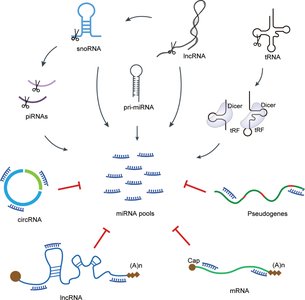
ncRNAs mediate interconnected regulatory networks, influencing gene expression in both the nucleus and cytoplasm. The ceRNA network is a prominent example, involving competition for miRNA binding among coding and non-coding RNAs.
ceRNA hypothesis: RNAs with miRNA response elements (MREs) compete for miRNA binding, forming a regulatory network.
Key conditions: Relative concentrations, number and effectiveness of MREs, and subcellular distribution impact network function.
Examples: ZEB2 mRNA, H19 lncRNA, VCAN 3'UTR, and pseudogenes as ceRNAs.
ncRNA-Mediated Networks in Genomics and Proteomics
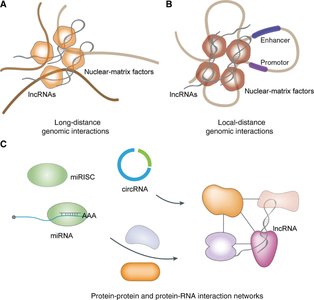
ncRNAs regulate genomic organization and protein interaction networks, contributing to both local and long-range genomic interactions and cell type-specific proteomes.
Genomic interactions: ncRNAs mediate promoter-enhancer interactions and coordinate gene cluster expression.
Protein networks: ncRNAs participate in protein-protein and protein-RNA interaction networks, e.g., HuR and lincMD1 in muscle differentiation.
Summary and Academic Context
Non-coding RNAs are fundamental to the regulation of genetic information in eukaryotes. Their diverse types, origins, and interactions form complex networks that integrate transcriptomics, genomics, and proteomics. Understanding ncRNA functions and networks is essential for modern genetics, with implications for disease, development, and cellular regulation.
Key Terms: ncRNA, ceRNA, miRNA, lncRNA, circRNA, siRNA, piRNA, snoRNA, snRNA, tRNA, rRNA, MRE, RBP, chromatin, transcriptome.
Additional info: The study notes expand on the original content by providing definitions, examples, and context for each ncRNA type and their interactions, ensuring completeness and academic quality for Genetics students.
