 뒤로
뒤로Prokaryotic DNA Replication: Mechanisms, Models, and Key Proteins
스터디 가이드 - 스마트 노트
 자료에 맞춘 맞춤형 노트, 핵심 정의, 예시, 맥락을 확장해 제공합니다.
Prokaryotic DNA Replication
Overview of DNA Replication Mechanisms
DNA replication is a fundamental process in prokaryotes, ensuring the faithful transmission of genetic information. Three models were historically proposed to explain how DNA is duplicated: conservative, semiconservative, and dispersive. Experimental evidence supports the semiconservative model.
Conservative Model: Both parental DNA strands remain together after replication.
Semiconservative Model: Each new DNA molecule contains one parental and one daughter strand. This is the correct model.
Dispersive Model: Parental and daughter DNA segments are interspersed in both strands.
Experimental Validation: Meselson-Stahl Experiment
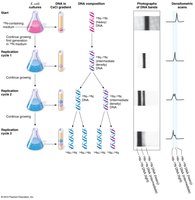
Matthew Meselson and Franklin Stahl conducted a classic experiment in 1958 to distinguish between the three models. They used isotopes of nitrogen (15N and 14N) to label DNA and followed its replication in E. coli.
Hypothesis: DNA replication is semiconservative.
Method: Cells were grown in 15N medium, then transferred to 14N medium. DNA was extracted, mixed with cesium chloride, and centrifuged to separate based on density.
Results: After one generation, DNA was "half-heavy"; after two generations, both "light" and "half-heavy" DNA were observed, supporting the semiconservative model.
Bacterial DNA Replication: Chromosome Structure and Origin
Bacterial Chromosome and Origin of Replication
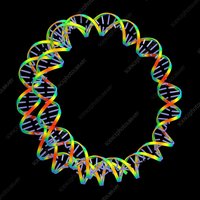
Bacterial chromosomes are typically circular and contain a single origin of replication (oriC). DNA synthesis proceeds bidirectionally from this origin, forming two replication forks that meet at the opposite side of the chromosome.
oriC: The origin of chromosomal replication in bacteria.
Bidirectional Replication: DNA synthesis occurs in both directions from oriC.
Initiation of Replication at oriC
Initiation involves specific DNA sequences and proteins that prepare the DNA for replication.
DnaA boxes: Sites for DnaA protein binding.
AT-rich regions: Sites where DNA strands separate easily.
GATC methylation sites: Regulate replication initiation.
Steps:
DnaA proteins bind to DnaA boxes and to each other.
Additional proteins cause DNA bending and strand separation at AT-rich regions.
DnaB (helicase) binds and further separates the strands, traveling in the 5’ to 3’ direction using ATP.
GATC Methylation and Regulation
GATC methylation sites are crucial for regulating replication. DNA adenine methyltransferase (Dam) methylates adenine residues. Only fully methylated DNA can efficiently initiate replication, helping prevent errors and mutations.
DNA Replication Machinery and Key Proteins
Unwinding and Primer Synthesis
Several proteins coordinate the unwinding of DNA and synthesis of RNA primers:
DNA helicase: Separates DNA strands by breaking hydrogen bonds.
Topoisomerase II (DNA gyrase): Alleviates positive supercoiling ahead of the replication fork.
Single-strand binding proteins: Stabilize separated strands.
Primase: Synthesizes short RNA primers (10–12 nucleotides) required for DNA polymerase activity.
DNA Polymerases in Bacteria
DNA polymerases catalyze the synthesis of new DNA strands. In E. coli, five DNA polymerases exist:
DNA pol I and III: Responsible for normal replication.
DNA pol II, IV, and V: Involved in DNA repair and replication of damaged DNA.
DNA pol III: Main enzyme for DNA synthesis, composed of 10 subunits (holoenzyme). The ⍺ subunit catalyzes nucleotide addition.
DNA pol I: Removes RNA primers and replaces them with DNA.
Structure of DNA Polymerase
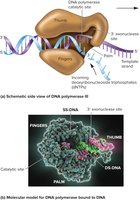
DNA polymerase structure resembles a human right hand, with the template DNA threaded through the palm and thumb/fingers wrapped around the DNA. This facilitates accurate and efficient DNA synthesis.
Synthesis of Leading and Lagging Strands
Leading Strand Synthesis
The leading strand is synthesized continuously in the 5’ to 3’ direction, starting from a single RNA primer at the origin.
DNA pol III adds nucleotides toward the replication fork.
Lagging Strand Synthesis
The lagging strand is synthesized discontinuously, also in the 5’ to 3’ direction but away from the replication fork. Multiple RNA primers are required, and DNA pol III synthesizes short DNA fragments called Okazaki fragments (1000–2000 nucleotides in bacteria).
DNA pol I removes RNA primers and fills gaps with DNA.
DNA ligase connects Okazaki fragments by forming covalent bonds.
Replication Complexes and Coordination
Primosome and Replisome
DNA helicase and primase form the primosome, which coordinates unwinding and primer synthesis. The primosome associates with two DNA polymerase III holoenzymes to form the replisome, enabling simultaneous replication of both strands.
Lagging Strand Looping
The lagging strand is looped to allow DNA polymerase to synthesize Okazaki fragments in the 5’ to 3’ direction. After each fragment, the clamp loader complex reloads the polymerase at the next primer, repeating the process.
Termination of Replication
Termination Sequences and Proteins
Replication ends at ter sequences (T1 and T2) on the opposite side of the chromosome from oriC. The tus protein binds to these sequences, stopping replication forks. DNA ligase links the two daughter strands, and topoisomerase separates intertwined molecules (catenanes).
Chemistry and Accuracy of DNA Replication
Chemical Mechanism
DNA polymerase catalyzes the formation of a covalent (ester) bond between the innermost phosphate of the incoming deoxyribonucleoside triphosphate and the 3’-OH of the previous deoxynucleotide. Pyrophosphate (PPi) is released.
Equation:
Processivity and Clamp Proteins
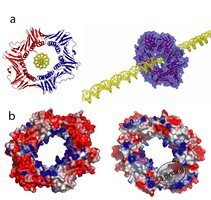
DNA polymerase III is highly processive, remaining attached to the template via the β subunit (clamp protein), which forms a ring around the DNA. The clamp loader complex loads the clamp onto DNA, promoting efficient synthesis.
Fidelity Mechanisms
DNA replication is highly accurate due to several mechanisms:
Stability of proper base pairs: Complementary pairs are more stable than mismatches.
Proofreading: DNA polymerase I and III possess 3’ to 5’ exonuclease activity, removing mismatched nucleotides.
Helix distortion: Mismatched bases distort the helix, preventing incorrect nucleotide incorporation.
Summary: Steps in DNA Replication
Initiation: Assembly of replication machinery at oriC.
Elongation: Synthesis of new DNA strands (leading and lagging).
Termination: Completion and separation of daughter DNA molecules.
