 뒤로
뒤로Risk Calculation in Genetic Counseling: Mini-Textbook Study Notes
스터디 가이드 - 스마트 노트
 자료에 맞춘 맞춤형 노트, 핵심 정의, 예시, 맥락을 확장해 제공합니다.
Introduction to Risk Calculation in Genetic Counseling
Overview
Genetic counseling is a nondirective communication process that addresses an individual's needs and concerns regarding the development or transmission of a genetic disorder. A key component is the mathematical assessment of genetic risk, which has become increasingly complex due to factors such as genetic heterogeneity, reduced penetrance, and the use of molecular genetic tools.
Genetic Counseling and the Laws of Probability
Concept of Risk
Risk can be expressed as a percentage, a proportion (0 to 1), a chance (e.g., 1 in 4), or as odds (e.g., 3 to 1 against).
It is important to clarify what the risk refers to (e.g., risk of inheriting a gene vs. risk of developing a disease).
Perception of risk is subjective and influenced by personal experience.
Laws of Probability
Law of Addition: For mutually exclusive events, the probability of either event occurring is the sum of their probabilities.
Law of Multiplication: For independent events, the probability of both occurring is the product of their probabilities.
Examples
For twin pregnancies, the probability of at least one twin being affected by a recessive disorder can be calculated by considering both monozygotic and dizygotic scenarios and applying the laws above.
The Binomial Distribution
The binomial distribution calculates the probability of a specific number of events (e.g., affected children) in a fixed number of trials (e.g., births), given the probability of each event.
Formula:
Where = total trials, = number of events, = probability of not occurring, = probability of occurring.
Bayes' Theorem
Bayes' theorem is used to update the probability of a hypothesis (e.g., carrier status) based on new evidence (e.g., test results or unaffected children).
Formula:
Where = prior probability of being a carrier, = probability of observation if carrier, = prior probability of not being a carrier, = probability of observation if not a carrier.
Autosomal Dominant Inheritance
Basic Principles
Caused by mutations in autosomal genes, manifest in heterozygotes.
Risk to each child of an affected individual is 1 in 2 (50%).
Risk calculation can be complicated by reduced penetrance, variable expression, age-dependent penetrance, and anticipation.
Reduced Penetrance
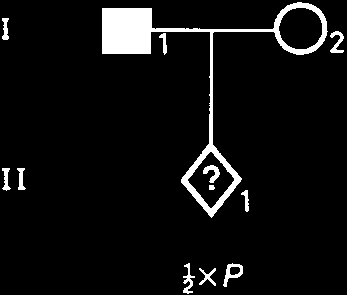
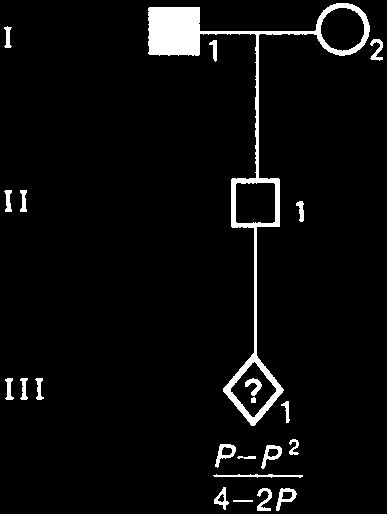
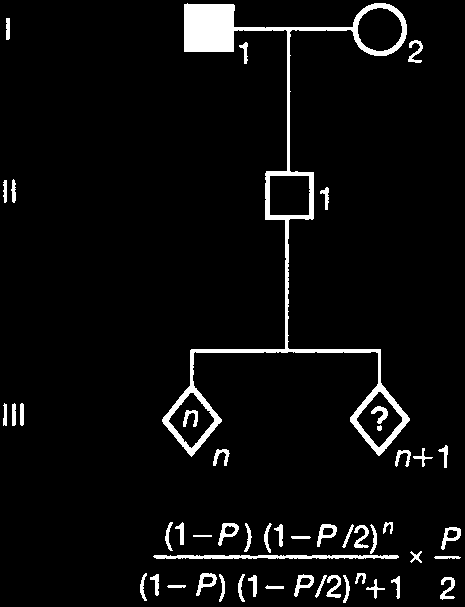
Penetrance (P): Proportion of individuals with a mutation who express the phenotype.
Risk to a child:
Risk to a grandchild (if intervening parent is unaffected):
Age-Dependent Penetrance
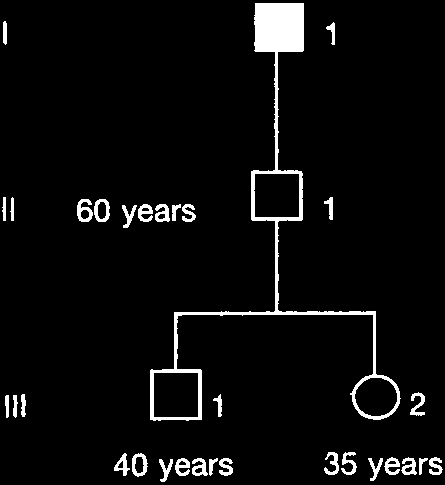
For late-onset disorders (e.g., Huntington's disease), risk is modified by the age of the individual and the age-specific penetrance.
Variable Expression
Severity of phenotype can vary among individuals with the same mutation.
Risk of severe complications can be calculated by multiplying the pedigree risk by the incidence of the complication.
Multiple Autosomal Dominant Disorders
If parents have different disorders, risk to child for each disorder is 1/2; for both, 1/4.
Autosomal Recessive Inheritance
Hardy-Weinberg Equilibrium
In a large, randomly mating population, genotype frequencies remain constant:
Carrier frequency ≈
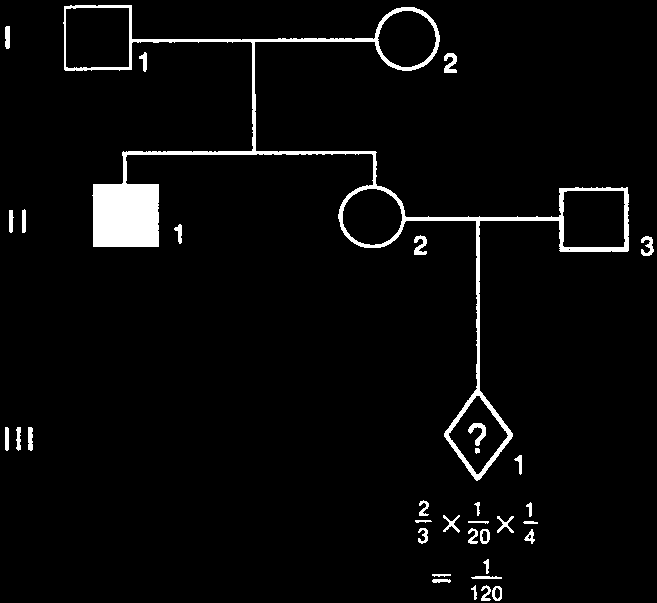
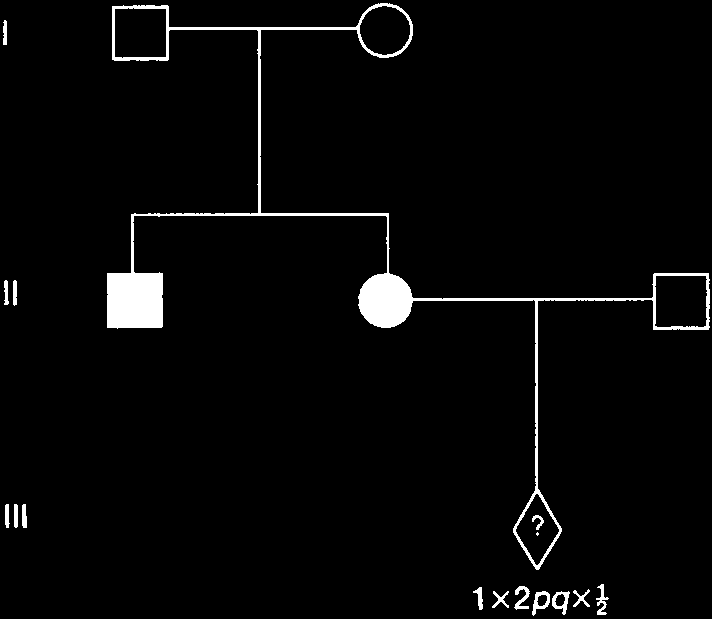
Risk to Offspring of a Healthy Sibling
Probability that an unaffected sibling is a carrier: 2/3
Risk to their child (with unrelated partner):
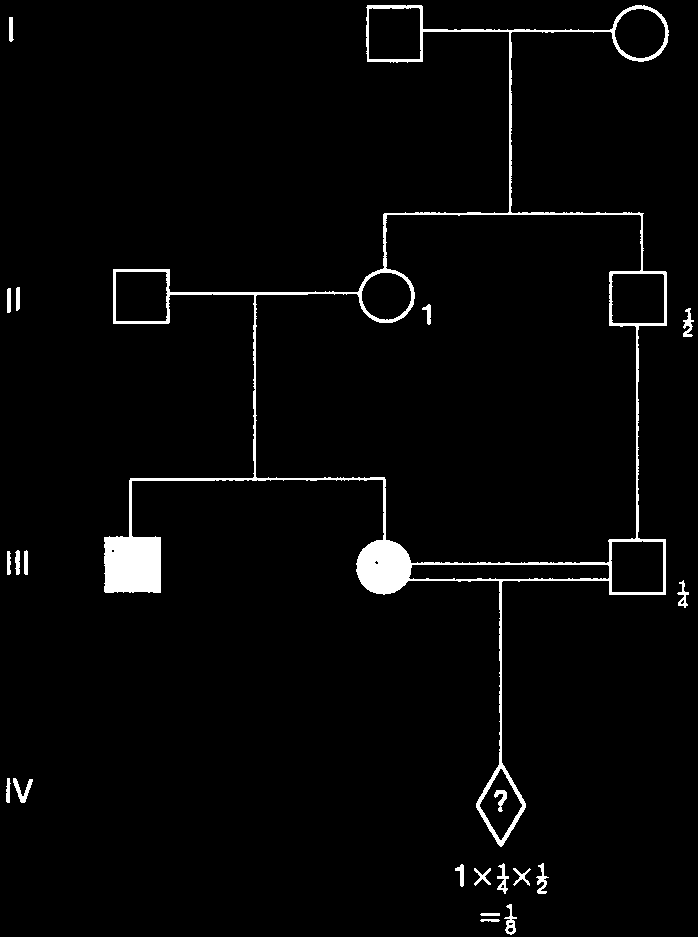
Risks to Extended Family
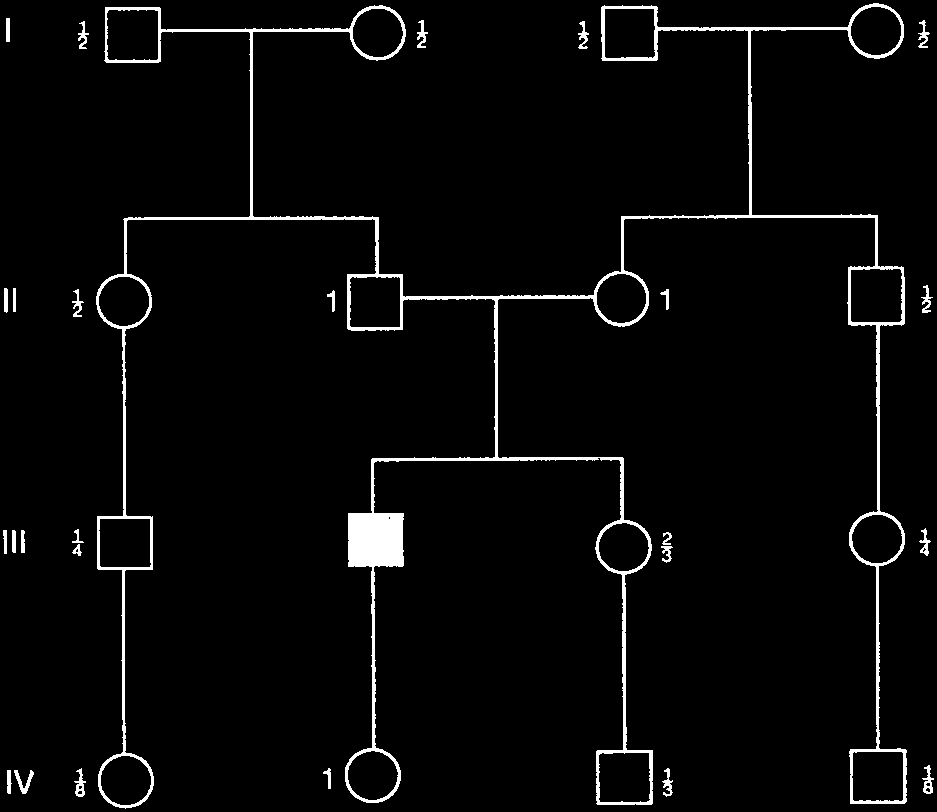
Probability of being a carrier is halved for each degree of relationship from the parents.
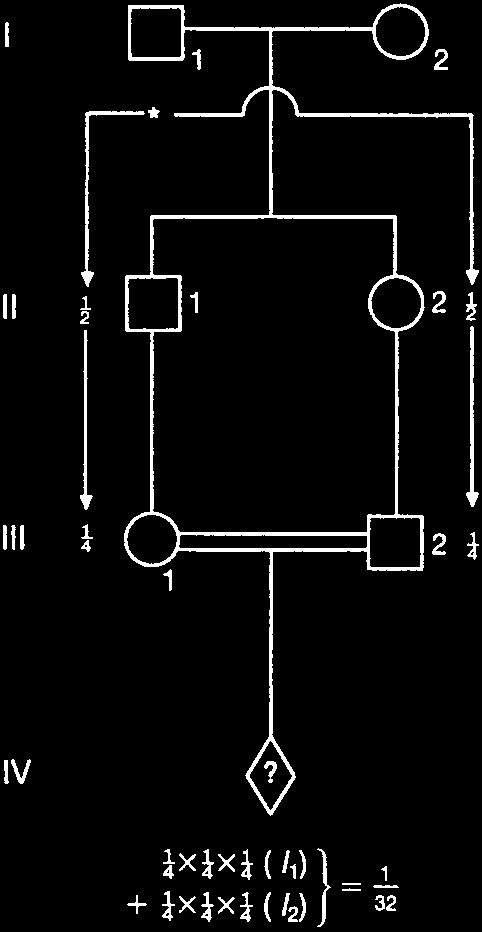
Consanguinity
Coefficient of inbreeding (F): Probability that a child is homozygous for a gene from a common ancestor.
Risk to child: (assuming one deleterious allele per ancestor)
Digenic Inheritance
Principles
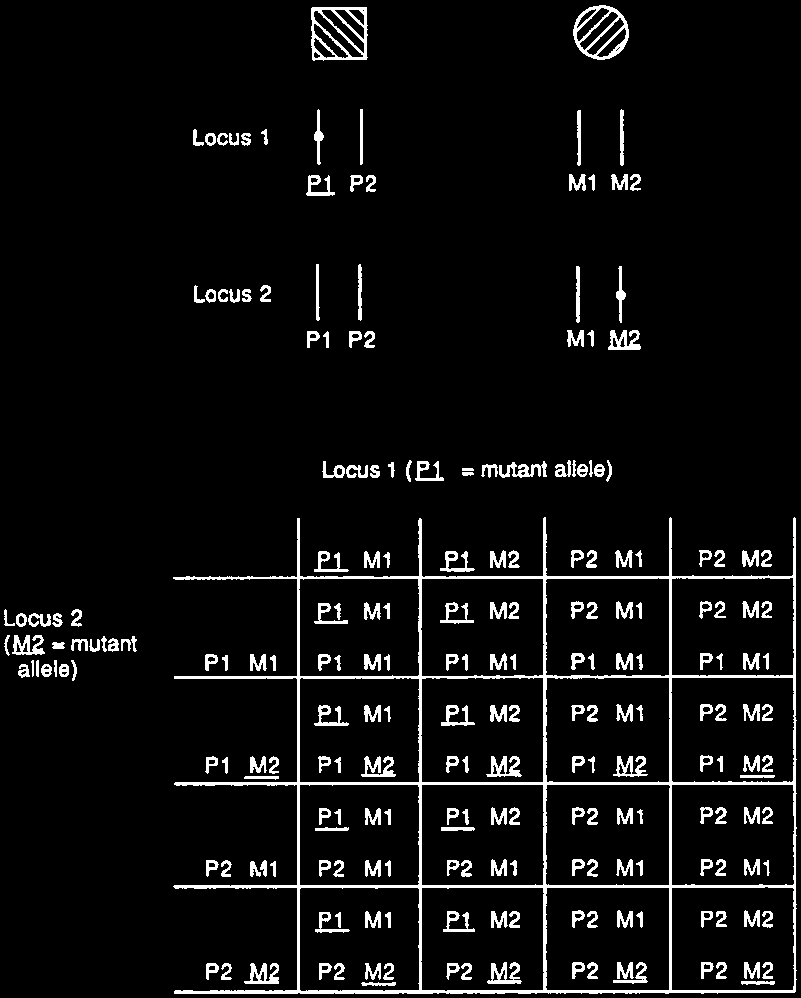
Disorders may result from mutations at two loci (digenic), requiring both mutations for disease expression.
Segregation ratios can mimic autosomal dominant with reduced penetrance or autosomal recessive inheritance.
Tables and Pedigree Analysis
Pedigree Symbols and Risk Calculation
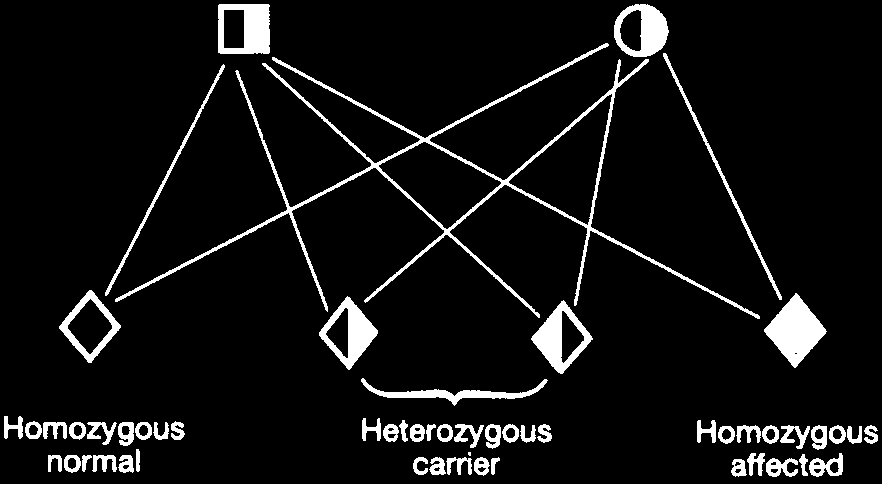
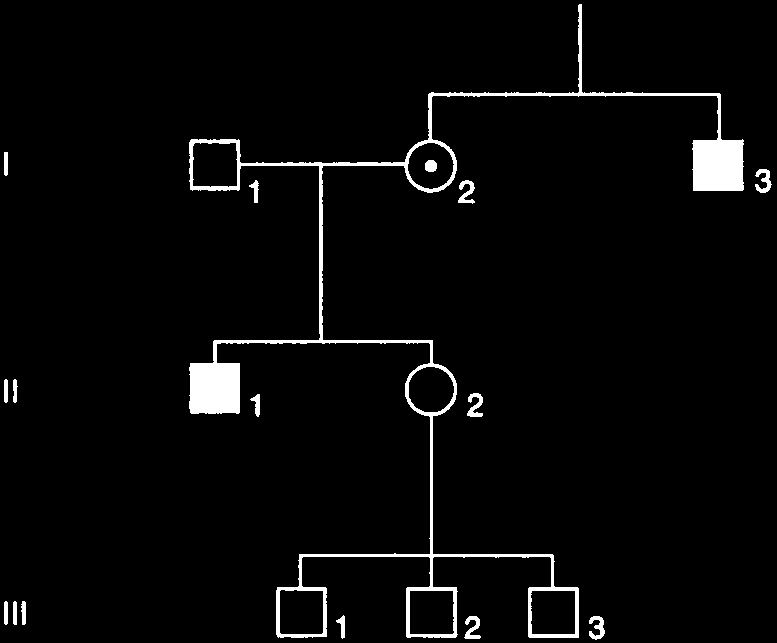
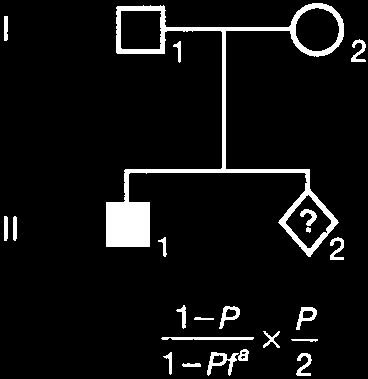
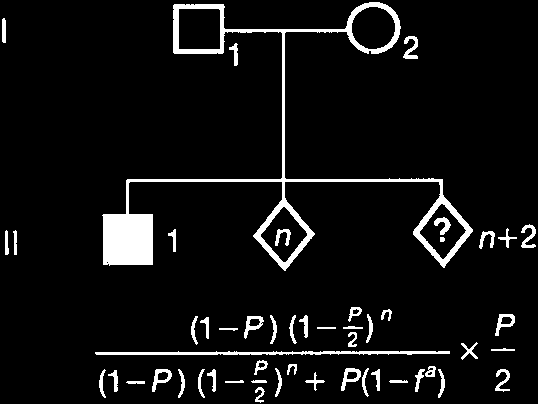
Squares = males, circles = females, filled = affected, half-filled = carrier, diamond = unknown sex.
Pedigree analysis is essential for calculating risks in families with genetic disorders.
Summary Table: Key Risk Formulas
Scenario | Risk Formula |
|---|---|
Autosomal dominant, child of affected | |
Autosomal dominant, reduced penetrance | |
Autosomal recessive, child of two carriers | |
Autosomal recessive, child of affected + carrier | |
Autosomal recessive, healthy sibling's child | |
Consanguinity (first cousins) | |
Digenic inheritance (double heterozygote) |
Additional info:
Some images show Punnett squares and extended pedigrees for more complex inheritance patterns.
Tables in the original text provide empiric risk values for specific disorders and family structures.
