 뒤로
뒤로Sex Determination and Sex Chromosomes: Genetics Study Guide
스터디 가이드 - 스마트 노트
 자료에 맞춘 맞춤형 노트, 핵심 정의, 예시, 맥락을 확장해 제공합니다.
Sex Determination and Sex Chromosomes
Introduction to Sex Determination
Sex determination is a fundamental genetic process in diploid eukaryotes, governing the differentiation of individuals into male or female phenotypes. This process relies on the union of gametes during fertilization and is often associated with heteromorphic chromosomes, such as the X and Y chromosomes, which distinguish the sexes in many species.
Sex chromosomes: Chromosomes that determine the sex of an organism (e.g., X and Y in humans).
Intersex traits: Phenotypes that do not fit binary male or female descriptions.
X and Y Chromosomes Linked to Sex Determination
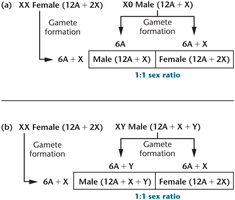
Early studies in the twentieth century established the connection between X and Y chromosomes and sex determination. Different species exhibit distinct mechanisms for sex determination, often involving the distribution of sex chromosomes during gamete formation.
Protenor (Butterfly): Uses the XX/XO system. Females have two X chromosomes; males have one X chromosome.
Lygaeus (Milkweed Bug): Uses the XX/XY system. Females have XX; males have XY.
Homogametic sex: Produces like chromosomes (e.g., XX in females).
Heterogametic sex: Produces unlike chromosomes (e.g., XY in males).
Heterogametic females: In some species (e.g., chickens), females are ZW and males are ZZ.
Sex Determination in Humans
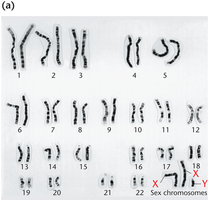
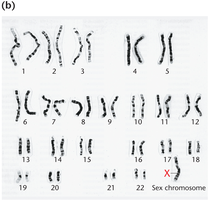
In humans, the presence of the Y chromosome determines maleness. The human karyotype consists of 22 pairs of autosomes and one pair of sex chromosomes (XX in females, XY in males).
Y chromosome: Contains genes critical for male development.
Klinefelter syndrome (47, XXY): Males with an extra X chromosome; symptoms include tall stature, underdeveloped testes, and some female secondary characteristics.
Turner syndrome (45, X): Females with only one X chromosome; symptoms include short stature, rudimentary ovaries, and underdeveloped secondary sex characteristics.
47, XXX syndrome: Females with three X chromosomes; may be unaffected or have sterility and intellectual disabilities.
47, XYY condition: Males with an extra Y chromosome; often tall, with possible intellectual disabilities.
Gonadal Differentiation and Intersex Traits
Gonadal primordia are tissues that can develop into either ovaries or testes. Up to 1.7% of live births result in intersex traits, where physical appearance, internal organs, or hormones do not fit binary categories.
Y Chromosome Structure and Function
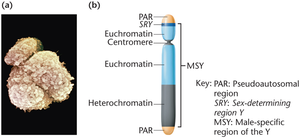
The Y chromosome contains at least 75 genes, fewer than the X chromosome. It has pseudoautosomal regions (PARs) at both ends, which share homology with the X chromosome and allow pairing during meiosis. The male-specific region of the Y (MSY) includes the SRY gene, which encodes the testis-determining factor (TDF).
SRY (Sex-determining region Y): Triggers male development by encoding TDF.
MSY: Divided into X-transposed, X-degenerative, and ampliconic regions, encoding proteins for testis development.
The Sex Ratio in Humans
The sex ratio is the proportion of male to female offspring. The primary sex ratio reflects conception, while the secondary sex ratio reflects births. Worldwide data show a slightly higher ratio of males to females at birth.
Assumptions: Equal numbers of X- and Y-bearing sperm, equal viability and motility, and equal egg receptivity.
Dosage Compensation and X-Inactivation
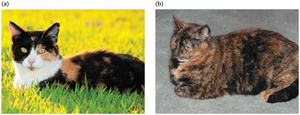
Dosage compensation is a genetic mechanism that balances the expression of X-linked genes between males and females. In mammals, this is achieved by X-inactivation, where one X chromosome in females becomes highly condensed and inactive (Barr body).
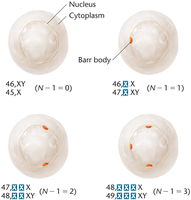
Barr bodies: Inactive X chromosomes observed as darkly stained bodies in interphase cells.
X-inactivation rule: Number of Barr bodies = N - 1, where N is the number of X chromosomes.
Lyon hypothesis: X-inactivation is random in somatic cells early in development; all descendant cells retain the same inactivation pattern.
X-inactivation center (Xic): Contains the XIST gene, which is critical for X-inactivation.
Exceptions: Not all X chromosomes are fully inactivated; some genes escape inactivation.
Sex Determination by X Chromosome to Autosome Ratio
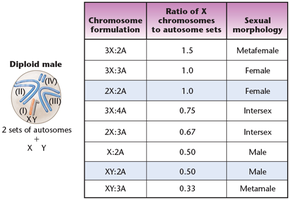
In some species, such as Drosophila melanogaster, sex is determined by the ratio of X chromosomes to sets of autosomes. The Y chromosome does not determine sex in these species.
Normal female: 2X:2A ratio
Normal male: XY:2A ratio
Metafemale: Ratio exceeds unity (e.g., 3X:2A)
Intersex: Intermediate ratios (e.g., 2X:3A)
Dosage Compensation in Drosophila
Unlike mammals, Drosophila males transcribe X-linked genes at twice the rate of females, and X-inactivation does not occur.
Sxl (Sex-lethal) gene: Master switch gene controlling female differentiation.
Sex Determination in Caenorhabditis elegans
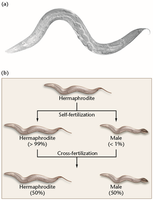
The nematode Caenorhabditis elegans exhibits two sexual phenotypes: males (XO) and hermaphrodites (XX). Hermaphrodites can self-fertilize, producing mostly hermaphrodite offspring, while cross-fertilization with males yields half male and half hermaphrodite offspring.
Temperature-Dependent Sex Determination in Reptiles
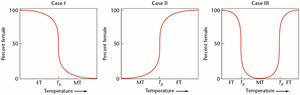
In many reptiles, sex determination is controlled by the incubation temperature of eggs during embryonic development. There are three distinct patterns of temperature-dependent sex determination (TSD) observed in crocodiles, turtles, and some lizards.
Case I: Low temperatures produce females, high temperatures produce males.
Case II: High temperatures produce females, low temperatures produce males.
Case III: Both low and high temperatures produce females, intermediate temperatures produce males.
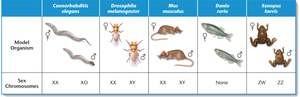
Summary Table: Sex Determination Mechanisms in Model Organisms
Model Organism | Sex Chromosomes |
|---|---|
Caenorhabditis elegans | XX, XO |
Drosophila melanogaster | XX, XY |
Mus musculus (mouse) | XX, XY |
Danio rerio (zebrafish) | None |
Xenopus laevis (frog) | ZW, ZZ |
Additional info: This table summarizes the diversity of sex determination systems across model organisms, highlighting the genetic and environmental mechanisms involved.
