
Ch. 10 - DNA Replication
Klug - Essentials of Genetics 10th Edition
Klug10th EditionEssentials of GeneticsISBN: 9780135588789당신이 사용하는 게 아니라요?교과서 변경
10장, 문제 22

Assume a hypothetical organism in which DNA replication is conservative. Design an experiment similar to that of Taylor, Woods, and Hughes that will unequivocally establish this fact. Using the format established in Figure 11.5, draw sister chromatids and illustrate the expected results establishing this mode of replication.

검증된 단계별 안내
1
Recall that in conservative DNA replication, the original double-stranded DNA molecule remains intact, and an entirely new double-stranded DNA molecule is synthesized. This contrasts with semiconservative replication, where each daughter DNA molecule contains one original and one new strand.
Design an experiment similar to Taylor, Woods, and Hughes by using a labeled nucleotide precursor (such as radioactive thymidine or a heavy isotope like 15N) to distinguish newly synthesized DNA from original DNA. Grow cells in the presence of this label for one round of DNA replication.
After one replication cycle, transfer the cells to a medium without the label and allow them to replicate again. Then, prepare chromosome spreads and use autoradiography to detect the location of the label on sister chromatids.
Draw sister chromatids as pairs of double-stranded DNA molecules. For conservative replication, after one round, one chromatid should be fully labeled (new DNA) and the other fully unlabeled (original DNA). After the second round, you would expect one chromatid fully labeled and the other fully unlabeled in each pair, with no mixing of label within chromatids.
Compare this expected pattern to the semiconservative model (where each chromatid would be half-labeled after one round) to unequivocally establish conservative replication. The key is that in conservative replication, the label is segregated into entirely new DNA molecules, not distributed between strands.

비슷한 문제에 대한 검증된 영상 답변:

이 영상 해법은 위 문제에 도움이 된다고 튜터들이 추천한 것입니다.
영상 길이:
2m
도움이 되었나요?

주요 개념

질문에 올바르게 답하기 위해 반드시 이해해야 하는 핵심 개념들은 다음과 같습니다.

DNA Replication Models

DNA replication can occur via three models: conservative, semi-conservative, and dispersive. In conservative replication, the original DNA molecule remains intact, and an entirely new copy is made. Understanding these models is essential to design experiments that distinguish between them based on the distribution of labeled DNA strands after replication.
추천 영상:
가이드 코스
11:59
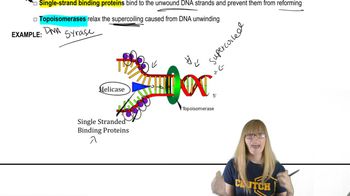
Steps to DNA Replication

Taylor, Woods, and Hughes Experiment

This classic experiment used radioactive thymidine to label DNA in root tip cells and autoradiography to track replication. It demonstrated semi-conservative replication by showing one labeled and one unlabeled chromatid after one replication cycle. Knowing this method helps in designing similar experiments to test alternative replication models.
추천 영상:
가이드 코스
08:06
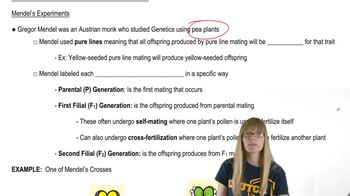
Mendel's Experiments

Autoradiography and Chromatid Visualization

Autoradiography detects radioactive labels incorporated into DNA, allowing visualization of newly synthesized strands. Drawing sister chromatids with expected label patterns after replication cycles helps interpret results. For conservative replication, one chromatid would be fully labeled and the other unlabeled, a key visual distinction.
추천 영상: