Ch. 10 - DNA Replication
Klug - Essentials of Genetics 10th Edition
Klug10th EditionEssentials of GeneticsISBN: 9780135588789당신이 사용하는 게 아니라요?교과서 변경
10장, 문제 24

In 1994, telomerase activity was discovered in human cancer cell lines. Although telomerase is not active in most human adult cells, all cells do contain the genes for telomerase proteins and telomerase RNA. Since inappropriate activation of telomerase may contribute to cancer, why do you think the genes coding for this enzyme have been maintained in the human genome throughout evolution? Are there any types of human body cells where telomerase activation would be advantageous or even necessary? Explain.

검증된 단계별 안내
1
Understand the role of telomerase: Telomerase is an enzyme that adds repetitive nucleotide sequences to the ends of chromosomes (telomeres), preventing their shortening during DNA replication. This helps maintain chromosome integrity and stability.
Consider why telomerase genes are conserved: Even though telomerase is inactive in most adult somatic cells, the genes coding for telomerase are preserved because they are essential for certain cell types that require continuous division and renewal.
Identify cell types where telomerase is active: Telomerase activity is necessary in germ cells (sperm and egg precursors), stem cells, and certain immune cells, as these cells need to divide many times without losing vital genetic information.
Explain the evolutionary advantage: Maintaining telomerase genes allows these critical cells to avoid telomere shortening, which would otherwise lead to cell aging and death, thus supporting reproduction, tissue regeneration, and immune function.
Discuss the link to cancer: While telomerase activation is beneficial in specific cells, inappropriate activation in somatic cells can lead to uncontrolled cell division, contributing to cancer development. This highlights the importance of tight regulation of telomerase activity.

비슷한 문제에 대한 검증된 영상 답변:

이 영상 해법은 위 문제에 도움이 된다고 튜터들이 추천한 것입니다.
영상 길이:
1m
도움이 되었나요?

주요 개념

질문에 올바르게 답하기 위해 반드시 이해해야 하는 핵심 개념들은 다음과 같습니다.

Telomerase Function and Mechanism

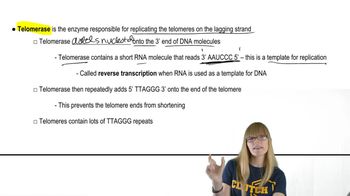
Telomerase is an enzyme that extends telomeres, the protective caps at the ends of chromosomes, by adding repetitive DNA sequences. This prevents chromosome shortening during cell division, which is crucial for maintaining genomic stability and cellular lifespan, especially in cells that divide frequently.
추천 영상:
가이드 코스
08:38
Telomeres and Telomerase

Regulation of Telomerase Activity in Human Cells

In most adult somatic cells, telomerase is inactive, leading to gradual telomere shortening and eventual cellular aging or senescence. However, telomerase genes remain in the genome and can be reactivated in certain cells or pathological conditions, such as cancer, where uncontrolled telomerase activity supports unlimited cell division.
추천 영상:
가이드 코스
08:38
Telomeres and Telomerase

Physiological Importance of Telomerase in Specific Cell Types

Telomerase activity is essential in stem cells, germ cells, and certain immune cells, where it maintains telomere length to support continuous division and tissue regeneration. Its presence in these cells explains why telomerase genes have been conserved evolutionarily despite the risks associated with its misregulation.
추천 영상:
가이드 코스
08:38
Telomeres and Telomerase