Ch. 3 - Mendelian Genetics
Klug - Essentials of Genetics 10th Edition
Klug10th EditionEssentials of GeneticsISBN: 9780135588789당신이 사용하는 게 아니라요?교과서 변경
3장, 문제 17

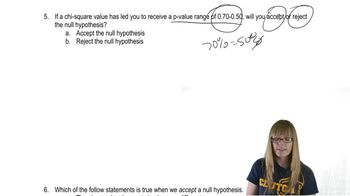
The basis for rejecting any null hypothesis is arbitrary. The researcher can set more or less stringent standards by deciding to raise or lower the p value used to reject or not reject the hypothesis. In the case of the chi-square analysis of genetic crosses, would the use of a standard of p = 0.10 be more or less stringent about not rejecting the null hypothesis? Explain.

검증된 단계별 안내
1
Understand that the p-value in hypothesis testing represents the probability of obtaining results at least as extreme as those observed, assuming the null hypothesis is true.
Recognize that a lower p-value threshold (e.g., 0.05) means you require stronger evidence against the null hypothesis to reject it, making the test more stringent.
Conversely, a higher p-value threshold (e.g., 0.10) means you accept weaker evidence against the null hypothesis to reject it, making the test less stringent.
In the context of chi-square analysis of genetic crosses, using a p-value standard of 0.10 means you are more willing to reject the null hypothesis even if the evidence is not very strong.
Therefore, setting the p-value at 0.10 is less stringent about not rejecting the null hypothesis compared to a lower p-value standard like 0.05.

비슷한 문제에 대한 검증된 영상 답변:

이 영상 해법은 위 문제에 도움이 된다고 튜터들이 추천한 것입니다.
영상 길이:
2m
도움이 되었나요?

주요 개념

질문에 올바르게 답하기 위해 반드시 이해해야 하는 핵심 개념들은 다음과 같습니다.

Null Hypothesis and Significance Level (p-value)

The null hypothesis is a default assumption that there is no effect or difference. The p-value represents the probability of observing the data if the null hypothesis is true. A significance level (alpha) is set to decide when to reject the null hypothesis, commonly 0.05, meaning results with p-values below this threshold lead to rejection.
추천 영상:

Stringency of Significance Levels

Stringency refers to how strict the criteria are for rejecting the null hypothesis. A lower p-value threshold (e.g., 0.01) is more stringent, requiring stronger evidence to reject the null. Conversely, a higher p-value threshold (e.g., 0.10) is less stringent, making it easier to reject the null hypothesis.
추천 영상:

Chi-square Test in Genetic Crosses

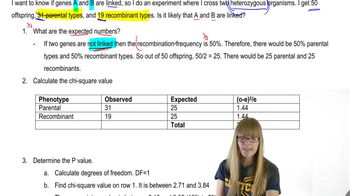
The chi-square test compares observed genetic data to expected ratios under the null hypothesis of no difference. It calculates a p-value to assess if deviations are due to chance. The chosen p-value threshold determines whether the genetic data significantly deviate from expected Mendelian ratios.
추천 영상:
가이드 코스
07:33
Chi Square and Linkage