
교과서 질문
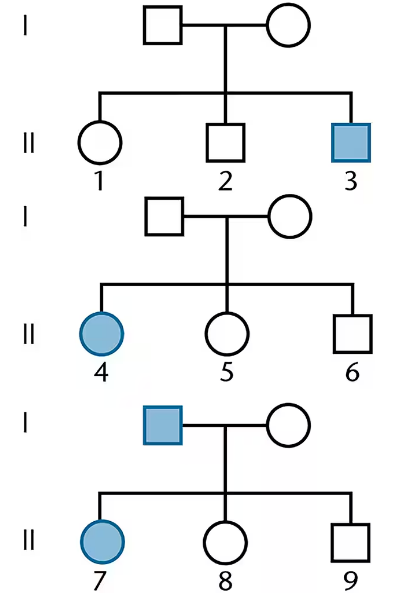
Consider the three pedigrees below, all involving a single human trait.
Which combination of conditions, if any, can be excluded? dominant and X-linked dominant and autosomal recessive and X-linked recessive and autosomal
624
views
 검증된 단계별 안내
 01:59
01:59
 05:13
05:13 09:08
09:08Consider the three pedigrees below, all involving a single human trait.
Which combination of conditions, if any, can be excluded? dominant and X-linked dominant and autosomal recessive and X-linked recessive and autosomal
Consider the three pedigrees below, all involving a single human trait.
Given your conclusions in part (a), indicate the genotype of the following individuals: II-1, II-6, II-9 If more than one possibility applies, list all possibilities. Use the symbols A and a for the genotypes.
Labrador retrievers may be black, brown (chocolate), or golden (yellow) in color (see chapter-opening photo). While each color may breed true, many different outcomes are seen when numerous litters are examined from a variety of matings where the parents are not necessarily true breeding. Following are just some of the many possibilities.
(a) black x brown → all black
(b) black x brown → 1/2 black, 1/2 brown
(c) black x brown → 3/4 black, 1/4 golden
(d) black x golden → all black
(e) black x golden → 4/8 golden 3/8 black 1/8 brown
(f) black x golden → 2/4 golden 1/4 black 1/4 brown
(g) brown x brown → 3/4 brown 1/4 golden
(h) black x black → 9/16 black 4/16 golden, 3/16 brown
Propose a mode of inheritance that is consistent with these data, and indicate the corresponding genotypes of the parents in each mating. Indicate as well the genotypes of dogs that breed true for each color.