Ch. 4 - Modification of Mendelian Ratios
Klug - Essentials of Genetics 10th Edition
Klug10th EditionEssentials of GeneticsISBN: 9780135588789당신이 사용하는 게 아니라요?교과서 변경
4장, 문제 21a

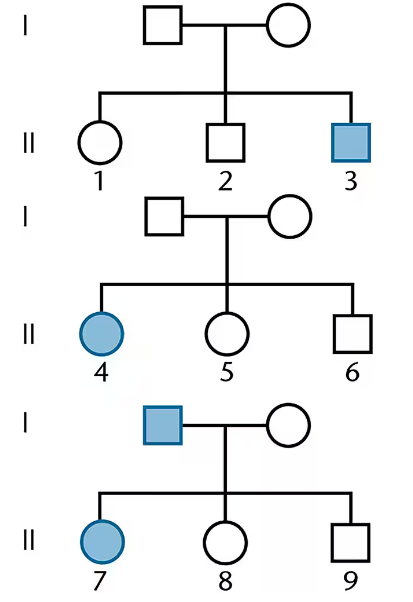
Consider the three pedigrees below, all involving a single human trait.

Which combination of conditions, if any, can be excluded? dominant and X-linked dominant and autosomal recessive and X-linked recessive and autosomal

검증된 단계별 안내
1
Step 1: Identify the pattern of affected individuals in each pedigree. Note the sex of affected individuals (squares for males, circles for females) and whether the trait appears in every generation or skips generations.
Step 2: For autosomal dominant traits, affected individuals usually appear in every generation and both males and females are equally likely to be affected. Check if this pattern fits any of the pedigrees.
Step 3: For X-linked dominant traits, affected males pass the trait to all daughters but no sons, and affected females can pass it to both sons and daughters. Look for affected females in every generation and affected males passing the trait to daughters.
Step 4: For autosomal recessive traits, the trait can skip generations, and affected individuals can have unaffected parents. Both males and females are equally affected. Check if the trait appears in siblings but not parents.
Step 5: For X-linked recessive traits, more males are affected than females, and affected males usually inherit the trait from carrier mothers. Affected males do not pass the trait to sons but can pass the allele to daughters who become carriers. Look for this pattern in the pedigrees.

비슷한 문제에 대한 검증된 영상 답변:

이 영상 해법은 위 문제에 도움이 된다고 튜터들이 추천한 것입니다.
영상 길이:
3m
도움이 되었나요?

주요 개념

질문에 올바르게 답하기 위해 반드시 이해해야 하는 핵심 개념들은 다음과 같습니다.

Modes of Inheritance

Modes of inheritance describe how traits are passed from parents to offspring. Common types include autosomal dominant, autosomal recessive, X-linked dominant, and X-linked recessive. Each mode has distinct patterns in pedigrees, such as affected individuals in every generation for dominant traits or skipping generations for recessive traits.
추천 영상:
가이드 코스
05:13
Organelle Inheritance

Pedigree Analysis

Pedigree analysis involves studying family trees to track the inheritance of traits. Squares represent males, circles represent females, and shaded symbols indicate affected individuals. By examining affected and unaffected members across generations, one can infer the likely mode of inheritance.
추천 영상:
가이드 코스
01:59
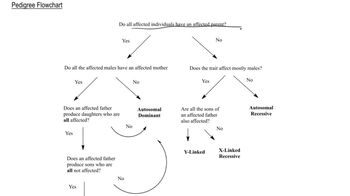
Pedigree Flowchart

X-linked vs Autosomal Traits

X-linked traits are associated with genes on the X chromosome and often show different patterns between males and females, such as males being more frequently affected in X-linked recessive traits. Autosomal traits are located on non-sex chromosomes and typically affect males and females equally.
추천 영상:
관련 실천
교과서 질문

A geneticist from an alien planet that prohibits genetic research brought with him to Earth two pure-breeding lines of frogs. One line croaks by uttering 'rib-it rib-it' and has purple eyes. The other line croaks more softly by muttering 'knee-deep knee-deep' and has green eyes. With a newfound freedom of inquiry, the geneticist mated the two types of frogs, producing F₁ frogs that were all utterers and had blue eyes. A large F₂ generation then yielded the following ratios:

27/64 blue-eyed, 'rib-it' utterer

12/64 green-eyed, 'rib-it' utterer

9/64 blue-eyed, 'knee-deep' mutterer

9/64 purple-eyed, 'rib-it' utterer

4/64 green-eyed, 'knee-deep' mutterer

3/64 purple-eyed, 'knee-deep' mutterer

Indicate the genotypes of the six F₂ phenotypes.

460
views
교과서 질문

Consider the three pedigrees below, all involving a single human trait.

For each combination that you excluded, indicate the single individual in generation II (e.g., II-1, II-2) that was most instrumental in your decision to exclude it. If none were excluded, answer 'none apply.'

573
views
교과서 질문

Consider the three pedigrees below, all involving a single human trait.

Given your conclusions in part (a), indicate the genotype of the following individuals: II-1, II-6, II-9 If more than one possibility applies, list all possibilities. Use the symbols A and a for the genotypes.

1027
views
교과서 질문

Labrador retrievers may be black, brown (chocolate), or golden (yellow) in color (see chapter-opening photo). While each color may breed true, many different outcomes are seen when numerous litters are examined from a variety of matings where the parents are not necessarily true breeding. Following are just some of the many possibilities.

(a) black x brown → all black

(b) black x brown → 1/2 black, 1/2 brown

(c) black x brown → 3/4 black, 1/4 golden

(d) black x golden → all black

(e) black x golden → 4/8 golden 3/8 black 1/8 brown

(f) black x golden → 2/4 golden 1/4 black 1/4 brown

(g) brown x brown → 3/4 brown 1/4 golden

(h) black x black → 9/16 black 4/16 golden, 3/16 brown

Propose a mode of inheritance that is consistent with these data, and indicate the corresponding genotypes of the parents in each mating. Indicate as well the genotypes of dogs that breed true for each color.

1012
views