Ch. 10 - DNA Structure and Analysis
Klug - Concepts of Genetics 12th Edition
Klug12th EditionConcepts of GeneticsISBN: 9780135564776당신이 사용하는 게 아니라요?교과서 변경
10장, 문제 29

In some organisms, cytosine is methylated at carbon 5 of the pyrimidine ring after it is incorporated into DNA. If a 5-methyl cytosine molecule is then hydrolyzed, what base will be generated?

검증된 단계별 안내
1
Understand the structure of cytosine and the position of methylation: cytosine is a pyrimidine base, and methylation occurs at carbon 5 of the pyrimidine ring, producing 5-methylcytosine.
Recall that hydrolysis of cytosine (or 5-methylcytosine) typically involves deamination, where the amino group (-NH2) is replaced by a keto group (=O).
Recognize that deamination of cytosine converts it into uracil, while deamination of 5-methylcytosine converts it into thymine because the methyl group at carbon 5 remains intact.
Therefore, when 5-methylcytosine undergoes hydrolytic deamination, the base generated is thymine.
Summarize that the key concept is that 5-methylcytosine deaminates to thymine, which is important in understanding mutation processes such as C to T transitions in DNA.

비슷한 문제에 대한 검증된 영상 답변:

이 영상 해법은 위 문제에 도움이 된다고 튜터들이 추천한 것입니다.
영상 길이:
31s
도움이 되었나요?

주요 개념

질문에 올바르게 답하기 위해 반드시 이해해야 하는 핵심 개념들은 다음과 같습니다.

DNA Methylation

DNA methylation involves the addition of a methyl group to the 5th carbon of cytosine bases, commonly forming 5-methylcytosine. This epigenetic modification affects gene expression without altering the DNA sequence and is important in processes like gene regulation and genomic imprinting.
추천 영상:
가이드 코스
01:45
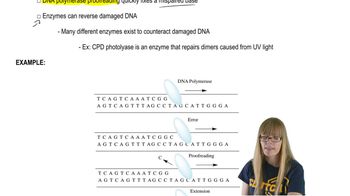
DNA Proofreading

5-Methylcytosine Deamination

5-Methylcytosine can spontaneously deaminate, losing an amino group and converting into thymine. This chemical change is significant because it can lead to mutations if not repaired, as thymine is a normal DNA base but mismatches with guanine.
추천 영상:
가이드 코스
03:49
Base Distortions

Base Hydrolysis and Resulting Products

Hydrolysis of a methylated cytosine base breaks chemical bonds, leading to the release of the base from the DNA backbone. When 5-methylcytosine is hydrolyzed and deaminated, the base generated is thymine, not cytosine, due to the methyl group and deamination altering its structure.
추천 영상:
가이드 코스
03:49
Base Distortions
관련 실천
교과서 질문

One of the most common spontaneous lesions that occurs in DNA under physiological conditions is the hydrolysis of the amino group of cytosine, converting the cytosine to uracil. What would be the effect on DNA structure of a uracil group replacing cytosine?

674
views
교과서 질문

A genetics student was asked to draw the chemical structure of an adenine- and thymine-containing dinucleotide derived from DNA. The answer is shown here:

The student made more than six major errors. One of them is circled, numbered 1, and explained. Find five others. Circle them, number them 2 through 6, and briefly explain each in the manner of the example given.

801
views
교과서 질문

A primitive eukaryote was discovered that displayed a unique nucleic acid as its genetic material. Analysis provided the following information:

A major hyperchromic shift is evident upon heating and monitoring UV absorption at 260 nm.

437
views
교과서 질문

Considering the information on B- and Z-DNA and right- and left-handed helices, carefully analyze structures (a) and (b) below and draw conclusions about their helical nature. Which is right-handed and which is left-handed?

568
views
교과서 질문

Because of its rapid turnaround time, fluorescent in situ hybridization (FISH) is commonly used in hospitals and laboratories as an aneuploid screen of cells retrieved from amniocentesis and chorionic villus sampling (CVS). Chromosomes 13, 18, 21, X, and Y are typically screened for aneuploidy in this way. Explain how FISH might be accomplished using amniotic or CVS samples and why the above chromosomes have been chosen for screening.

543
views
교과서 질문

A primitive eukaryote was discovered that displayed a unique nucleic acid as its genetic material. Analysis provided the following information:

The general X-ray diffraction pattern is similar to that of DNA, but with somewhat different dimensions and more irregularity.

557
views