뒤로
뒤로
문제 1a
How do we know that genes exist in bacteria and bacteriophages?
문제 1b
How do we know that bacteria undergo genetic recombination, allowing the transfer of genes from one organism to another?
문제 1c
How do we know whether or not genetic recombination between bacteria involves cell-to-cell contact?
문제 1d
How do we know that bacteriophages recombine genetic material through transduction and that cell-to-cell contact is not essential for transduction to occur?
문제 1e
In this chapter, we have focused on genetic systems present in bacteria and on the viruses that use bacteria as hosts (bacteriophages). In particular, we discussed mechanisms by which bacteria and their phages undergo genetic recombination, which allows geneticists to map bacterial and bacteriophage chromosomes. In the process, we found many opportunities to consider how this information was acquired. From the explanations given in the chapter, what answers would you propose to the following questions? How do we know that intergenic exchange occurs in bacteriophages?
문제 1f
In this chapter, we have focused on genetic systems present in bacteria and on the viruses that use bacteria as hosts (bacteriophages). In particular, we discussed mechanisms by which bacteria and their phages undergo genetic recombination, which allows geneticists to map bacterial and bacteriophage chromosomes. In the process, we found many opportunities to consider how this information was acquired. From the explanations given in the chapter, what answers would you propose to the following questions? How do we know that in bacteriophage T4 the rII locus is subdivided into two regions, or cistrons?
문제 2
Write a short summary that contrasts how recombination occurs in bacteria and bacteriophages.
문제 3a
With respect to F⁺ and F⁻ bacterial matings, answer the following questions: How was it established that physical contact between cells was necessary?
문제 3b
With respect to F⁺ and F⁻ bacterial matings, answer the following questions: How was it established that chromosome transfer was unidirectional?
문제 3c
With respect to F⁺ and F⁻ bacterial matings, answer the following questions: What is the genetic basis for a bacterium's being F⁺.
문제 4
List all major differences between:
(a) The F⁺ x F⁻ and the Hfr x F⁻ bacterial crosses
(b) The F⁺, F⁻, Hfr, and F' bacteria.
문제 5
Describe the basis for chromosome mapping in the Hfr x F⁻ crosses.
- In general, when recombination experiments are conducted with bacteria, participating bacteria are mixed in complete medium, then transferred to a minimal growth medium. Why isn't the protocol reversed: minimal medium first, complete medium second?
문제 6
문제 7
Why are the recombinants produced from an Hfr x F⁻ cross rarely, if ever, F⁺?
문제 8
Describe the origin of F' bacteria and merozygotes.
문제 9
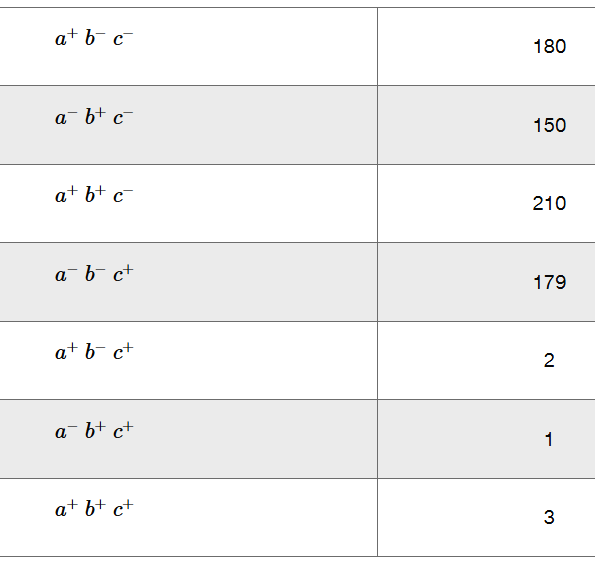
In a transformation experiment, donor DNA was obtained from a prototroph bacterial strain (a⁺b⁺c⁺), and the recipient was a triple auxotroph (a⁻b⁻c⁻). What general conclusions can you draw about the linkage relationships among the three genes from the following transformant classes that were recovered?
문제 10
Describe the role of heteroduplex formation during transformation.
문제 11
Explain the observations that led Zinder and Lederberg to conclude that the prototrophs recovered in their transduction experiments were not the result of F⁺ mediated conjugation.
문제 12
Define plaque, lysogeny, and prophage.
문제 13
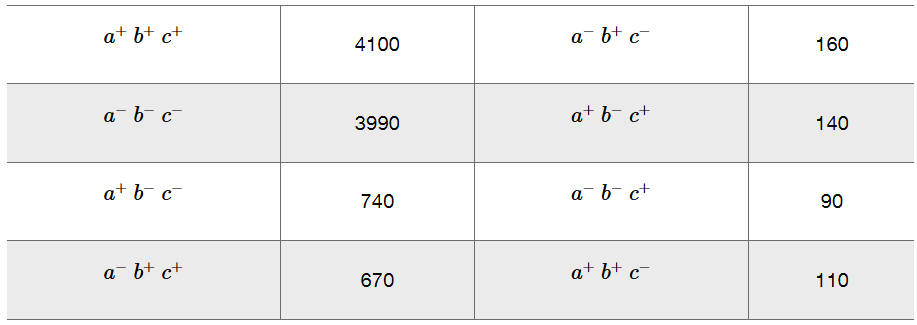
Two theoretical genetic strains of a virus (a⁻b⁻c⁻ and a⁺b⁺c⁺) were used to simultaneously infect a culture of host bacteria. Of 10,000 plaques scored, the following genotypes were observed. Determine the genetic map of these three genes on the viral chromosome. Decide whether the interference was positive or negative.
문제 14
The bacteriophage genome consists of many genes encoding proteins that make up the head, collar, tail, and tail fibers. When these genes are transcribed following phage infection, how are these proteins synthesized, since the phage genome lacks genes essential to ribosome structure?
문제 15
If a single bacteriophage infects one E. coli cell present on a lawn of bacteria and, upon lysis, yields 200 viable viruses, how many phages will exist in a single plaque if three more lytic cycles occur?
문제 16
If a single bacteriophage infects one E. coli cell present on a lawn of bacteria and, upon lysis, yields 200 viable viruses, how many phages will exist in a single plaque if three more lytic cycles occur?
문제 17
In recombination studies of the rII locus in phage T4, what is the significance of the value determined by calculating phage growth in the K12 versus the B strains of E. coli following simultaneous infection in E. coli B? Which value is always greater?
문제 18
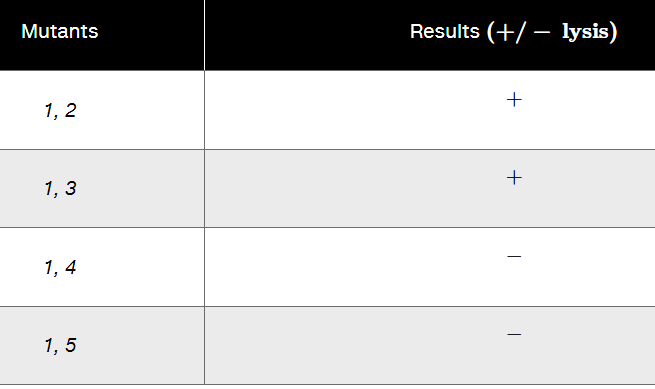
In an analysis of rII mutants, complementation testing yielded the following results:
문제 19
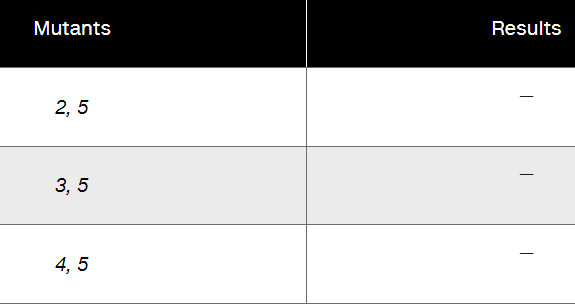
If further testing of the mutations in Problem 18 yielded the following results, what would you conclude about mutant 5?
문제 20a
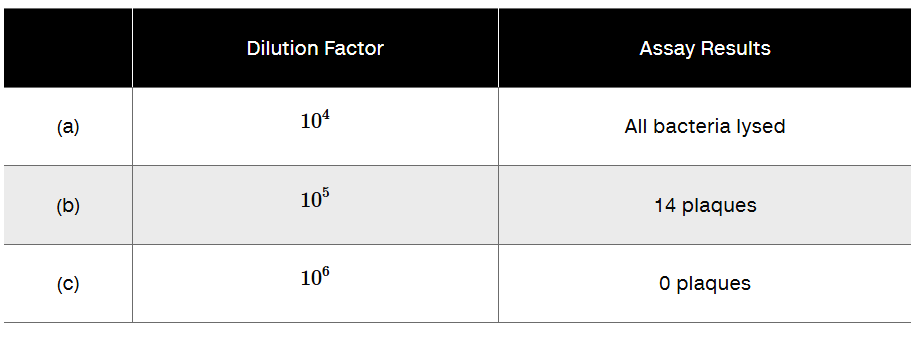
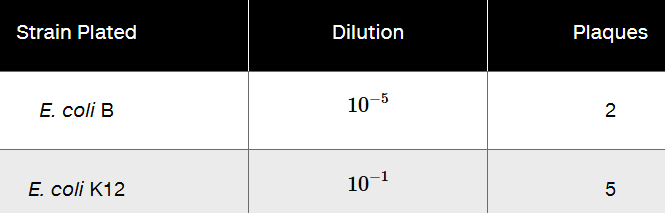
Using mutants 2 and 3 from Problem 19, following mixed infection on E. coli B, progeny viruses were plated in a series of dilutions on both E. coli B and K12 with the following results.
What is the recombination frequency between the two mutants?
문제 20b
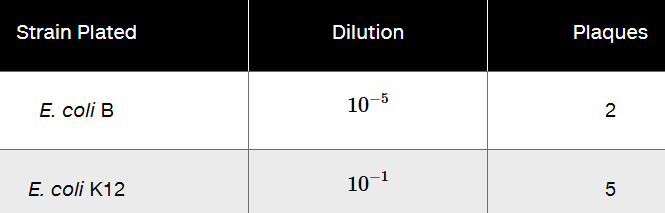
Using mutants 2 and 3 from Problem 19, following mixed infection on E. coli B, progeny viruses were plated in a series of dilutions on both E. coli B and K12 with the following results.
Another mutation, 6, was tested in relation to mutations 1 through 5 from Problems 18–20. In initial testing, mutant 6 complemented mutants 2 and 3. In recombination testing with 1, 4, and 5, mutant 6 yielded recombinants with 1 and 5, but not with 4. What can you conclude about mutation 6?
문제 21
During the analysis of seven rII mutations in phage T4, mutants 1, 2, and 6 were in cistron A, while mutants 3, 4, and 5 were in cistron B. Of these, mutant 4 was a deletion overlapping mutant 5. The remainder were point mutations. Nothing was known about mutant 7. Predict the results of complementation (+ or -) between 1 and 2; 1 and 3; 2 and 4; and 4 and 5.
- In studies of recombination between mutants 1 and 2 from Problem 21, the results shown in the following table were obtained. Strain Dilution Plaques Phenotypes E. coli B 10⁻⁷ 4 r E. coli K12 10⁻² 8 + Mutant 7 (Problem 21) failed to complement any of the other mutants (1–6). Define the nature of mutant 7.
문제 22