Ch. 10 - DNA Structure and Analysis
Klug - Concepts of Genetics 12th Edition
Klug12th EditionConcepts of GeneticsISBN: 9780135564776당신이 사용하는 게 아니라요?교과서 변경
10장, 문제 1b

How do we know that DNA also serves as the genetic material in eukaryotes such as humans?

검증된 단계별 안내
1
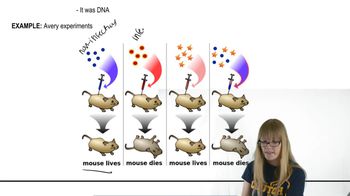
Understand the historical experiments that demonstrated DNA as the genetic material in eukaryotes. For example, the Avery-MacLeod-McCarty experiment and the Hershey-Chase experiment provided foundational evidence that DNA is the genetic material in prokaryotes and viruses, which laid the groundwork for studying eukaryotes.
Review the evidence from eukaryotic studies, such as the use of radioactive labeling in experiments that showed DNA, not protein, is passed on during cell division and reproduction in eukaryotic cells.
Consider the role of DNA in the nucleus of eukaryotic cells. DNA is localized in the nucleus, and its quantity is consistent with the ploidy of the organism (e.g., diploid cells have twice the DNA of haploid cells). This correlation supports its role as the genetic material.
Examine the experiments involving transformation and transfection in eukaryotic cells. For example, introducing purified DNA into eukaryotic cells can result in the expression of new traits, further proving that DNA carries genetic information.
Analyze the molecular structure of DNA as proposed by Watson and Crick. The double-helix structure, with its ability to replicate and encode information through the sequence of nucleotide bases, provides a mechanistic explanation for how DNA serves as the genetic material in eukaryotes.

비슷한 문제에 대한 검증된 영상 답변:

이 영상 해법은 위 문제에 도움이 된다고 튜터들이 추천한 것입니다.
영상 길이:
1m
도움이 되었나요?

주요 개념

질문에 올바르게 답하기 위해 반드시 이해해야 하는 핵심 개념들은 다음과 같습니다.

DNA as Genetic Material

DNA is recognized as the genetic material because it carries the instructions necessary for the growth, development, and reproduction of organisms. Experiments, such as those by Avery, MacLeod, and McCarty, demonstrated that DNA from pathogenic bacteria could transform non-pathogenic bacteria, indicating that DNA is responsible for heredity. This foundational concept is crucial for understanding how genetic information is passed on in eukaryotes.
추천 영상:
가이드 코스
09:32
History and Experiments

Structure of DNA

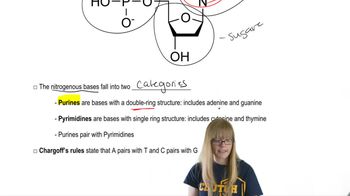
The structure of DNA, elucidated by Watson and Crick, is a double helix composed of two strands of nucleotides. Each nucleotide consists of a sugar, a phosphate group, and a nitrogenous base. The specific pairing of bases (adenine with thymine, and cytosine with guanine) allows for accurate replication and transmission of genetic information, which is essential for the functioning of eukaryotic cells, including those in humans.
추천 영상:

Techniques for Studying DNA

Various techniques have been developed to study DNA, including polymerase chain reaction (PCR), gel electrophoresis, and DNA sequencing. These methods allow scientists to analyze the structure, function, and variations of DNA, providing insights into how DNA serves as genetic material in eukaryotes. Understanding these techniques is vital for exploring genetic inheritance and the molecular basis of traits in humans.
추천 영상: