Ch. 11 - DNA Replication and Recombination
Klug - Concepts of Genetics 12th Edition
Klug12th EditionConcepts of GeneticsISBN: 9780135564776당신이 사용하는 게 아니라요?교과서 변경
11장, 문제 28b

Assume that the sequence of bases shown below is present on one nucleotide chain of a DNA duplex and that the chain has opened up at a replication fork. Synthesis of an RNA primer occurs on this template starting at the base that is underlined.
In the intact RNA primer, which nucleotide has a free 3'-OH terminus?
3'.......GGCTACCTGGATTCA....5'

검증된 단계별 안내
1
Step 1: Understand the problem. The DNA sequence provided is the template strand, and the RNA primer is synthesized complementary to this strand. The RNA primer starts at the underlined base, and we need to determine which nucleotide in the RNA primer has a free 3'-OH terminus.
Step 2: Identify the direction of synthesis. RNA primers are synthesized in the 5' to 3' direction, meaning the first nucleotide added will have a free 5'-phosphate group, and the last nucleotide added will have a free 3'-OH group.
Step 3: Determine the complementary RNA sequence. RNA bases pair with DNA bases as follows: Adenine (A) pairs with Uracil (U), Thymine (T) pairs with Adenine (A), Cytosine (C) pairs with Guanine (G), and Guanine (G) pairs with Cytosine (C). Use this pairing rule to transcribe the RNA primer starting at the underlined base.
Step 4: Locate the last nucleotide in the RNA primer. Once the RNA primer sequence is determined, identify the last nucleotide added during synthesis, as this will have the free 3'-OH terminus.
Step 5: Confirm the orientation of the RNA primer. Ensure that the RNA primer is written in the 5' to 3' direction, and verify that the nucleotide at the 3' end has the free hydroxyl (-OH) group.

비슷한 문제에 대한 검증된 영상 답변:

이 영상 해법은 위 문제에 도움이 된다고 튜터들이 추천한 것입니다.
영상 길이:
1m
도움이 되었나요?

주요 개념

질문에 올바르게 답하기 위해 반드시 이해해야 하는 핵심 개념들은 다음과 같습니다.

DNA Replication

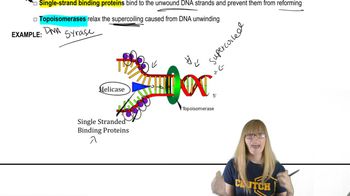
DNA replication is the biological process by which a cell duplicates its DNA before cell division. It involves unwinding the double helix and synthesizing new strands complementary to the original template strands. This process is crucial for genetic continuity and is facilitated by enzymes such as DNA polymerase.
추천 영상:
가이드 코스
11:59
Steps to DNA Replication

RNA Primer

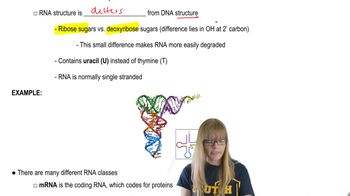
An RNA primer is a short strand of RNA that provides a starting point for DNA synthesis during replication. It is synthesized by the enzyme primase and is essential because DNA polymerases cannot initiate synthesis without a free 3'-OH group. The RNA primer is later removed and replaced with DNA.
추천 영상:

3'-OH Terminus

The 3'-OH terminus refers to the end of a nucleic acid strand that has a free hydroxyl group (-OH) attached to the third carbon of the sugar molecule. This free 3'-OH group is critical for the addition of new nucleotides during DNA or RNA synthesis, allowing the formation of phosphodiester bonds and elongation of the nucleic acid chain.
추천 영상:
관련 실천
교과서 질문

DNA polymerases in all organisms add only 5' nucleotides to the 3' end of a growing DNA strand, never to the 5' end. One possible reason for this is the fact that most DNA polymerases have a proofreading function that would not be energetically possible if DNA synthesis occurred in the 3' to 5' direction.

Sketch the reaction that DNA polymerase would have to catalyze if DNA synthesis occurred in the 3' to 5' direction.

668
views
교과서 질문

Reiji and Tuneko Okazaki conducted a now classic experiment in 1968 in which they discovered a population of short fragments synthesized during DNA replication. They introduced a short pulse of ³H-thymidine into a culture of E. coli and extracted DNA from the cells at various intervals. In analyzing the DNA after centrifugation in denaturing gradients, they noticed that as the interval between the time of ³H-thymidine introduction and the time of centrifugation increased, the proportion of short strands decreased and more labeled DNA was found in larger strands. What would account for this observation?

1265
views
교과서 질문

Consider the drawing of a dinucleotide below.

Is the arrow closest to the 5' or the 3' end?

451
views
교과서 질문

DNA polymerases in all organisms add only 5' nucleotides to the 3' end of a growing DNA strand, never to the 5' end. One possible reason for this is the fact that most DNA polymerases have a proofreading function that would not be energetically possible if DNA synthesis occurred in the 3' to 5' direction.

Consider the information in your sketch and speculate as to why proofreading would be problematic.

1786
views
교과서 질문

Assume that the sequence of bases shown below is present on one nucleotide chain of a DNA duplex and that the chain has opened up at a replication fork. Synthesis of an RNA primer occurs on this template starting at the base that is underlined.

If the RNA primer consists of eight nucleotides, what is its base sequence?

3'.......GGCTACCTGGATTCA....5'

671
views
교과서 질문

Consider the drawing of a dinucleotide below.

Is it DNA or RNA?

657
views