Ch. 11 - DNA Replication and Recombination
Klug - Concepts of Genetics 12th Edition
Klug12th EditionConcepts of GeneticsISBN: 9780135564776당신이 사용하는 게 아니라요?교과서 변경
11장, 문제 25

The genome of D. melanogaster consists of approximately 1.7x10⁸ base pairs. DNA synthesis occurs at a rate of 30 base pairs per second. In the early embryo, the entire genome is replicated in five minutes. How many bidirectional origins of synthesis are required to accomplish this feat?

검증된 단계별 안내
1
Step 1: Calculate the total time for replication in seconds. Since the genome is replicated in 5 minutes, convert this to seconds: 5 minutes × 60 seconds/minute = 300 seconds.
Step 2: Determine the total number of base pairs that need to be replicated. The genome of D. melanogaster consists of approximately 1.7 × 10⁸ base pairs.
Step 3: Calculate the total replication capacity of a single origin of synthesis. DNA synthesis occurs at a rate of 30 base pairs per second, and replication is bidirectional, meaning each origin synthesizes DNA in two directions. Therefore, the replication capacity per origin is: 30 base pairs/second × 2 directions × 300 seconds.
Step 4: Divide the total number of base pairs in the genome by the replication capacity of a single origin to determine the number of origins required. Use the formula: \( \text{Number of origins} = \frac{\text{Total base pairs}}{\text{Replication capacity per origin}} \).
Step 5: Round the result to the nearest whole number, as the number of origins must be an integer.

비슷한 문제에 대한 검증된 영상 답변:

이 영상 해법은 위 문제에 도움이 된다고 튜터들이 추천한 것입니다.
영상 길이:
1m

주요 개념

질문에 올바르게 답하기 위해 반드시 이해해야 하는 핵심 개념들은 다음과 같습니다.

Genome Size

The genome size refers to the total amount of genetic material contained within an organism's DNA, measured in base pairs. In the case of D. melanogaster, the genome consists of approximately 1.7x10⁸ base pairs, which is essential for understanding the scale of DNA replication that needs to occur during cell division.
추천 영상:
가이드 코스
02:48
Genomics Overview

DNA Replication Rate

DNA replication rate is the speed at which DNA polymerases synthesize new DNA strands. In this scenario, the replication occurs at a rate of 30 base pairs per second, which is crucial for calculating how long it will take to replicate the entire genome and determining the number of origins of replication needed.
추천 영상:
가이드 코스
11:59
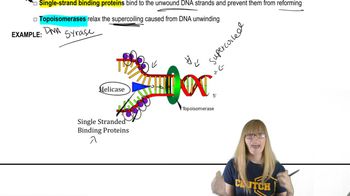
Steps to DNA Replication

Bidirectional Origins of Synthesis

Bidirectional origins of synthesis are specific sites on the DNA where replication begins, allowing the process to occur in two directions simultaneously. This concept is important for efficiently replicating large genomes, as it reduces the time required for complete genome replication, especially in the context of the five-minute timeframe given for D. melanogaster.
추천 영상:
가이드 코스
02:43
Translesion Synthesis
관련 실천
교과서 질문

In 1994, telomerase activity was discovered in human cancer cell lines. Although telomerase is not active in most human adult cells, all cells do contain the genes for telomerase proteins and telomerase RNA. Since inappropriate activation of telomerase may contribute to cancer, why do you think the genes coding for this enzyme have been maintained in the human genome throughout evolution? Are there any types of human body cells where telomerase activation would be advantageous or even necessary? Explain.

741
views
교과서 질문

DNA polymerases in all organisms add only 5' nucleotides to the 3' end of a growing DNA strand, never to the 5' end. One possible reason for this is the fact that most DNA polymerases have a proofreading function that would not be energetically possible if DNA synthesis occurred in the 3' to 5' direction.

Sketch the reaction that DNA polymerase would have to catalyze if DNA synthesis occurred in the 3' to 5' direction.

668
views
교과서 질문

DNA polymerases in all organisms add only 5' nucleotides to the 3' end of a growing DNA strand, never to the 5' end. One possible reason for this is the fact that most DNA polymerases have a proofreading function that would not be energetically possible if DNA synthesis occurred in the 3' to 5' direction.

Consider the information in your sketch and speculate as to why proofreading would be problematic.

1786
views
교과서 질문

Many of the gene products involved in DNA synthesis were initially defined by studying mutant E. coli strains that could not synthesize DNA.

The dnaQ gene encodes the ε subunit of DNA polymerase. What effect is expected from a mutation in this gene?

491
views
교과서 질문

Many of the gene products involved in DNA synthesis were initially defined by studying mutant E. coli strains that could not synthesize DNA.

The dnaE gene encodes the α subunit of DNA polymerase III. What effect is expected from a mutation in this gene? How could the mutant strain be maintained?

614
views
교과서 질문

Assume a hypothetical organism in which DNA replication is conservative. Design an experiment similar to that of Taylor, Woods, and Hughes that will unequivocally establish this fact. Using the format established in Figure 11.5, draw sister chromatids and illustrate the expected results establishing this mode of replication.

805
views