Ch. 13 - The Genetic Code and Transcription
Klug - Concepts of Genetics 12th Edition
Klug12th EditionConcepts of GeneticsISBN: 9780135564776당신이 사용하는 게 아니라요?교과서 변경
13장, 문제 29c

Shown here are the amino acid sequences of the wild-type and three mutant forms of a short protein.
__________________________________________________
Wild-type: Met-Trp-Tyr-Arg-Gly-Ser-Pro-Thr
Mutant 1: Met-Trp
Mutant 2: Met-Trp-His-Arg-Gly-Ser-Pro-Thr
Mutant 3: Met -Cys-Ile-Val-Val-Val-Gln-His
______________________________________________
Use this information to answer the following questions:
The wild-type RNA consists of nine triplets. What is the role of the ninth triplet?

검증된 단계별 안내
1
Step 1: Understand that the wild-type protein sequence is composed of eight amino acids, but the RNA has nine triplets (codons). Each codon corresponds to one amino acid or a special signal during translation.
Step 2: Recall that the last codon in an mRNA sequence often does not code for an amino acid but instead serves as a stop codon, signaling the end of translation.
Step 3: Identify that the ninth triplet in the wild-type RNA likely functions as a stop codon, which terminates protein synthesis and ensures the protein is the correct length.
Step 4: Compare the mutant sequences to see if any changes affect the length or composition of the protein, which can help confirm the role of the ninth triplet as a stop signal.
Step 5: Conclude that the ninth triplet's role is to act as a termination signal (stop codon) in the mRNA, preventing further addition of amino acids beyond the eighth residue.

비슷한 문제에 대한 검증된 영상 답변:

이 영상 해법은 위 문제에 도움이 된다고 튜터들이 추천한 것입니다.
영상 길이:
1m
도움이 되었나요?

주요 개념

질문에 올바르게 답하기 위해 반드시 이해해야 하는 핵심 개념들은 다음과 같습니다.

Genetic Code and Codons

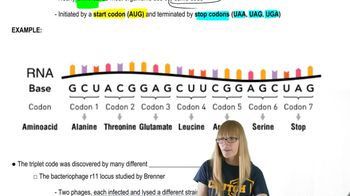
The genetic code consists of triplets of nucleotides called codons, each specifying a particular amino acid or a stop signal during protein synthesis. Understanding how codons translate into amino acids is essential for interpreting RNA sequences and their corresponding protein products.
추천 영상:
가이드 코스
11:43
The Genetic Code

Stop Codons and Termination of Translation

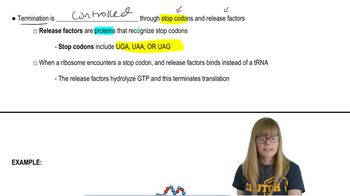
Stop codons are specific triplets in mRNA (UAA, UAG, UGA) that do not code for amino acids but signal the end of translation. The ninth triplet in the wild-type RNA likely functions as a stop codon, terminating protein synthesis and defining the protein's length.
추천 영상:
가이드 코스
01:55
Translation Termination

Effects of Mutations on Protein Sequence

Mutations can alter the amino acid sequence by changing codons, causing premature stops or extensions. Comparing wild-type and mutant sequences helps identify the role of specific codons, such as how the absence or change of the ninth triplet affects protein length and function.
추천 영상:
관련 실천
교과서 질문

Shown here are the amino acid sequences of the wild-type and three mutant forms of a short protein.

___________________________________________________

Wild-type: Met-Trp-Tyr-Arg-Gly-Ser-Pro-Thr

Mutant 1: Met-Trp

Mutant 2: Met-Trp-His-Arg-Gly-Ser-Pro-Thr

Mutant 3: Met -Cys-Ile-Val-Val-Val-Gln-His

___________________________________________________

Use this information to answer the following questions:

Another mutation (mutant 4) is isolated. Its amino acid sequence is unchanged from the wild type, but the mutant cells produce abnormally low amounts of the wild-type proteins. As specifically as you can, predict where this mutation exists in the gene.

1178
views
교과서 질문

Shown here are the amino acid sequences of the wild-type and three mutant forms of a short protein.

___________________________________________________

Wild-type: Met-Trp-Tyr-Arg-Gly-Ser-Pro-Thr

Mutant 1: Met-Trp

Mutant 2: Met-Trp-His-Arg-Gly-Ser-Pro-Thr

Mutant 3: Met-Cys-Ile-Val-Val-Val-Gln-His                 _


Use this information to answer the following questions:

Using the genetic coding dictionary, predict the type of mutation that led to each altered protein.

1048
views
교과서 질문

Shown here are the amino acid sequences of the wild-type and three mutant forms of a short protein.

___________________________________________________

Wild-type: Met-Trp-Tyr-Arg-Gly-Ser-Pro-Thr

Mutant 1: Met-Trp

Mutant 2: Met-Trp-His-Arg-Gly-Ser-Pro-Thr

Mutant 3: Met-Cys-Ile-Val-Val-Val-Gln-Hi

___________________________________________________

Use this information to answer the following questions:

For each mutant protein, determine the specific ribonucleotide change that led to its synthesis.

479
views
교과서 질문

In a mixed copolymer experiment, messages were created with either 4/5C:1/5A or 4/5A:1/5C. These messages yielded proteins with the following amino acid compositions.

Using these data, predict the most specific coding composition for each amino acid.

931
views
교과서 질문

Shown here are the amino acid sequences of the wild-type and three mutant forms of a short protein.

___________________________________________________

Wild-type: Met-Trp-Tyr-Arg-Gly-Ser-Pro-Thr

Mutant 1: Met-Trp

Mutant 2: Met-Trp-His-Arg-Gly-Ser-Pro-Thr

Mutant 3: Met-Cys-Ile-Val-Val-Val-Gln-Hi

___________________________________________________

Use this information to answer the following questions:

Of the first eight wild-type triplets, which, if any, can you determine specifically from an analysis of the mutant proteins? In each case, explain why or why not.

566
views
교과서 질문

The genetic code is degenerate. Amino acids are encoded by either 1, 2, 3, 4, or 6 triplet codons. An interesting question is whether the number of triplet codes for a given amino acid is in any way correlated with the frequency with which that amino acid appears in proteins. That is, is the genetic code optimized for its intended use? Some approximations of the frequency of appearance of nine amino acids in proteins in E. coli are given in the following:

Determine how many triplets encode each amino acid.

810
views