Ch. 14 - Translation and Proteins
Klug - Concepts of Genetics 12th Edition
Klug12th EditionConcepts of GeneticsISBN: 9780135564776당신이 사용하는 게 아니라요?교과서 변경
14장, 문제 25

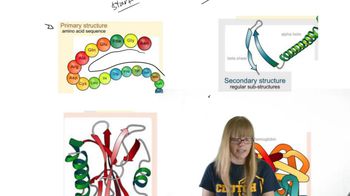
What are the two common types of protein secondary structure, and how do they differ?

검증된 단계별 안내
1
Identify the two common types of protein secondary structures: alpha helices and beta sheets.
Understand that an alpha helix is a right-handed coil where each amino acid corresponds to a 100-degree turn in the helix, and the structure is stabilized by hydrogen bonds between the carbonyl oxygen of one amino acid and the amide hydrogen of another four residues away.
Recognize that beta sheets consist of beta strands connected laterally by at least two or three backbone hydrogen bonds, forming a sheet-like structure. The strands can be parallel or antiparallel.
Note the difference in hydrogen bonding: in alpha helices, hydrogen bonds occur within a single strand, while in beta sheets, they occur between different strands.
Consider the functional implications: alpha helices often form structural components of proteins, while beta sheets can provide strength and stability, often found in the core of proteins.

비슷한 문제에 대한 검증된 영상 답변:

이 영상 해법은 위 문제에 도움이 된다고 튜터들이 추천한 것입니다.
영상 길이:
53s
도움이 되었나요?

주요 개념

질문에 올바르게 답하기 위해 반드시 이해해야 하는 핵심 개념들은 다음과 같습니다.

Protein Secondary Structure

Protein secondary structure refers to the local folded structures that form within a polypeptide due to hydrogen bonding between the backbone atoms. The two most common types are alpha helices and beta sheets, which contribute to the overall stability and functionality of proteins.
추천 영상:

Alpha Helix

An alpha helix is a right-handed coiled structure where each turn of the helix is stabilized by hydrogen bonds between the carbonyl oxygen of one amino acid and the amide hydrogen of another, four residues down the chain. This structure is characterized by its helical shape and is commonly found in many proteins.
추천 영상:
가이드 코스
09:22
Review of Regulation

Beta Sheet

Beta sheets are formed by linking two or more beta strands through hydrogen bonds, creating a sheet-like structure. These strands can be parallel or antiparallel, depending on the direction of the polypeptide chains, and they provide significant tensile strength to proteins, often found in fibrous proteins.
추천 영상: