Ch. 15 - Gene Mutation, DNA Repair, and Transposition
Klug - Concepts of Genetics 12th Edition
Klug12th EditionConcepts of GeneticsISBN: 9780135564776당신이 사용하는 게 아니라요?교과서 변경
15장, 문제 32

When a double-strand DNA break occurs in a eukaryotic cell, it may be repaired by either nonhomologous end joining or homologous recombination. How do these different repair mechanisms lead to potentially different outcomes?

검증된 단계별 안내
1
Identify the two main DNA repair mechanisms: nonhomologous end joining (NHEJ) and homologous recombination (HR).
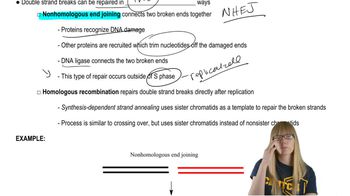
Understand that NHEJ directly ligates the broken DNA ends without the need for a homologous template, which can lead to insertions or deletions (indels) at the repair site.
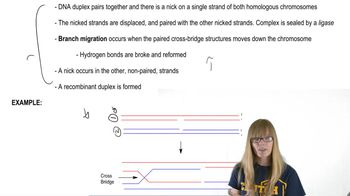
Recognize that HR uses a homologous sequence as a template for repair, typically resulting in error-free repair, as it restores the original DNA sequence.
Consider the context in which each mechanism is used: NHEJ is more common in the G1 phase of the cell cycle when a sister chromatid is not available, while HR is more prevalent in the S and G2 phases when a sister chromatid is present.
Reflect on the potential outcomes: NHEJ can lead to mutations due to indels, while HR maintains genetic integrity by accurately repairing the break.

비슷한 문제에 대한 검증된 영상 답변:

이 영상 해법은 위 문제에 도움이 된다고 튜터들이 추천한 것입니다.
영상 길이:
3m
도움이 되었나요?

주요 개념

질문에 올바르게 답하기 위해 반드시 이해해야 하는 핵심 개념들은 다음과 같습니다.

Double-Strand DNA Breaks

Double-strand DNA breaks (DSBs) are critical lesions that can occur due to various factors, including environmental stress and replication errors. These breaks can lead to genomic instability if not repaired properly. Understanding the nature of DSBs is essential, as the repair mechanisms employed by the cell can significantly influence the outcome of the damage.
추천 영상:
가이드 코스
03:03
Double Strand Breaks

Nonhomologous End Joining (NHEJ)

Nonhomologous end joining is a repair mechanism that directly ligates the broken ends of DNA without the need for a homologous template. While it is a quick and efficient process, NHEJ can lead to insertions or deletions at the repair site, potentially resulting in mutations. This mechanism is particularly important in the G1 phase of the cell cycle when homologous recombination is not available.
추천 영상:
가이드 코스
03:03
Double Strand Breaks

Homologous Recombination (HR)

Homologous recombination is a more precise repair mechanism that uses a homologous sequence as a template to accurately repair double-strand breaks. This process typically occurs during the S and G2 phases of the cell cycle when sister chromatids are available. HR minimizes the risk of mutations and preserves genomic integrity, making it a preferred method for repairing DSBs when possible.
추천 영상:
가이드 코스
03:51
Recombination after Single Strand Breaks
관련 실천
교과서 질문

Mutations in the IL2RG gene cause approximately 30 percent of severe combined immunodeficiency disorder (SCID) cases in humans. These mutations result in alterations to a protein component of cytokine receptors that are essential for proper development of the immune system. The IL2RG gene is composed of eight exons and contains upstream and downstream sequences that are necessary for proper transcription and translation. Below are some of the mutations observed. For each, explain its likely influence on the IL2RG gene product (assume its length to be 375 amino acids).

Large deletion covering Exons 2 and 3

594
views
교과서 질문

Mutations in the IL2RG gene cause approximately 30 percent of severe combined immunodeficiency disorder (SCID) cases in humans. These mutations result in alterations to a protein component of cytokine receptors that are essential for proper development of the immune system. The IL2RG gene is composed of eight exons and contains upstream and downstream sequences that are necessary for proper transcription and translation. Below are some of the mutations observed. For each, explain its likely influence on the IL2RG gene product (assume its length to be 375 amino acids).

Deletion in Exon 2, in frame

517
views
교과서 질문

Mutations in the IL2RG gene cause approximately 30 percent of severe combined immunodeficiency disorder (SCID) cases in humans. These mutations result in alterations to a protein component of cytokine receptors that are essential for proper development of the immune system. The IL2RG gene is composed of eight exons and contains upstream and downstream sequences that are necessary for proper transcription and translation. Below are some of the mutations observed. For each, explain its likely influence on the IL2RG gene product (assume its length to be 375 amino acids).

Deletion in Exon 2, causing frameshift

548
views