Ch. 17 - Transcriptional Regulation in Eukaryotes
Klug - Concepts of Genetics 12th Edition
Klug12th EditionConcepts of GeneticsISBN: 9780135564776당신이 사용하는 게 아니라요?교과서 변경
17장, 문제 20

DNA supercoiling, which occurs when coiling tension is generated ahead of the replication fork, is relieved by DNA gyrase. Supercoiling may also be involved in transcription regulation. Researchers discovered that enhancers operating over a long distance (2500 bp) are dependent on DNA supercoiling, while enhancers operating over shorter distances (110 bp) are not so dependent [Liu et al. (2001). Proc. Natl. Acad. Sci. USA 98:14,883–14,888]. Using a diagram, suggest a way in which supercoiling may positively influence enhancer activity over long distances.

검증된 단계별 안내
1
Step 1: Understand the concept of DNA supercoiling and its role in DNA topology. DNA supercoiling refers to the overwinding or underwinding of the DNA double helix, which affects how DNA is compacted and accessed within the cell. This tension can influence the physical proximity of distant DNA regions.
Step 2: Recognize that enhancers are DNA sequences that increase the transcription of target genes, often by looping the DNA to bring the enhancer close to the promoter region despite being separated by thousands of base pairs.
Step 3: Consider how supercoiling can induce or stabilize DNA looping. Positive or negative supercoiling can create torsional strain that facilitates the bending or looping of DNA, effectively bringing distant enhancer and promoter regions into close spatial proximity.
Step 4: Sketch a diagram showing a long DNA segment with an enhancer and promoter separated by 2500 bp. Illustrate how supercoiling causes the DNA to loop, reducing the effective distance between the enhancer and promoter, thereby enhancing their interaction.
Step 5: Explain that this looping mediated by supercoiling can increase the frequency or stability of enhancer-promoter contacts, which positively influences enhancer activity over long distances, whereas short-distance enhancers (e.g., 110 bp apart) do not require such looping and thus are less dependent on supercoiling.

비슷한 문제에 대한 검증된 영상 답변:

이 영상 해법은 위 문제에 도움이 된다고 튜터들이 추천한 것입니다.
영상 길이:
1m
도움이 되었나요?

주요 개념

질문에 올바르게 답하기 위해 반드시 이해해야 하는 핵심 개념들은 다음과 같습니다.

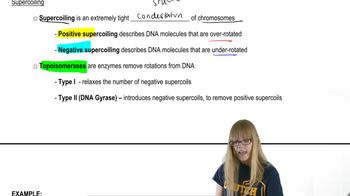
DNA Supercoiling

DNA supercoiling refers to the overwinding or underwinding of the DNA double helix, which creates tension and affects its three-dimensional structure. This tension is generated during processes like replication and transcription and can influence DNA accessibility and interactions. Supercoiling can compact DNA and facilitate or hinder the binding of regulatory proteins.
추천 영상:

Role of DNA Gyrase

DNA gyrase is an enzyme that introduces negative supercoils into DNA, relieving positive supercoiling tension ahead of the replication fork. By managing DNA supercoiling, gyrase helps maintain DNA topology necessary for efficient replication and transcription. Its activity ensures that DNA remains in a state conducive to protein binding and regulatory interactions.
추천 영상:
가이드 코스
01:45
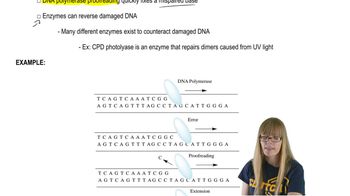
DNA Proofreading

Enhancer-Promoter Interactions and Distance Dependence

Enhancers are DNA elements that increase gene transcription by interacting with promoters, sometimes over long distances. DNA supercoiling can facilitate these long-range interactions by looping or bringing distant DNA regions closer together, enhancing the physical contact between enhancers and promoters. This spatial organization is crucial for gene regulation, especially when enhancers act over thousands of base pairs.
추천 영상:
가이드 코스
07:56
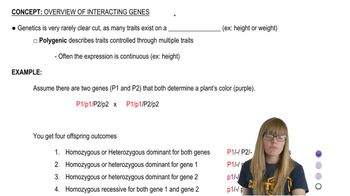
Interacting Genes Overview