Ch. 18 - Post-transcriptional Regulation in Eukaryotes
Klug - Concepts of Genetics  12th Edition
Klug12th EditionConcepts of Genetics ISBN: 9780135564776당신이 사용하는 게 아니라요?교과서 변경
18장, 문제 21

How may the covalent modification of a protein with a phosphate group alter its function?

검증된 단계별 안내
1
Understand that covalent modification refers to the addition or removal of a chemical group to a protein, which can change the protein's properties and activity.
Recognize that phosphorylation is the addition of a phosphate group (PO₄³⁻) to specific amino acid residues, commonly serine, threonine, or tyrosine, in the protein.
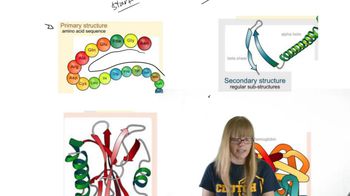
Consider how the addition of a negatively charged phosphate group can induce a conformational change in the protein's three-dimensional structure, potentially altering its shape and function.
Analyze how this conformational change can affect the protein's activity by either activating or inhibiting its enzymatic function, altering its interaction with other molecules, or changing its cellular localization.
Summarize that phosphorylation acts as a regulatory mechanism, allowing cells to control protein function dynamically in response to various signals.

비슷한 문제에 대한 검증된 영상 답변:

이 영상 해법은 위 문제에 도움이 된다고 튜터들이 추천한 것입니다.
영상 길이:
2m
도움이 되었나요?

주요 개념

질문에 올바르게 답하기 위해 반드시 이해해야 하는 핵심 개념들은 다음과 같습니다.

Protein Phosphorylation

Protein phosphorylation is the covalent addition of a phosphate group, usually to serine, threonine, or tyrosine residues. This modification is catalyzed by enzymes called kinases and can change the protein's activity, interactions, or localization.
추천 영상:

Conformational Change

The addition of a phosphate group can induce a conformational change in the protein's structure. This structural alteration can activate or inhibit the protein's function by exposing or hiding active sites or interaction domains.
추천 영상:
가이드 코스
03:03
New Alleles and Migration

Regulation of Protein Function

Phosphorylation acts as a regulatory mechanism, controlling processes like enzyme activity, signal transduction, and protein-protein interactions. It is reversible, allowing dynamic control through phosphatases that remove phosphate groups.
추천 영상:
관련 실천
교과서 질문

Incorrectly spliced RNAs often lead to human pathologies. Scientists have examined cancer cells for splice-specific changes and found that many of the changes disrupt tumor-suppressor gene function [Xu and Lee (2003). Nucl. Acids Res. 31:5635–5643]. In general, what would be the effects of splicing changes on these RNAs and the function of tumor-suppressor gene function? How might loss of splicing specificity be associated with cancer?

485
views
교과서 질문

What role do ubiquitin ligases play in the regulation of gene expression?

552
views
교과서 질문

How and why are eukaryotic mRNAs transported and localized to discrete regions of the cell?

463
views
교과서 질문

We discussed several specific cis-elements in mRNAs that regulate splicing, stability, decay, localization, and translation. However, it is likely that many other uncharacterized cis-elements exist. One way in which they may be characterized is through the use of a reporter gene such as the gene encoding the green fluorescent protein (GFP) from jellyfish. GFP emits green fluorescence when excited by blue light. Explain how one might be able to devise an assay to test for the effect of various cis-elements on posttranscriptional gene regulation using cells that transcribe a GFP mRNA with genetically inserted cis-elements.

474
views
교과서 질문

How is it possible that a given mRNA in a cell is found throughout the cytoplasm but the protein that it encodes is only found in a few specific regions?

437
views
교과서 질문

How are mRNAs stored within the cell in a translationally inactive state, and how can their translation be stimulated?

556
views