Ch. 18 - Post-transcriptional Regulation in Eukaryotes
Klug - Concepts of Genetics  12th Edition
Klug12th EditionConcepts of Genetics ISBN: 9780135564776당신이 사용하는 게 아니라요?교과서 변경
18장, 문제 1a

How do we know that alternative splicing enables one gene to encode different isoforms with different functions?

검증된 단계별 안내
1
Understand the concept of alternative splicing: it is a process during gene expression where a single pre-mRNA transcript can be spliced in different ways to produce multiple mature mRNA variants, leading to different protein isoforms from one gene.
Examine experimental evidence where researchers isolate mRNA transcripts from the same gene and use techniques like RT-PCR or RNA sequencing to identify different splice variants, confirming that multiple mRNAs arise from one gene.
Analyze protein products corresponding to these different mRNA isoforms using methods such as Western blotting or mass spectrometry to show that distinct protein isoforms are produced.
Investigate functional assays where different isoforms are expressed in cells or organisms to observe differences in their biological activity or localization, demonstrating that these isoforms have different functions.
Review genetic or molecular experiments where mutations affecting splicing patterns alter the production of specific isoforms and lead to changes in phenotype, further supporting the role of alternative splicing in generating functional diversity from a single gene.

비슷한 문제에 대한 검증된 영상 답변:

이 영상 해법은 위 문제에 도움이 된다고 튜터들이 추천한 것입니다.
영상 길이:
42s
도움이 되었나요?

주요 개념

질문에 올바르게 답하기 위해 반드시 이해해야 하는 핵심 개념들은 다음과 같습니다.

Alternative Splicing

Alternative splicing is a process during gene expression where different combinations of exons are joined together from a single pre-mRNA transcript. This results in multiple mRNA variants from one gene, producing protein isoforms with diverse structures and functions, increasing proteomic complexity without increasing gene number.
추천 영상:
가이드 코스
01:57
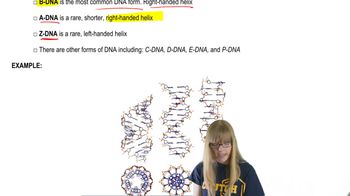
Alternative DNA Forms

Experimental Evidence for Alternative Splicing

Scientists use techniques like RT-PCR, RNA sequencing, and protein analysis to detect different mRNA and protein isoforms from the same gene. Functional assays and mutational studies help demonstrate that these isoforms have distinct biological roles, confirming that alternative splicing generates functionally diverse proteins.
추천 영상:
가이드 코스
01:57
Alternative DNA Forms

Posttranscriptional Regulation of Gene Expression

Posttranscriptional regulation involves control mechanisms acting on RNA after transcription, including splicing, editing, and stability. Alternative splicing is a key posttranscriptional mechanism that modulates which protein variants are produced, allowing cells to adapt protein function to developmental stages or environmental cues.
추천 영상:
가이드 코스
02:09
Penetrance and Expressivity