Ch. 19 - Epigenetics
Klug - Concepts of Genetics 12th Edition
Klug12th EditionConcepts of GeneticsISBN: 9780135564776당신이 사용하는 게 아니라요?교과서 변경
19장, 문제 23b

Amino acids are classified as positively charged, negatively charged, or electrically neutral.
How does this property of lysine allow it to interact with DNA?

검증된 단계별 안내
1
Understand the chemical properties of lysine: Lysine is a positively charged amino acid due to its side chain, which contains an amino group that can accept a proton, giving it a positive charge at physiological pH.
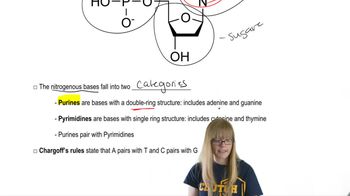
Recall the chemical structure of DNA: DNA is negatively charged because of the phosphate groups in its backbone, which carry negative charges.
Apply the principle of electrostatic interactions: Positively charged molecules, like lysine, are attracted to negatively charged molecules, such as DNA, due to electrostatic forces.
Consider the biological significance: Lysine's positive charge allows it to interact with DNA, often through binding to the phosphate groups, which is important in processes like chromatin structure formation and gene regulation.
Relate this to histones: Lysine is commonly found in histone proteins, which help package DNA into chromatin. The positive charge of lysine facilitates the binding of histones to the negatively charged DNA, enabling tight packing and regulation of gene expression.

비슷한 문제에 대한 검증된 영상 답변:

이 영상 해법은 위 문제에 도움이 된다고 튜터들이 추천한 것입니다.
영상 길이:
1m

주요 개념

질문에 올바르게 답하기 위해 반드시 이해해야 하는 핵심 개념들은 다음과 같습니다.

Amino Acid Classification

Amino acids are organic compounds that serve as the building blocks of proteins. They can be classified based on their side chains into three categories: positively charged (basic), negatively charged (acidic), and electrically neutral. This classification affects their interactions with other molecules, including nucleic acids like DNA.
추천 영상:

Lysine's Positive Charge

Lysine is a basic amino acid characterized by its positively charged side chain at physiological pH. This positive charge allows lysine to form ionic bonds with negatively charged molecules, such as the phosphate backbone of DNA, facilitating interactions that are crucial for processes like DNA binding and protein-DNA complex formation.
추천 영상:
가이드 코스
07:
Positional Cloning

DNA Structure and Charge

DNA is a negatively charged molecule due to its phosphate groups. The interaction between positively charged amino acids like lysine and the negatively charged DNA backbone is essential for the stability and specificity of protein-DNA interactions, which play a vital role in gene regulation and expression.
추천 영상: