Ch. 19 - Epigenetics
Klug - Concepts of Genetics  12th Edition
Klug12th EditionConcepts of Genetics ISBN: 9780135564776당신이 사용하는 게 아니라요?교과서 변경
19장, 문제 22a

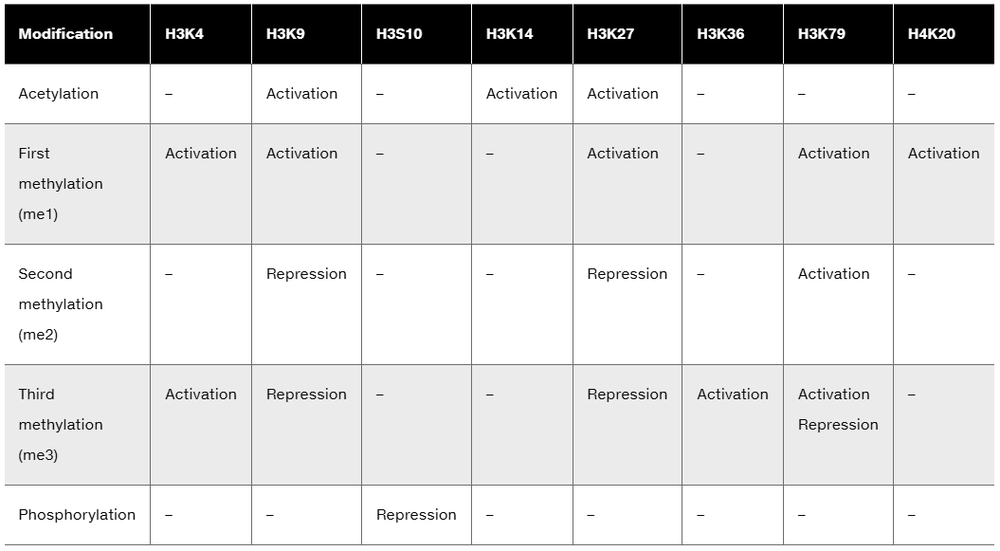
From the following table, draw up a list of histone H3 modifications associated with gene activation. Then draw up a list of H3 modifications associated with repression.
Are there any overlaps on the lists?
Table showing histone H3 modifications with specific sites linked to gene activation, repression, or both.

검증된 단계별 안내
1
Understand that histone H3 modifications are chemical changes to the histone protein that affect chromatin structure and gene expression. These modifications can either activate or repress gene transcription.
List common histone H3 modifications associated with gene activation, such as methylation at lysine 4 (H3K4me), acetylation at lysine 9 (H3K9ac), and acetylation at lysine 27 (H3K27ac). These modifications generally open chromatin and promote transcription.
List common histone H3 modifications associated with gene repression, such as methylation at lysine 9 (H3K9me) and methylation at lysine 27 (H3K27me). These modifications typically condense chromatin and inhibit transcription.
Compare the two lists to identify any overlaps. Note that some lysine residues can be modified in different ways (e.g., acetylation vs. methylation) with opposite effects on gene expression.
Summarize that while the same lysine residues on histone H3 can be targets for both activating and repressing modifications, the type of modification (acetylation vs. methylation) and the specific methylation state (mono-, di-, or tri-methylation) determine whether the effect is activation or repression.

비슷한 문제에 대한 검증된 영상 답변:

이 영상 해법은 위 문제에 도움이 된다고 튜터들이 추천한 것입니다.
영상 길이:
1m
도움이 되었나요?

주요 개념

질문에 올바르게 답하기 위해 반드시 이해해야 하는 핵심 개념들은 다음과 같습니다.

Histone Modifications and Chromatin Structure

Histone modifications are chemical changes to histone proteins, such as methylation or acetylation, that influence chromatin structure and gene expression. These modifications can either loosen or tighten DNA packaging, thereby regulating access of transcription machinery to genes.
추천 영상:
가이드 코스
07:55
Histone Protein Modifications

Histone H3 Modifications Associated with Gene Activation

Certain modifications on histone H3, like acetylation at lysine 9 (H3K9ac) and lysine 27 (H3K27ac), and methylation at lysine 4 (H3K4me3), are linked to active transcription. These marks promote an open chromatin state, facilitating gene expression.
추천 영상:
가이드 코스
07:55
Histone Protein Modifications

Histone H3 Modifications Associated with Gene Repression

Repressive histone H3 modifications include methylation at lysine 9 (H3K9me3) and lysine 27 (H3K27me3), which promote chromatin compaction and gene silencing. These marks recruit proteins that maintain a closed chromatin state, preventing transcription.
추천 영상:
가이드 코스
07:55
Histone Protein Modifications
관련 실천
교과서 질문

From the following table, draw up a list of histone H3 modifications associated with gene activation. Then draw up a list of H3 modifications associated with repression.

Are these overlaps explained by different modifications?

487
views
교과서 질문

Prader–Willi syndrome (PWS) is a genetic disorder with a clinical profile of obesity, intellectual disability, and short stature. It can be caused in several ways. Most common is a deletion on the paternal copy of chromosome 15, but it can also be caused by an epigenetic imprinting disorder and uniparental disomy, an event in which the affected child receives two copies of the maternal chromosome 15. A child with PWS comes to your clinic for a diagnosis of the molecular basis for this condition. The gel below shows the results of testing with short tandem repeats (STRs) from the region of chromosome 15 associated with the disorder.

Based on your interpretation of the data, what is the cause of PWS in this case? Explain your reasoning. 

1108
views
교과서 질문

Amino acids are classified as positively charged, negatively charged, or electrically neutral.

Which category includes lysine?

576
views
교과서 질문

From the following table, draw up a list of histone H3 modifications associated with gene activation. Then draw up a list of H3 modifications associated with repression.

If not, how can you reconcile these differences?

428
views
교과서 질문

Trace the relationship between the methylation status of the glucocorticoid receptor gene and the behavioral response to stress.

676
views
교과서 질문

Prader–Willi syndrome (PWS) is a genetic disorder with a clinical profile of obesity, intellectual disability, and short stature. It can be caused in several ways. Most common is a deletion on the paternal copy of chromosome 15, but it can also be caused by an epigenetic imprinting disorder and uniparental disomy, an event in which the affected child receives two copies of the maternal chromosome 15. A child with PWS comes to your clinic for a diagnosis of the molecular basis for this condition. The gel below shows the results of testing with short tandem repeats (STRs) from the region of chromosome 15 associated with the disorder.

Is this case caused by a deletion in the paternal copy of chromosome 15? Explain.

1276
views