Ch. 2 - Mitosis and Meiosis
Klug - Concepts of Genetics 12th Edition
Klug12th EditionConcepts of GeneticsISBN: 9780135564776당신이 사용하는 게 아니라요?교과서 변경
2장, 문제 16

Considering Problem 15, predict the number of different haploid cells that could be produced by meiosis if a fourth chromosome pair (W1 and W2) were added.

검증된 단계별 안내
1
Recall that the number of different haploid cells produced by meiosis depends on the number of chromosome pairs due to independent assortment. Each chromosome pair can segregate independently, creating genetic variation.
Identify the formula for the number of different haploid cells produced by independent assortment: \$2^n\(, where \)n$ is the number of chromosome pairs.
Determine the original number of chromosome pairs in Problem 15 (assume it was \(n\) pairs).
Add the new chromosome pair (W1 and W2) to the original number of pairs, resulting in \(n + 1\) pairs.
Apply the formula with the updated number of pairs: calculate \(2^{n+1}\) to find the new number of different haploid cells that could be produced.

비슷한 문제에 대한 검증된 영상 답변:

이 영상 해법은 위 문제에 도움이 된다고 튜터들이 추천한 것입니다.
영상 길이:
1m
도움이 되었나요?

주요 개념

질문에 올바르게 답하기 위해 반드시 이해해야 하는 핵심 개념들은 다음과 같습니다.

Meiosis and Haploid Cell Formation

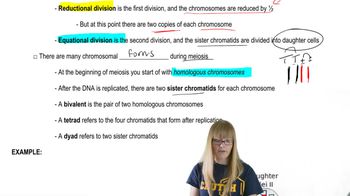
Meiosis is a type of cell division that reduces the chromosome number by half, producing haploid cells from diploid cells. During meiosis, homologous chromosomes separate, ensuring each haploid cell receives one chromosome from each pair, which is essential for sexual reproduction.
추천 영상:
가이드 코스
05:30
Meiosis Overview

Chromosome Pairs and Genetic Variation

Each chromosome pair consists of two homologous chromosomes, one from each parent. The number of different haploid cells produced depends on how these pairs assort independently during meiosis, leading to genetic variation through different combinations of chromosomes.
추천 영상:
가이드 코스
09:28
Genomic Variation

Independent Assortment and Calculation of Possible Haploid Combinations

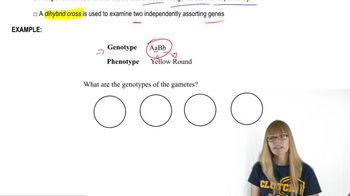
Independent assortment refers to the random distribution of chromosome pairs into gametes during meiosis. The number of possible haploid combinations is calculated as 2^n, where n is the number of chromosome pairs. Adding a fourth pair increases the combinations exponentially.
추천 영상:
가이드 코스
04:58
Gamete Genetics and Independent Assortment
관련 실천
교과서 질문
Explain why meiosis leads to significant genetic variation while mitosis does not.
1192
views
교과서 질문

A diploid cell contains three pairs of homologous chromosomes designated C1 and C2, M1 and M2, and S1 and S2. No crossing over occurs. What combinations of chromosomes are possible in?

(a) daughter cells following mitosis

(b) cells undergoing the first meiotic metaphase

(c) haploid cells following both divisions of meiosis

1973
views
교과서 질문

What is the probability that, in an organism with a haploid number of 10, a sperm will be formed that contains all 10 chromosomes whose centromeres were derived from maternal homologs?

553
views
1
comments
교과서 질문

Contrast spermatogenesis and oogenesis. What is the significance of the formation of polar bodies?

626
views
교과서 질문

During oogenesis in an animal species with a haploid number of 6, one dyad undergoes nondisjunction during meiosis II. Following the second meiotic division, this dyad ends up intact in the ovum. How many chromosomes are present in

(a) the mature ovum and

(b) the second polar body?

(c) Following fertilization by a normal sperm, what chromosome condition is created?

741
views
교과서 질문

The nuclear DNA content of a single sperm cell in Drosophila melanogaster is approximately 0.18 picogram. What would be the expected nuclear DNA content of a primary spermatocyte in Drosophila? What would be the expected nuclear DNA content of a somatic cell (non-sex cell) in the G1 phase? What would be the expected nuclear DNA content of a somatic cell at metaphase?

732
views