Ch. 2 - Mitosis and Meiosis
Klug - Concepts of Genetics 12th Edition
Klug12th EditionConcepts of GeneticsISBN: 9780135564776당신이 사용하는 게 아니라요?교과서 변경
2장, 문제 26

Consider a diploid cell that contains three pairs of chromosomes designated AA, BB, and CC. Each pair contains a maternal and a paternal member (e.g., Am and Ap). Using these designations, demonstrate your understanding of mitosis and meiosis by drawing chromatid combinations as requested. Be sure to indicate when chromatids are paired as a result of replication and/or synapsis.
During meiosis I, assuming no crossing over, what chromatid combination(s) will be present at the completion of prophase I? Draw all possible alignments of chromatids as migration begins during early anaphase.

검증된 단계별 안내
1
Begin by understanding the chromosome composition: the diploid cell has three pairs of chromosomes (AA, BB, CC), each with a maternal (e.g., A^{m}) and paternal (e.g., A^{p}) homolog. Before meiosis I, each chromosome replicates, so each consists of two sister chromatids joined at the centromere.
At the completion of prophase I, homologous chromosomes undergo synapsis, pairing tightly to form bivalents (tetrads). Each bivalent consists of four chromatids: two sister chromatids from the maternal chromosome and two sister chromatids from the paternal chromosome. Since no crossing over occurs, the chromatids remain unchanged in their original configuration.
For each chromosome pair (AA, BB, CC), represent the bivalent as two homologous chromosomes paired side-by-side, each with two sister chromatids. For example, the A bivalent will have A^{m} chromatids paired with A^{p} chromatids, each consisting of two sister chromatids (A^{m}_1 and A^{m}_2, A^{p}_1 and A^{p}_2).
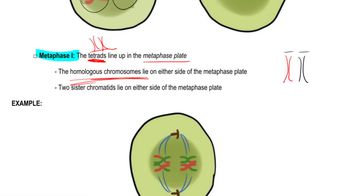
As early anaphase I begins, homologous chromosomes separate and migrate to opposite poles. The key point is that sister chromatids remain attached; thus, each migrating unit is a chromosome with two sister chromatids. Draw all possible alignments showing that for each chromosome pair, either the maternal or paternal homolog can move to a given pole, reflecting independent assortment.
Summarize that at the end of prophase I, the cell contains three bivalents (each with four chromatids), and during early anaphase I, homologous chromosomes separate but sister chromatids stay together, resulting in chromatids aligned as pairs moving toward opposite poles without recombination.

비슷한 문제에 대한 검증된 영상 답변:

이 영상 해법은 위 문제에 도움이 된다고 튜터들이 추천한 것입니다.
영상 길이:
2m

주요 개념

질문에 올바르게 답하기 위해 반드시 이해해야 하는 핵심 개념들은 다음과 같습니다.

Chromosome Structure and Replication

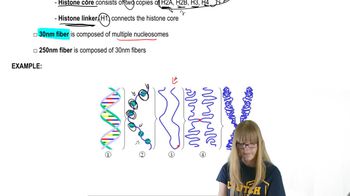
Chromosomes consist of two sister chromatids joined at a centromere after DNA replication during the S phase. Each chromatid is an identical copy, and together they form a replicated chromosome. Understanding this structure is essential to track chromatids through cell division stages like mitosis and meiosis.
추천 영상:
가이드 코스
07:10
Chromosome Structure

Synapsis and Homologous Chromosome Pairing in Meiosis I

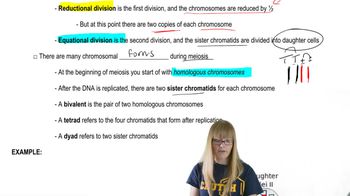
During prophase I of meiosis, homologous chromosomes (maternal and paternal pairs) undergo synapsis, pairing tightly along their lengths to form tetrads. This pairing allows for alignment and potential crossing over, though in this question crossing over is excluded. Synapsis is key to understanding chromatid arrangements at this stage.
추천 영상:
가이드 코스
05:30
Meiosis Overview

Chromatid Segregation During Meiosis I Anaphase

In meiosis I, homologous chromosomes (each with two sister chromatids) separate and migrate to opposite poles, but sister chromatids remain attached. This reductional division halves the chromosome number. Recognizing that chromatids stay paired until meiosis II clarifies the chromatid combinations present during early anaphase I.
추천 영상:
관련 실천
교과서 질문

If one follows 50 primary oocytes in an animal through their various stages of oogenesis, how many secondary oocytes would be formed? How many first polar bodies would be formed? How many ootids would be formed? If one follows 50 primary spermatocytes in an animal through their various stages of spermatogenesis, how many secondary spermatocytes would be formed? How many spermatids would be formed?

724
views
교과서 질문

Consider a diploid cell that contains three pairs of chromosomes designated AA, BB, and CC. Each pair contains a maternal and a paternal member (e.g., Am and Ap). Using these designations, demonstrate your understanding of mitosis and meiosis by drawing chromatid combinations as requested. Be sure to indicate when chromatids are paired as a result of replication and/or synapsis.

Are there any possible combinations present during prophase of meiosis II other than those that you drew in Problem 26? If so, draw them.

584
views
교과서 질문

You are given a metaphase chromosome preparation (a slide) from an unknown organism that contains 12 chromosomes. Two that are clearly smaller than the rest appear identical in length and centromere placement. Describe all that you can about these chromosomes.

819
views
교과서 질문

Consider a diploid cell that contains three pairs of chromosomes designated AA, BB, and CC. Each pair contains a maternal and a paternal member (e.g., Am and Ap). Using these designations, demonstrate your understanding of mitosis and meiosis by drawing chromatid combinations as requested. Be sure to indicate when chromatids are paired as a result of replication and/or synapsis.

In mitosis, what chromatid combination(s) will be present during metaphase? What combination(s) will be present at each pole at the completion of anaphase?

554
views
교과서 질문

Consider a diploid cell that contains three pairs of chromosomes designated AA, BB, and CC. Each pair contains a maternal and a paternal member (e.g., Am and Ap). Using these designations, demonstrate your understanding of mitosis and meiosis by drawing chromatid combinations as requested. Be sure to indicate when chromatids are paired as a result of replication and/or synapsis.

Assume that during meiosis I none of the C chromosomes disjoin at metaphase, but they separate into dyads (instead of monads) during meiosis II. How would this change the alignments that you constructed during the anaphase stages in meiosis I and II? Draw them.

572
views
교과서 질문

Consider a diploid cell that contains three pairs of chromosomes designated AA, BB, and CC. Each pair contains a maternal and a paternal member (e.g., Am and Ap). Using these designations, demonstrate your understanding of mitosis and meiosis by drawing chromatid combinations as requested. Be sure to indicate when chromatids are paired as a result of replication and/or synapsis.

Draw all possible combinations of chromatids during the early phases of anaphase in meiosis II.

507
views