Ch. 2 - Mitosis and Meiosis
Klug - Concepts of Genetics 12th Edition
Klug12th EditionConcepts of GeneticsISBN: 9780135564776당신이 사용하는 게 아니라요?교과서 변경
2장, 문제 3

What role do the following cellular components play in the storage, expression, or transmission of genetic information?
(a) Chromatin
(b) Nucleolus
(c) Ribosome
(d) Mitochondrion
(e) Centriole
(f) Centromere

검증된 단계별 안내
1
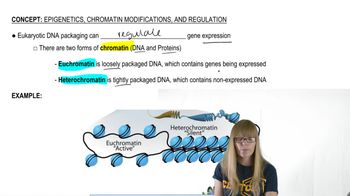
Identify the role of chromatin: Understand that chromatin is composed of DNA and proteins, and its primary function is to package DNA into a compact, dense shape, which facilitates storage and regulates gene expression by controlling access to the DNA.
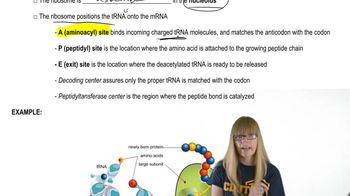
Explain the nucleolus: Recognize that the nucleolus is a region within the nucleus responsible for synthesizing ribosomal RNA (rRNA) and assembling ribosomal subunits, which are essential for protein synthesis, thus indirectly influencing gene expression.
Describe the ribosome's function: Know that ribosomes are the cellular machinery that translates messenger RNA (mRNA) into proteins, directly executing the genetic code and enabling gene expression.
Discuss the mitochondrion: Understand that mitochondria contain their own DNA and are involved in energy production; their genetic material is inherited maternally and plays a role in the transmission of genetic information across generations.
Clarify the roles of the centriole and centromere: Centrioles are involved in organizing the mitotic spindle during cell division, ensuring proper chromosome segregation (transmission of genetic information), while the centromere is the chromosome region where sister chromatids are held together and where spindle fibers attach, critical for accurate chromosome movement during cell division.

비슷한 문제에 대한 검증된 영상 답변:

이 영상 해법은 위 문제에 도움이 된다고 튜터들이 추천한 것입니다.
영상 길이:
1m
도움이 되었나요?

주요 개념

질문에 올바르게 답하기 위해 반드시 이해해야 하는 핵심 개념들은 다음과 같습니다.

Chromatin and Genetic Information Storage

Chromatin is a complex of DNA and proteins found in the nucleus that packages genetic material into a compact, organized structure. It regulates gene expression by controlling DNA accessibility and plays a key role in DNA replication and repair, thus ensuring proper storage and transmission of genetic information.
추천 영상:

Role of Ribosomes and Nucleolus in Gene Expression

The nucleolus is a nuclear substructure where ribosomal RNA (rRNA) is synthesized and ribosome assembly begins. Ribosomes, composed of rRNA and proteins, are the cellular machinery that translates messenger RNA (mRNA) into proteins, directly facilitating the expression of genetic information.
추천 영상:
가이드 코스
03:49
Ribosome Structure

Mitochondrion, Centriole, and Centromere Functions in Genetic Transmission

Mitochondria contain their own DNA and contribute to genetic inheritance through maternal lineage. Centrioles organize the mitotic spindle during cell division, ensuring accurate chromosome segregation. The centromere is the chromosome region where spindle fibers attach, critical for proper chromosome movement and genetic information transmission during mitosis.
추천 영상:
가이드 코스
08:26
Functional Genomics