Ch. 20 - Recombinant DNA Technology
Klug - Concepts of Genetics  12th Edition
Klug12th EditionConcepts of Genetics ISBN: 9780135564776당신이 사용하는 게 아니라요?교과서 변경
20장, 문제 9

What are the advantages of using a restriction enzyme whose recognition site is relatively rare? When would you use such enzymes?

검증된 단계별 안내
1
Understand that restriction enzymes cut DNA at specific recognition sites, which are short sequences of nucleotides. The frequency of these sites in a DNA molecule depends on the length and specificity of the recognition sequence.
Recognize that a restriction enzyme with a rare recognition site cuts DNA less frequently, resulting in fewer and larger DNA fragments compared to enzymes with common recognition sites.
Consider the advantage of using such enzymes: they produce larger fragments that can be useful for cloning large DNA segments, mapping genomes, or analyzing large structural features of DNA.
Identify scenarios where rare-cutting enzymes are preferred, such as when you want to isolate or study large genes, genomic regions, or when performing techniques like pulsed-field gel electrophoresis that separate large DNA fragments.
Summarize that rare-cutting restriction enzymes are valuable tools when the goal is to minimize the number of cuts and maintain larger DNA fragments for detailed genetic analysis or manipulation.

비슷한 문제에 대한 검증된 영상 답변:

이 영상 해법은 위 문제에 도움이 된다고 튜터들이 추천한 것입니다.
영상 길이:
2m
도움이 되었나요?

주요 개념

질문에 올바르게 답하기 위해 반드시 이해해야 하는 핵심 개념들은 다음과 같습니다.

Restriction Enzymes and Recognition Sites

Restriction enzymes are proteins that cut DNA at specific sequences called recognition sites. These sites are usually short, palindromic sequences. The frequency of these sites in a genome depends on their length and sequence specificity, influencing how often the enzyme cuts the DNA.
추천 영상:
가이드 코스
07:11
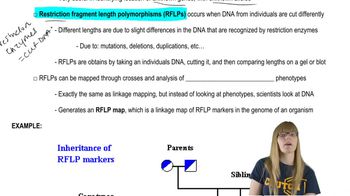
Mapping with Markers

Advantages of Rare Recognition Sites

Enzymes with rare recognition sites cut DNA less frequently, producing fewer and larger fragments. This is useful for cloning large DNA segments or when fewer cuts are needed to maintain the integrity of the DNA, reducing complexity in downstream analysis.
추천 영상:
가이드 코스
04:12
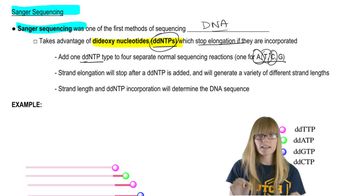
Sanger Sequencing

Applications of Rare-Cutting Restriction Enzymes

Rare-cutting enzymes are used in applications like constructing genomic libraries, mapping large DNA molecules, or preparing DNA for techniques requiring large intact fragments, such as pulsed-field gel electrophoresis or certain cloning strategies.
추천 영상:
가이드 코스
07:11
Mapping with Markers
관련 실천
교과서 질문

Restriction sites are palindromic; that is, they read the same in the 5' to 3' direction on each strand of DNA. What is the advantage of having restriction sites organized this way?

854
views
교과서 질문

Using DNA sequencing on a cloned DNA segment, you recover the nucleotide sequence shown below. Does this segment contain a palindromic recognition sequence for a restriction enzyme? If so, what is the double-stranded sequence of the palindrome, and what enzyme would cut at this sequence?

CAGTATGGATCCCAT

703
views
교과서 질문

List the advantages and disadvantages of using plasmids as cloning vectors. What advantages do BACs and YACs provide over plasmids as cloning vectors?

1343
views
교과서 질문

In 1975, the Asilomar Conference on Recombinant DNA was organized by Paul Berg, a pioneer of recombinant DNA technology, at a conference center at Asilomar State Beach in California. Physicians, scientists, lawyers, ethicists, and others gathered to draft guidelines for safe applications of recombinant DNA technology. These general guidelines were adopted by the federal government and are still in practice today. Consider the implications of recombinant DNA as a new technology. What concerns might the scientific community have had then about recombinant DNA technology? Might those same concerns exist today?

947
views
교과서 질문

In the context of recombinant DNA technology, of what use is a probe?

850
views
교과서 질문

If you performed a PCR experiment starting with only one copy of double-stranded DNA, approximately how many DNA molecules would be present in the reaction tube after 15 cycles of amplification?

742
views