
Ch. 21 - Genomic Analysis
Klug - Concepts of Genetics 12th Edition
Klug12th EditionConcepts of GeneticsISBN: 9780135564776당신이 사용하는 게 아니라요?교과서 변경
21장, 문제 24

Genomic sequencing has opened the door to numerous studies that help us understand the evolutionary forces shaping the genetic makeup of organisms. Using databases containing the sequences of 25 genomes, scientists examined the relationship between GC content and global amino acid composition [Kreil, D. P., and Ouzounis, C. A. (2001) Nucl. Acids Res. 29:1608–1615]. They found that it is possible to identify thermophilic species on the basis of their amino acid composition alone, which suggests that evolution in a hot environment selects for a certain whole organism amino acid composition. In what way might evolution in extreme environments influence genome and amino acid composition? How might evolution in extreme environments influence the interpretation of genome sequence data?

검증된 단계별 안내
1
Step 1: Understand the concept of GC content and amino acid composition. GC content refers to the percentage of guanine (G) and cytosine (C) bases in a genome, which can affect DNA stability. Amino acid composition refers to the relative frequencies of different amino acids in proteins encoded by the genome.
Step 2: Recognize that evolution in extreme environments, such as high temperatures (thermophilic conditions), can select for genomes with higher GC content because GC pairs form three hydrogen bonds, providing greater DNA stability under heat stress. Similarly, proteins may evolve to have amino acid compositions that enhance their stability and function in these conditions.
Step 3: Consider how these evolutionary pressures influence genome and protein sequences. For example, thermophilic organisms might have genomes enriched in GC content and proteins enriched in amino acids that promote thermostability, such as charged or hydrophobic residues that stabilize protein structure.
Step 4: Reflect on how these adaptations affect the interpretation of genome sequence data. When analyzing sequences from organisms in extreme environments, one must account for the possibility that observed nucleotide or amino acid biases are adaptive rather than neutral, which can influence phylogenetic analyses, gene prediction, and functional annotation.
Step 5: Summarize that understanding the relationship between environmental pressures and genome/protein composition helps in correctly interpreting evolutionary relationships and functional predictions from genomic data, especially when comparing organisms from diverse habitats.

비슷한 문제에 대한 검증된 영상 답변:

이 영상 해법은 위 문제에 도움이 된다고 튜터들이 추천한 것입니다.
영상 길이:
1m
도움이 되었나요?

주요 개념

질문에 올바르게 답하기 위해 반드시 이해해야 하는 핵심 개념들은 다음과 같습니다.

GC Content and Genome Stability

GC content refers to the percentage of guanine and cytosine bases in DNA, which affects the stability of the genome. Higher GC content increases the melting temperature of DNA, making it more stable under extreme conditions like high temperatures. This adaptation can influence the overall nucleotide composition and is often observed in thermophilic organisms.
추천 영상:
가이드 코스
02:48
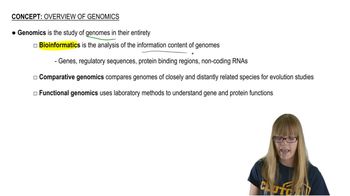
Genomics Overview

Amino Acid Composition and Protein Stability

Amino acid composition affects protein structure and stability, especially in extreme environments. Thermophiles tend to have proteins enriched with amino acids that enhance stability, such as charged and hydrophobic residues, to maintain function at high temperatures. This selective pressure shapes the proteome and reflects evolutionary adaptation.
추천 영상:

Evolutionary Adaptation and Genome Interpretation

Evolution in extreme environments drives specific genomic and proteomic adaptations that can bias sequence data interpretation. Recognizing these adaptations is crucial for accurate phylogenetic analysis and functional annotation, as standard models may not account for environment-driven compositional shifts, potentially leading to misinterpretation of evolutionary relationships.
추천 영상:
가이드 코스
02:48
Genomics Overview
관련 실천
교과서 질문

Whole-exome sequencing (WES) is helping physicians diagnose a genetic condition that has defied diagnosis by traditional means. The implication here is that exons in the nuclear genome are sequenced in the hopes that, by comparison with the genomes of nonaffected individuals, a diagnosis might be revealed.

What are the strengths and weaknesses of this approach?

521
views
교과서 질문

Homology can be defined as the presence of common structures because of shared ancestry. Homology can involve genes, proteins, or anatomical structures. As a result of 'descent with modification,' many homologous structures have adapted different purposes.

Under what circumstances might one expect proteins of similar function to not share homology? Would you expect such proteins to be homologous at the level of DNA sequences?

513
views
교과서 질문

Comparisons between human and chimpanzee genomes indicate that a gene that may function as a wild-type or normal gene in one primate may function as a disease-causing gene in another [The Chimpanzee Sequencing and Analysis Consortium (2005). Nature 437:69–87]. For instance, the PPARG locus (regulator of adipocyte differentiation) is a wild-type allele in chimps but is clearly associated with Type 2 diabetes in humans. What factors might cause this apparent contradiction? Would you consider such apparent contradictions to be rare or common? What impact might such findings have on the use of comparative genomics to identify and design therapies for disease-causing genes in humans?

814
views
교과서 질문

Whole-exome sequencing (WES) is helping physicians diagnose a genetic condition that has defied diagnosis by traditional means. The implication here is that exons in the nuclear genome are sequenced in the hopes that, by comparison with the genomes of nonaffected individuals, a diagnosis might be revealed.

If you were ordering WES for a patient, would you also include an analysis of the patient's mitochondrial genome?

657
views
교과서 질문

Homology can be defined as the presence of common structures because of shared ancestry. Homology can involve genes, proteins, or anatomical structures. As a result of 'descent with modification,' many homologous structures have adapted different purposes.

Is it likely that homologous proteins from different species have the same or similar functions? Explain.

647
views
교과서 질문

Recall that when the HGP was completed, more than 40 percent of the genes identified had unknown functions. The PANTHER database provides access to comprehensive and current functional assignments for human genes (and genes from other species).

Go to http://www.pantherdb.org/data/. In the frame on the left side of the screen locate the 'Quick links' and use the 'Whole genome function views' link to a view of a pie chart of current functional classes for human genes. Mouse over the pie chart to answer these questions. What percentage of human genes encode transcription factors? Cytoskeletal proteins? Transmembrane receptor regulatory/adaptor proteins?

811
views