Ch. 23 - Developmental Genetics
Klug - Concepts of Genetics  12th Edition
Klug12th EditionConcepts of Genetics ISBN: 9780135564776당신이 사용하는 게 아니라요?교과서 변경
23장, 문제 23b

Much of what we know about gene interactions in development has been learned using nematodes, yeast, flies, and bacteria. This is due, in part, to the relative ease of genetic manipulation of these well-characterized genomes. However, of great interest are gene interactions involving complex diseases in humans. Wang and White [(2011). Nature Methods 8(4):341–346] describe work using RNAi to examine the interactive proteome in mammalian cells. They mention that knockdown inefficiencies and off-target effects of introduced RNAi species are areas that need particular improvement if the methodology is to be fruitful.
Comment on how 'knockdown inefficiencies' and 'off-target effects' would influence the interpretation of results.

검증된 단계별 안내
1
Step 1: Understand the concept of 'knockdown inefficiencies' in RNA interference (RNAi). This refers to the incomplete reduction of the target gene's expression, meaning the gene is not fully silenced, which can lead to residual protein activity affecting the observed phenotype.
Step 2: Recognize that 'off-target effects' occur when the RNAi molecules unintentionally bind to and suppress genes other than the intended target, potentially causing misleading phenotypic changes unrelated to the gene of interest.
Step 3: Analyze how knockdown inefficiencies can cause underestimation of a gene's role because partial gene expression might mask the full effect of gene loss, leading to ambiguous or weak phenotypic outcomes.
Step 4: Consider that off-target effects can confound results by introducing phenotypes that are mistakenly attributed to the target gene, thereby complicating the interpretation of gene function and interactions.
Step 5: Conclude that both knockdown inefficiencies and off-target effects reduce the reliability of RNAi experiments, making it essential to use controls and complementary methods to validate findings and accurately interpret gene interactions.

비슷한 문제에 대한 검증된 영상 답변:

이 영상 해법은 위 문제에 도움이 된다고 튜터들이 추천한 것입니다.
영상 길이:
2m
도움이 되었나요?

주요 개념

질문에 올바르게 답하기 위해 반드시 이해해야 하는 핵심 개념들은 다음과 같습니다.

RNA Interference (RNAi) Mechanism

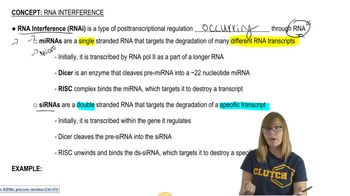
RNAi is a biological process where small RNA molecules inhibit gene expression by degrading target mRNA or blocking its translation. It is widely used to 'knock down' gene function in cells, allowing researchers to study gene roles. Understanding RNAi is essential to grasp how gene silencing is achieved and why its efficiency matters.
추천 영상:
가이드 코스
06:59
RNA Interference

Knockdown Inefficiencies

Knockdown inefficiencies occur when RNAi fails to sufficiently reduce the target gene's expression, leading to incomplete gene silencing. This can cause ambiguous results, as residual gene activity may mask the true phenotype or interaction, complicating data interpretation in gene function studies.
추천 영상:
가이드 코스
11:59
Steps to DNA Replication

Off-Target Effects in RNAi

Off-target effects happen when RNAi molecules unintentionally silence genes other than the intended target, due to partial sequence complementarity. These unintended knockdowns can produce misleading phenotypes, making it difficult to attribute observed effects solely to the target gene, thus affecting the reliability of experimental conclusions.
추천 영상:
가이드 코스
03:38
Maternal Effect
관련 실천
교과서 질문

Vulval development in C. elegans is dependent on the response of some of the central epidermal progenitor cells in the region of the developing vulva to a chemical signal from the gonad. Signaling from the gonad is blocked by action of the vulvaless mutant let-23 so that none of the central progenitor cells form vulval structures. In the vulvaless mutant, n300, the central progenitor cells do not form.

What phenotype (vulva formed or vulvaless) would you expect from the double mutant? Why?

765
views
교과서 질문

Much of what we know about gene interactions in development has been learned using nematodes, yeast, flies, and bacteria. This is due, in part, to the relative ease of genetic manipulation of these well-characterized genomes. However, of great interest are gene interactions involving complex diseases in humans. Wang and White [(2011). Nature Methods 8(4):341–346] describe work using RNAi to examine the interactive proteome in mammalian cells. They mention that knockdown inefficiencies and off-target effects of introduced RNAi species are areas that need particular improvement if the methodology is to be fruitful.

How might one use RNAi to study developmental pathways?

494
views
교과서 질문

Dominguez et al. (2004) suggest that by studying genes that determine growth and tissue specification in the eye of Drosophila, much can be learned about human eye development.

What evidence indicates that the eyeless gene is part of a developmental network?

387
views
교과서 질문

Vulval development in C. elegans is dependent on the response of some of the central epidermal progenitor cells in the region of the developing vulva to a chemical signal from the gonad. Signaling from the gonad is blocked by action of the vulvaless mutant let-23 so that none of the central progenitor cells form vulval structures. In the vulvaless mutant, n300, the central progenitor cells do not form.

Which gene is likely to act earlier in the vulval developmental pathway?

524
views
교과서 질문

Dominguez et al. (2004) suggest that by studying genes that determine growth and tissue specification in the eye of Drosophila, much can be learned about human eye development.

What evidence suggests that genetic eye determinants in Drosophila are also found in humans? Include a discussion of orthologous genes in your answer.

419
views