
Ch. 25 - Quantitative Genetics and Multifactorial Traits
Klug - Concepts of Genetics 12th Edition
Klug12th EditionConcepts of GeneticsISBN: 9780135564776당신이 사용하는 게 아니라요?교과서 변경
25장, 문제 29e

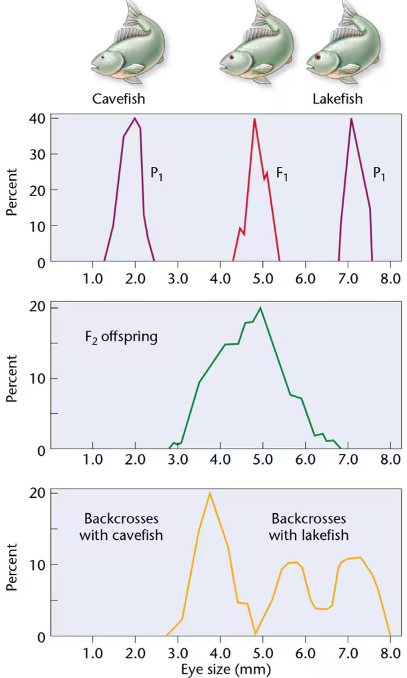
In 1988, Horst Wilkens investigated blind cavefish, comparing them with members of a sibling species with normal vision that are found in a lake [Wilkens, H. (1988). Evol. Biol. 25:271–367]. We will call them cavefish and lakefish. Wilkens found that cavefish eyes are about seven times smaller than lakefish eyes. F₁ hybrids have eyes of intermediate size. These data, as well as the F₁ × F₁ cross and those from backcrosses (F₁ × cavefish and F₁ × lakefish), are depicted below. Examine Wilkens's results and respond to the following questions:
A comparison of the embryonic eye in cavefish and lakefish revealed that both reach approximately 4 mm in diameter. However, lakefish eyes continue to grow, while cavefish eye size is greatly reduced. Speculate on the role of the genes involved in this problem.
Graphs showing eye size distributions in cavefish, lakefish, their hybrids, F2 offspring, and backcrosses.

검증된 단계별 안내
1
Understand the context: The problem describes a developmental difference in eye size between cavefish and lakefish. Cavefish eyes stop growing after reaching approximately 4 mm in diameter, while lakefish eyes continue to grow. This suggests genetic regulation of eye development and growth.
Identify potential genetic mechanisms: Genes involved in eye development, such as those regulating cell proliferation, apoptosis (programmed cell death), or tissue differentiation, may play a role. For example, mutations or changes in expression of these genes could lead to reduced eye growth in cavefish.
Consider environmental influences: Cavefish live in dark environments where vision is not necessary for survival. Over time, natural selection may have favored genetic changes that reduce energy investment in eye development, leading to the observed phenotype.
Explore candidate genes: Research has shown that genes like shh (Sonic Hedgehog) and fgf (Fibroblast Growth Factor) are involved in eye development. Altered expression or function of these genes could explain the reduced eye size in cavefish.
Hypothesize gene interactions: Speculate that cavefish may have mutations or regulatory changes in genes that suppress eye growth or promote apoptosis in eye tissue. These changes could be adaptive for their environment, conserving energy for other survival traits.

비슷한 문제에 대한 검증된 영상 답변:

이 영상 해법은 위 문제에 도움이 된다고 튜터들이 추천한 것입니다.
영상 길이:
2m
도움이 되었나요?

주요 개념

질문에 올바르게 답하기 위해 반드시 이해해야 하는 핵심 개념들은 다음과 같습니다.

Gene Expression and Regulation

Gene expression refers to the process by which information from a gene is used to synthesize functional gene products, typically proteins. In the context of cavefish and lakefish, differences in gene expression can lead to variations in eye development, with certain genes being upregulated or downregulated in response to environmental factors, influencing eye size.
추천 영상:
가이드 코스
02:09
Penetrance and Expressivity

Evolutionary Adaptation

Evolutionary adaptation is the process through which species evolve traits that enhance their survival and reproduction in specific environments. Cavefish, living in dark environments, may have adapted to reduced eye size due to the lack of light, leading to energy conservation and a focus on other sensory adaptations, while lakefish retain larger eyes for better vision.
추천 영상:

Developmental Biology

Developmental biology studies the process by which organisms grow and develop, including the formation of structures like the eye. The differences in eye size between cavefish and lakefish can be attributed to variations in developmental pathways influenced by genetic factors, which dictate how and when eye structures form during embryonic development.
추천 영상:
가이드 코스
11:19
Segmentation Genes
관련 실천
교과서 질문

In 1988, Horst Wilkens investigated blind cavefish, comparing them with members of a sibling species with normal vision that are found in a lake [Wilkens, H. (1988). Evol. Biol. 25:271–367]. We will call them cavefish and lakefish. Wilkens found that cavefish eyes are about seven times smaller than lakefish eyes. F₁ hybrids have eyes of intermediate size. These data, as well as the F₁ × F₁ cross and those from backcrosses (F₁ × cavefish and F₁ × lakefish), are depicted below. Examine Wilkens's results and respond to the following questions:

Wilkens examined about 1000 F₂ progeny and estimated that 6–7 genes are involved in determining eye size. Is the sample size adequate to justify this conclusion? Propose an experimental protocol to test the hypothesis.

371
views
교과서 질문

In 1988, Horst Wilkens investigated blind cavefish, comparing them with members of a sibling species with normal vision that are found in a lake [Wilkens, H. (1988). Evol. Biol. 25:271–367]. We will call them cavefish and lakefish. Wilkens found that cavefish eyes are about seven times smaller than lakefish eyes. F₁ hybrids have eyes of intermediate size. These data, as well as the F₁×F₁ cross and those from backcrosses (F₁×cavefish and F₁×lakefish), are depicted below. Examine Wilkens's results and respond to the following questions:

Based on the results of the F₁ backcross with cavefish, is your explanation supported? Explain. 

513
views
교과서 질문

In 1988, Horst Wilkens investigated blind cavefish, comparing them with members of a sibling species with normal vision that are found in a lake [Wilkens, H. (1988). Evol. Biol. 25:271–367]. We will call them cavefish and lakefish. Wilkens found that cavefish eyes are about seven times smaller than lakefish eyes. F₁ hybrids have eyes of intermediate size. These data, as well as the F₁×F₁ cross and those from backcrosses (F₁×cavefish and F₁×lakefish), are depicted below. Examine Wilkens's results and respond to the following questions:

Based on the results of the F₁ backcross with lakefish, is your explanation supported? Explain.

477
views