Ch. 25 - Quantitative Genetics and Multifactorial Traits
Klug - Concepts of Genetics  12th Edition
Klug12th EditionConcepts of Genetics ISBN: 9780135564776당신이 사용하는 게 아니라요?교과서 변경
25장, 문제 1d

How do we assess environmental factors to determine if they impact the phenotype of a quantitatively inherited trait?

검증된 단계별 안내
1
Identify the quantitative trait of interest and measure its phenotype across a population exposed to different environmental conditions.
Collect data on environmental variables that could influence the trait, such as temperature, nutrition, or stress levels, ensuring these factors vary systematically or naturally among the individuals.
Use statistical methods like analysis of variance (ANOVA) or regression analysis to compare phenotypic variation with environmental variation, testing whether changes in the environment correlate with changes in the trait.
Estimate the proportion of phenotypic variance attributable to environmental factors versus genetic factors by partitioning variance components, often using models such as the linear mixed model or the breeder's equation.
Interpret the results to determine if environmental factors significantly impact the phenotype, considering the possibility of gene-environment interactions that may modify the expression of the quantitative trait.

비슷한 문제에 대한 검증된 영상 답변:

이 영상 해법은 위 문제에 도움이 된다고 튜터들이 추천한 것입니다.
영상 길이:
1m
도움이 되었나요?

주요 개념

질문에 올바르게 답하기 위해 반드시 이해해야 하는 핵심 개념들은 다음과 같습니다.

Quantitative Inheritance

Quantitative inheritance refers to traits controlled by multiple genes, each contributing a small effect, resulting in continuous variation (e.g., height or skin color). These traits do not follow simple Mendelian patterns and are influenced by both genetic and environmental factors.
추천 영상:
가이드 코스
05:13
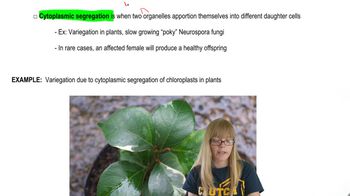
Organelle Inheritance

Phenotype and Environmental Influence

Phenotype is the observable characteristic of an organism, shaped by genetic makeup and environmental conditions. Environmental factors such as nutrition, temperature, or stress can modify the expression of quantitative traits, making it essential to separate genetic effects from environmental impacts.
추천 영상:
가이드 코스
10:48
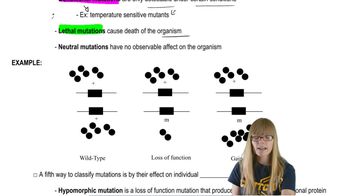
Mutations and Phenotypes

Statistical Methods for Environmental Assessment

To assess environmental effects on quantitative traits, researchers use statistical tools like analysis of variance (ANOVA) and regression analysis. These methods help partition phenotypic variance into genetic and environmental components, enabling the evaluation of how much environment influences the trait.
추천 영상:
가이드 코스
07:40
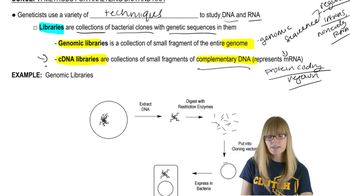
Methods for Analyzing DNA and RNA