Ch. 26 - Population and Evolutionary Genetics
Klug - Concepts of Genetics 12th Edition
Klug12th EditionConcepts of GeneticsISBN: 9780135564776당신이 사용하는 게 아니라요?교과서 변경
26장, 문제 26

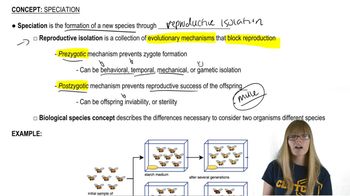
What are the two groups of reproductive isolating mechanisms? Which of these is regarded as more efficient, and why?

검증된 단계별 안내
1
Identify the two main groups of reproductive isolating mechanisms: prezygotic isolation and postzygotic isolation.
Explain that prezygotic isolation occurs before fertilization and includes mechanisms that prevent mating or fertilization between different species, such as temporal isolation, behavioral isolation, mechanical isolation, and gametic isolation.
Describe postzygotic isolation as mechanisms that occur after fertilization, leading to reduced viability or fertility of the hybrid offspring, such as hybrid inviability, hybrid sterility, and hybrid breakdown.
Discuss why prezygotic isolation is generally regarded as more efficient because it prevents the formation of unfit or sterile hybrids, saving energy and resources that would otherwise be wasted on unsuccessful reproduction.
Summarize that prezygotic mechanisms act earlier in the reproductive process, thus effectively maintaining species boundaries by preventing gene flow before zygote formation.

비슷한 문제에 대한 검증된 영상 답변:

이 영상 해법은 위 문제에 도움이 된다고 튜터들이 추천한 것입니다.
영상 길이:
1m
도움이 되었나요?

주요 개념

질문에 올바르게 답하기 위해 반드시 이해해야 하는 핵심 개념들은 다음과 같습니다.

Reproductive Isolating Mechanisms

Reproductive isolating mechanisms are biological features that prevent different species from interbreeding. They maintain species boundaries by reducing gene flow, ensuring species remain distinct. These mechanisms are essential for the process of speciation.
추천 영상:

Prezygotic Isolation

Prezygotic isolation occurs before fertilization and prevents mating or fertilization between species. Examples include temporal isolation (different mating times), behavioral isolation (different mating behaviors), and mechanical isolation (incompatible reproductive structures).
추천 영상:

Postzygotic Isolation

Postzygotic isolation happens after fertilization and reduces the viability or fertility of hybrid offspring. Examples include hybrid inviability, hybrid sterility, and hybrid breakdown. It is generally considered less efficient because energy is spent producing unfit hybrids.
추천 영상:
관련 실천
교과서 질문

Some critics have warned that the use of gene therapy to correct genetic disorders will affect the course of human evolution. Evaluate this criticism in light of what you know about population genetics and evolution, distinguishing between somatic gene therapy and germ-line gene therapy.

625
views
교과서 질문

A form of dwarfism known as Ellis–van Creveld syndrome was first discovered in the late 1930s, when Richard Ellis and Simon van Creveld shared a train compartment on the way to a pediatrics meeting. In the course of conversation, they discovered that they each had a patient with this syndrome. They published a description of the syndrome in 1940. Affected individuals have a short-limbed form of dwarfism and often have defects of the lips and teeth, and polydactyly (extra fingers). The largest pedigree for the condition was reported in an Old Order Amish population in eastern Pennsylvania by Victor McKusick and his colleagues (1964). In that community, about 5 per 1000 births are affected, and in the population of 8000, the observed frequency is 2 per 1000. All affected individuals have unaffected parents, and all affected cases can trace their ancestry to Samuel King and his wife, who arrived in the area in 1774. It is known that neither King nor his wife was affected with the disorder. There are no cases of the disorder in other Amish communities, such as those in Ohio or Indiana.

What is the most likely explanation for the high frequency of the disorder in the Pennsylvania Amish community and its absence in other Amish communities?

782
views
교과서 질문

What genetic changes take place during speciation?

520
views
교과서 질문

List the barriers that prevent interbreeding, and give an example of each.

457
views
교과서 질문

A form of dwarfism known as Ellis–van Creveld syndrome was first discovered in the late 1930s, when Richard Ellis and Simon van Creveld shared a train compartment on the way to a pediatrics meeting. In the course of conversation, they discovered that they each had a patient with this syndrome. They published a description of the syndrome in 1940. Affected individuals have a short-limbed form of dwarfism and often have defects of the lips and teeth, and polydactyly (extra fingers). The largest pedigree for the condition was reported in an Old Order Amish population in eastern Pennsylvania by Victor McKusick and his colleagues (1964). In that community, about 5 per 1000 births are affected, and in the population of 8000, the observed frequency is 2 per 1000. All affected individuals have unaffected parents, and all affected cases can trace their ancestry to Samuel King and his wife, who arrived in the area in 1774. It is known that neither King nor his wife was affected with the disorder. There are no cases of the disorder in other Amish communities, such as those in Ohio or Indiana.

From the information provided, derive the most likely mode of inheritance of this disorder. Using the Hardy–Weinberg law, calculate the frequency of the mutant allele in the population and the frequency of heterozygotes, assuming Hardy–Weinberg conditions.

811
views
교과서 질문

The original source of new alleles, upon which selection operates, is mutation, a random event that occurs without regard to selectional value in the organism. Although many model organisms have been used to study mutational events in populations, some investigators have developed abiotic molecular models. Soll et al. (2006. Genetics 175: 267-275) examined one such model to study the relationship between both deleterious and advantageous mutations and population size in a ligase molecule composed of RNA (a ribozyme). Soll found that the smaller the population of molecules, the more likely it was that not only deleterious mutations but also advantageous mutations would disappear. Why would population size influence the survival of both types of mutations (deleterious and advantageous) in populations?

544
views