Ch. 3 - Mendelian Genetics
Klug - Concepts of Genetics 12th Edition
Klug12th EditionConcepts of GeneticsISBN: 9780135564776당신이 사용하는 게 아니라요?교과서 변경
3장, 문제 3d

Albinism in humans is inherited as a simple recessive trait. For the following families, determine the genotypes of the parents and offspring. (When two alternative genotypes are possible, list both.)
Construct a pedigree of the families in (b) and (c). Assume that one of the normal children in (b) and one of the albino children in (c) become the parents of eight children. Add these children to the pedigree, predicting their phenotypes (normal or albino).

검증된 단계별 안내
1
Understand the inheritance pattern: Albinism is a simple recessive trait, meaning that an individual must inherit two recessive alleles (aa) to express the albino phenotype. A heterozygous individual (Aa) will have a normal phenotype but can pass on the recessive allele.
Determine the genotypes of the parents and offspring: Analyze the family data provided in the problem. Use the phenotypes of the parents and offspring to deduce their genotypes. For example, if two normal parents have an albino child, both parents must be heterozygous (Aa).
Construct the pedigree for families (b) and (c): Use standard pedigree symbols (squares for males, circles for females, shaded for albino, unshaded for normal) to represent the family members. Label each individual with their genotype if it can be determined or list possible genotypes if ambiguous.
Predict the phenotypes of the eight children: If one normal child from family (b) (likely genotype Aa) and one albino child from family (c) (genotype aa) become parents, use a Punnett square to determine the probability of their offspring being normal (Aa or aa) or albino (aa).
Add the predicted children to the pedigree: Extend the pedigree to include the eight children, marking their phenotypes (normal or albino) based on the probabilities calculated in the Punnett square. Ensure the pedigree remains clear and follows standard conventions.

비슷한 문제에 대한 검증된 영상 답변:

이 영상 해법은 위 문제에 도움이 된다고 튜터들이 추천한 것입니다.
영상 길이:
5m
도움이 되었나요?

주요 개념

질문에 올바르게 답하기 위해 반드시 이해해야 하는 핵심 개념들은 다음과 같습니다.

Recessive Inheritance

Recessive inheritance refers to a pattern where a trait is expressed only when an individual has two copies of the recessive allele. In the case of albinism, which is caused by a recessive allele, individuals must inherit the allele from both parents to exhibit the trait. If they have one dominant allele, they will not show the phenotype but can still pass the recessive allele to their offspring.
추천 영상:
가이드 코스
05:13
Organelle Inheritance

Genotype vs. Phenotype

Genotype refers to the genetic makeup of an individual, specifically the alleles they carry, while phenotype is the observable expression of those genes, such as physical traits. For albinism, individuals with the genotype 'aa' will exhibit the albino phenotype, whereas those with 'AA' or 'Aa' will display normal pigmentation. Understanding this distinction is crucial for predicting offspring traits based on parental genotypes.
추천 영상:
가이드 코스
07:52
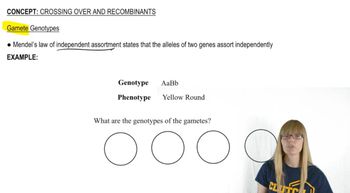
Gamete Genotypes

Pedigree Analysis

A pedigree is a diagram that depicts the genetic relationships and inheritance patterns within a family over generations. It helps visualize how traits, such as albinism, are passed down and can be used to determine the genotypes of individuals based on their phenotypes. By analyzing a pedigree, one can predict the likelihood of traits appearing in future generations, which is essential for understanding inheritance patterns.
추천 영상:
가이드 코스
01:59
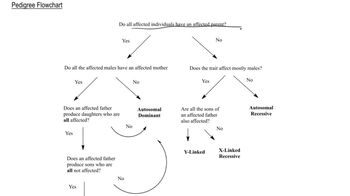
Pedigree Flowchart