Ch. 3 - Mendelian Genetics
Klug - Concepts of Genetics 12th Edition
Klug12th EditionConcepts of GeneticsISBN: 9780135564776당신이 사용하는 게 아니라요?교과서 변경
3장, 문제 9

Which of Mendel's postulates can only be demonstrated in crosses involving at least two pairs of traits? State the postulate.

검증된 단계별 안내
1
Identify Mendel's four postulates: (1) Unit factors exist in pairs, (2) Dominance and recessiveness, (3) Segregation, and (4) Independent assortment.
Understand that the postulate of independent assortment states that alleles for different traits segregate independently of one another during gamete formation.
Recognize that independent assortment can only be observed when studying two or more pairs of traits, as it involves the behavior of alleles at different loci.
Consider a dihybrid cross (e.g., AaBb x AaBb) to demonstrate independent assortment, where the alleles for one trait (A/a) segregate independently of the alleles for another trait (B/b).
Conclude that Mendel's postulate of independent assortment is the one that requires crosses involving at least two pairs of traits to be demonstrated.

비슷한 문제에 대한 검증된 영상 답변:

이 영상 해법은 위 문제에 도움이 된다고 튜터들이 추천한 것입니다.
영상 길이:
3m
도움이 되었나요?

주요 개념

질문에 올바르게 답하기 위해 반드시 이해해야 하는 핵심 개념들은 다음과 같습니다.

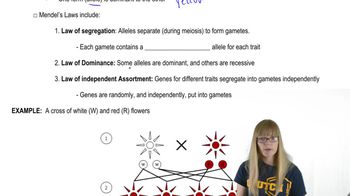
Mendel's Law of Independent Assortment

Mendel's Law of Independent Assortment states that alleles for different traits segregate independently of one another during gamete formation. This principle can only be observed when examining crosses that involve at least two pairs of traits, as it allows for the combination of different alleles to produce various phenotypes in the offspring.
추천 영상:

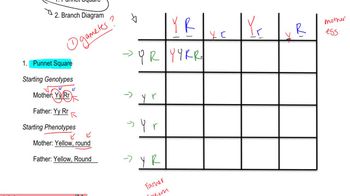
Dihybrid Cross

A dihybrid cross is a genetic cross that examines the inheritance of two different traits, each represented by two alleles. This type of cross is essential for demonstrating Mendel's Law of Independent Assortment, as it allows researchers to observe how the alleles for each trait assort independently, leading to a variety of possible combinations in the offspring.
추천 영상:

Phenotypic Ratio

The phenotypic ratio is the ratio of different phenotypes that appear in the offspring from a genetic cross. In a typical dihybrid cross, the expected phenotypic ratio is 9:3:3:1, which illustrates the independent assortment of alleles for two traits. Understanding this ratio is crucial for analyzing the outcomes of crosses involving multiple traits.
추천 영상:
가이드 코스
10:48
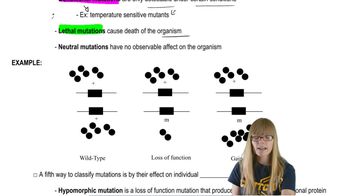
Mutations and Phenotypes
관련 실천
교과서 질문

Mendel crossed peas having round seeds and yellow cotyledons (seed leaves) with peas having wrinkled seeds and green cotyledons. All the F₁ plants had round seeds with yellow cotyledons. Diagram this cross through the F₂ generation, using both the Punnett square and forked-line, or branch diagram, methods.

868
views
교과서 질문

What advantages were provided by Mendel's choice of the garden pea in his experiments?

778
views
교과서 질문
Based on the preceding cross, what is the probability that an organism in the F₂ generation will have round seeds and green cotyledons and be true breeding?
622
views
교과서 질문

In a cross between a black and a white guinea pig, all members of the F₁ generation are black. The F₂ generation is made up of approximately 3/4 black and 1/4 white guinea pigs. What will the offspring be like if two F₂ white guinea pigs are mated?

707
views
교과서 질문

In a cross between a black and a white guinea pig, all members of the F₁ generation are black. The F₂ generation is made up of approximately 3/4 black and 1/4 white guinea pigs. Two different matings were made between black members of the F₂ generation, with the following results. Diagram each of the crosses.

Cross Offspring

Cross 1 All black

Cross 2 3/4 black, 1/4 white

817
views
교과서 질문

In a cross between a black and a white guinea pig, all members of the F₁ generation are black. The F₂ generation is made up of approximately 3/4 black and 1/4 white guinea pigs. Diagram this cross, showing the genotypes and phenotypes.

2972
views