Ch. 4 - Extensions of Mendelian Genetics
Klug - Concepts of Genetics 12th Edition
Klug12th EditionConcepts of GeneticsISBN: 9780135564776당신이 사용하는 게 아니라요?교과서 변경
4장, 문제 37

A true-breeding purple-leafed plant isolated from one side of El Yunque, the rain forest in Puerto Rico, was crossed to a true-breeding white variety found on the other side. The F₁ offspring were all purple. A large number of F₁ x F₁ crosses produced the following results:
purple: 4219, white: 5781 (Total = 10,000)
Propose an explanation for the inheritance of leaf color. As a geneticist, how might you go about testing your hypothesis? Describe the genetic experiments that you would conduct.

검증된 단계별 안내
1
Step 1: Analyze the F₁ generation results. Since all F₁ offspring are purple, this suggests that the purple trait is dominant over the white trait. This indicates that the purple-leafed parent likely contributed a dominant allele (P), while the white-leafed parent contributed a recessive allele (p). The F₁ genotype is therefore heterozygous (Pp).
Step 2: Examine the F₁ x F₁ cross results. The observed ratio of purple (4219) to white (5781) is approximately 3:4. This deviates from the classic Mendelian 3:1 ratio expected for a single-gene inheritance pattern. This suggests that more than one gene may be involved in determining leaf color.
Step 3: Propose a hypothesis. Based on the observed ratio, hypothesize that leaf color is controlled by two genes with epistatic interactions. For example, one gene may determine whether pigment is produced (e.g., P for pigment, p for no pigment), and another gene may modify the pigment color (e.g., C for purple, c for white).
Step 4: Design a genetic experiment to test the hypothesis. Perform a test cross by crossing F₁ individuals (PpCc) with a homozygous recessive individual (ppcc). Analyze the phenotypic ratios of the offspring to determine if they align with the proposed two-gene model. Use a Punnett square to predict the expected ratios for comparison.
Step 5: Conduct further experiments to confirm the genetic basis. Perform complementation tests and analyze the segregation patterns in subsequent generations. Additionally, use molecular techniques such as gene sequencing or marker analysis to identify the specific genes involved and confirm their roles in leaf color determination.

비슷한 문제에 대한 검증된 영상 답변:

이 영상 해법은 위 문제에 도움이 된다고 튜터들이 추천한 것입니다.
영상 길이:
2m

주요 개념

질문에 올바르게 답하기 위해 반드시 이해해야 하는 핵심 개념들은 다음과 같습니다.

Mendelian Inheritance

Mendelian inheritance refers to the principles of heredity established by Gregor Mendel, which include the concepts of dominant and recessive traits. In this case, the purple leaf color is likely a dominant trait, as all F₁ offspring exhibited purple leaves when crossed with a true-breeding white variety. The observed 3:1 ratio of purple to white in the F₂ generation supports this model, indicating that the purple allele masks the expression of the white allele.
추천 영상:
가이드 코스
05:13
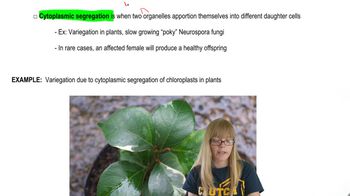
Organelle Inheritance

Genotype and Phenotype

The genotype is the genetic makeup of an organism, while the phenotype is the observable physical or biochemical characteristics. In this scenario, the genotype of the true-breeding purple plant is homozygous dominant (PP), and the white plant is homozygous recessive (pp). The F₁ generation, being heterozygous (Pp), displays the purple phenotype, demonstrating how genotype influences phenotype in inheritance patterns.
추천 영상:
가이드 코스
07:52
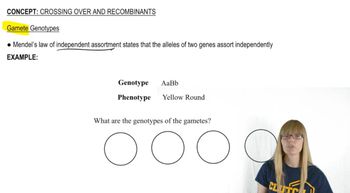
Gamete Genotypes

Test Cross

A test cross is a genetic experiment used to determine the genotype of an organism exhibiting a dominant phenotype. By crossing the purple-leafed plant (Pp) with a homozygous recessive plant (pp), one can observe the phenotypic ratios in the offspring. If any offspring display the recessive phenotype, it indicates that the purple plant is heterozygous; if all offspring are purple, the plant is likely homozygous dominant.
추천 영상:
가이드 코스
26:08
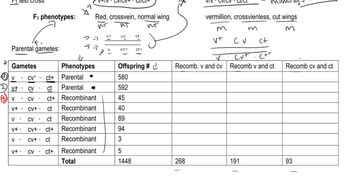
Trihybrid Cross
관련 실천
교과서 질문

A geneticist from an alien planet that prohibits genetic research brought with him to Earth two pure-breeding lines of frogs. One line croaks by uttering 'rib-it rib-it' and has purple eyes. The other line croaks more softly by muttering 'knee-deep knee-deep' and has green eyes. With a newfound freedom of inquiry, the geneticist mated the two types of frogs, producing F₁ frogs that were all utterers and had blue eyes. A large F₂ generation then yielded the following ratios:

27/64 blue-eyed, 'rib-it' utterer

12/64 green-eyed, 'rib-it' utterer

9/64 blue-eyed, 'knee-deep' mutterer

9/64 purple-eyed, 'rib-it' utterer

4/64 green-eyed, 'knee-deep' mutterer

3/64 purple-eyed, 'knee-deep' mutterer

Of these, how many are controlling eye color? How can you tell? How many are controlling croaking?

578
views
교과서 질문

Discuss the topic of phenotypic expression and the many factors that impinge on it.

504
views
교과서 질문

In Dexter and Kerry cattle, animals may be polled (hornless) or horned. The Dexter animals have short legs, whereas the Kerry animals have long legs. When many offspring were obtained from matings between polled Kerrys and horned Dexters, half were found to be polled Dexters and half polled Kerrys. When these two types of F₁ cattle were mated to one another, the following F₂ data were obtained:

3/8 polled Dexters

3/8 polled Kerrys

1/8 horned Dexters

1/8 horned Kerrys

A geneticist was puzzled by these data and interviewed farmers who had bred these cattle for decades. She learned that Kerrys were true breeding. Dexters, on the other hand, were not true breeding and never produced as many offspring as Kerrys. Provide a genetic explanation for these observations.

727
views
교과서 질문

A geneticist from an alien planet that prohibits genetic research brought with him to Earth two pure-breeding lines of frogs. One line croaks by uttering 'rib-it rib-it' and has purple eyes. The other line croaks more softly by muttering 'knee-deep knee-deep' and has green eyes. With a newfound freedom of inquiry, the geneticist mated the two types of frogs, producing F₁ frogs that were all utterers and had blue eyes. A large F₂ generation then yielded the following ratios:

27/64 blue-eyed, 'rib-it' utterer

12/64 green-eyed, 'rib-it' utterer

9/64 blue-eyed, 'knee-deep' mutterer

9/64 purple-eyed, 'rib-it' utterer

4/64 green-eyed, 'knee-deep' mutterer

3/64 purple-eyed, 'knee-deep' mutterer

How many total gene pairs are involved in the inheritance of both traits? Support your answer.

491
views
교과서 질문

Labrador retrievers may be black, brown (chocolate), or golden (yellow) in color (see chapter-opening photo). While each color may breed true, many different outcomes are seen when numerous litters are examined from a variety of matings where the parents are not necessarily true breeding. Following are just some of the many possibilities.

(a) black x brown → all black

(b) black x brown → 1/2 black, 1/2 brown

(c) black x brown → 3/4 black, 1/4 golden

(d) black x golden → all black

(e) black x golden → 4/8 golden 3/8 black 1/8 brown

(f) black x golden → 2/4 golden 1/4 black 1/4 brown

(g) brown x brown → 3/4 brown 1/4 golden

(h) black x black → 9/16 black 4/16 golden, 3/16 brown

Propose a mode of inheritance that is consistent with these data, and indicate the corresponding genotypes of the parents in each mating. Indicate as well the genotypes of dogs that breed true for each color.

1012
views
교과서 질문

Contrast penetrance and expressivity as the terms relate to phenotypic expression.

795
views