Ch. 4 - Extensions of Mendelian Genetics
Klug - Concepts of Genetics 12th Edition
Klug12th EditionConcepts of GeneticsISBN: 9780135564776당신이 사용하는 게 아니라요?교과서 변경
4장, 문제 30a

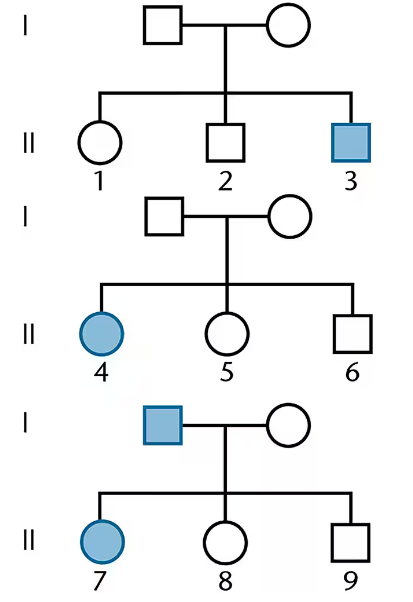
Consider the three pedigrees below, all involving a single human trait.

Which combination of conditions, if any, can be excluded? dominant and X-linked dominant and autosomal recessive and X-linked recessive and autosomal

검증된 단계별 안내
1
Step 1: Identify the pattern of affected individuals in each pedigree. Note the sex of affected individuals (squares for males, circles for females) and whether the trait appears in every generation or skips generations.
Step 2: For autosomal dominant traits, affected individuals usually appear in every generation and both males and females are equally likely to be affected. Check if this pattern fits any of the pedigrees.
Step 3: For X-linked dominant traits, affected males pass the trait to all daughters but no sons, and affected females can pass it to both sons and daughters. Look for affected females in every generation and affected males passing the trait to daughters.
Step 4: For autosomal recessive traits, the trait can skip generations, and affected individuals can have unaffected parents. Both males and females are equally affected. Check if the trait appears in siblings but not parents.
Step 5: For X-linked recessive traits, more males are affected than females, and affected males usually inherit the trait from carrier mothers. Affected males do not pass the trait to sons but can pass the allele to daughters who become carriers. Look for this pattern in the pedigrees.

비슷한 문제에 대한 검증된 영상 답변:

이 영상 해법은 위 문제에 도움이 된다고 튜터들이 추천한 것입니다.
영상 길이:
3m
도움이 되었나요?

주요 개념

질문에 올바르게 답하기 위해 반드시 이해해야 하는 핵심 개념들은 다음과 같습니다.

Modes of Inheritance

Modes of inheritance describe how traits are passed from parents to offspring. Common types include autosomal dominant, autosomal recessive, X-linked dominant, and X-linked recessive. Each mode has distinct patterns in pedigrees, such as affected individuals in every generation for dominant traits or skipping generations for recessive traits.
추천 영상:
가이드 코스
05:13
Organelle Inheritance

Pedigree Analysis

Pedigree analysis involves studying family trees to track the inheritance of traits. Squares represent males, circles represent females, and shaded symbols indicate affected individuals. By examining affected and unaffected members across generations, one can infer the likely mode of inheritance.
추천 영상:
가이드 코스
01:59
Pedigree Flowchart

X-linked vs Autosomal Traits

X-linked traits are associated with genes on the X chromosome and often show different patterns between males and females, such as males being more frequently affected in X-linked recessive traits. Autosomal traits are located on non-sex chromosomes and typically affect males and females equally.
추천 영상:
관련 실천
교과서 질문

In a cross in Drosophila involving the X-linked recessive eye mutation white and the autosomally linked recessive eye mutation sepia (resulting in a dark eye), predict the F₁ and F₂ results of crossing true-breeding parents of the following phenotypes: Note that white is epistatic to the expression of sepia.

white females x sepia males

1660
views
교과서 질문

While vermilion is X-linked in Drosophila and causes the eye color to be bright red, brown is an autosomal recessive mutation that causes the eye to be brown. Flies carrying both mutations lose all pigmentation and are white-eyed. Predict the F₁ and F₂ results of the following crosses:

white females x wild-type males

1886
views
교과서 질문

In a cross in Drosophila involving the X-linked recessive eye mutation white and the autosomally linked recessive eye mutation sepia (resulting in a dark eye), predict the F₁ and F₂ results of crossing true-breeding parents of the following phenotypes: Note that white is epistatic to the expression of sepia.

sepia females x white males

855
views
교과서 질문

Consider the three pedigrees below, all involving a single human trait.

For each combination that you excluded, indicate the single individual in generation II (e.g., II-1, II-2) that was most instrumental in your decision to exclude it. If none were excluded, answer 'none apply.'

573
views
교과서 질문

In goats, the development of the beard is due to a recessive gene. The following cross involving true-breeding goats was made and carried to the F₂ generation:

Offer an explanation for the inheritance and expression of this trait, diagramming the cross. Propose one or more crosses to test your hypothesis.

740
views
교과서 질문

Consider the three pedigrees below, all involving a single human trait.

Given your conclusions in part (a), indicate the genotype of the following individuals: II-1, II-6, II-9 If more than one possibility applies, list all possibilities. Use the symbols A and a for the genotypes.

1027
views