Ch. 4 - Extensions of Mendelian Genetics
Klug - Concepts of Genetics 12th Edition
Klug12th EditionConcepts of GeneticsISBN: 9780135564776당신이 사용하는 게 아니라요?교과서 변경
4장, 문제 16b

Pigment in mouse fur is only produced when the C allele is present. Individuals of the cc genotype are white. If color is present, it may be determined by the A, a alleles. AA or Aa results in agouti color, while aa results in black coats. In three crosses between agouti females whose genotypes were unknown and males of the aacc genotype, the following phenotypic ratios were obtained:
(1) 8 agouti
(2) 9 agouti
(3) 4 agouti, 8 white 10 black, 5 black, 10 white

검증된 단계별 안내
1
Step 1: Understand the genetic system described. The C allele controls pigment production: C_ (CC or Cc) produces pigment, while cc results in white fur. Among pigmented mice (C_), the A locus determines color: AA or Aa gives agouti, and aa gives black.
Step 2: Analyze the males' genotype: aacc. Since they are cc, they are white and do not produce pigment. Their genotype is homozygous recessive at both loci.
Step 3: Since the males are aacc, all offspring will inherit a c allele from the father, making their genotype at the C locus at least c_. The mother’s genotype is unknown but must have at least one C allele to produce pigment in offspring.
Step 4: For each cross, use the phenotypic ratios to deduce the mother's genotype. For example, if all offspring are pigmented (agouti), the mother is likely CC or Cc and AA or Aa. If white offspring appear, the mother may be Cc, allowing cc offspring (white) to appear.
Step 5: Use Punnett squares for each locus separately (C and A) to predict offspring genotypes and phenotypes. Combine these to match the observed ratios, which will help infer the mother's genotype in each cross.

비슷한 문제에 대한 검증된 영상 답변:

이 영상 해법은 위 문제에 도움이 된다고 튜터들이 추천한 것입니다.
영상 길이:
2m
도움이 되었나요?

주요 개념

질문에 올바르게 답하기 위해 반드시 이해해야 하는 핵심 개념들은 다음과 같습니다.

Epistasis and Gene Interaction

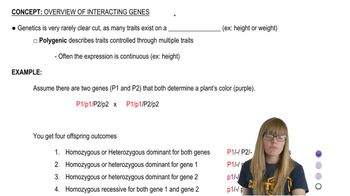
Epistasis occurs when one gene masks or modifies the expression of another gene. In this question, the C allele controls pigment production, and its recessive form (cc) results in white fur regardless of the A locus genotype. Understanding how the C locus epistatically affects the A locus is essential to interpret the phenotypic ratios.
추천 영상:
가이드 코스
07:56
Interacting Genes Overview

Mendelian Inheritance and Genotypic Ratios

Mendelian inheritance principles explain how alleles segregate and assort independently during gamete formation. Knowing how to predict offspring genotypes and phenotypes from parental crosses, especially with dominant and recessive alleles, helps analyze the given crosses and their resulting phenotypic ratios.
추천 영상:
가이드 코스
07:52
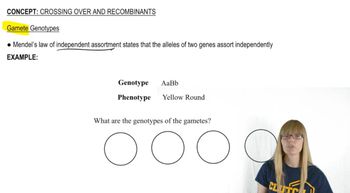
Gamete Genotypes

Phenotypic Ratios and Genotype Inference

Phenotypic ratios observed in offspring can be used to infer the unknown parental genotypes. By comparing expected ratios from different genotype combinations with observed data, one can deduce the likely genotypes of the agouti females, considering the interaction between the A and C loci.
추천 영상:
가이드 코스
07:52
Gamete Genotypes
관련 실천
교과서 질문

In rats, the following genotypes of two independently assorting autosomal genes determine coat color:

A third gene pair on a separate autosome determines whether or not any color will be produced. The CC and Cc genotypes allow color according to the expression of the A and B alleles. However, the cc genotype results in albino rats regardless of the A and B alleles present. Determine the F₁ phenotypic ratio of the following crosses:

AAbbCC×aaBBcc

593
views
교과서 질문

With reference to the eye color phenotypes produced by the recessive, autosomal, unlinked brown and scarlet loci in Drosophila, predict the F₁ and F₂ results of the following P₁ crosses. (Recall that when both the brown and scarlet alleles are homozygous, no pigment is produced, and the eyes are white.)

Wild type x Scarlet

649
views
교과서 질문

With reference to the eye color phenotypes produced by the recessive, autosomal, unlinked brown and scarlet loci in Drosophila, predict the F₁ and F₂ results of the following P₁ crosses. (Recall that when both the brown and scarlet alleles are homozygous, no pigment is produced, and the eyes are white.)

Brown x White

524
views
교과서 질문

In rats, the following genotypes of two independently assorting autosomal genes determine coat color:

A third gene pair on a separate autosome determines whether or not any color will be produced. The CC and Cc genotypes allow color according to the expression of the A and B alleles. However, the cc genotype results in albino rats regardless of the A and B alleles present. Determine the F₁ phenotypic ratio of the following crosses:

AaBbCc×AaBbcc

472
views
교과서 질문

In rats, the following genotypes of two independently assorting autosomal genes determine coat color:

A third gene pair on a separate autosome determines whether or not any color will be produced. The CC and Cc genotypes allow color according to the expression of the A and B alleles. However, the cc genotype results in albino rats regardless of the A and B alleles present. Determine the F₁ phenotypic ratio of the following crosses: AaBBCc×AaBBCc

760
views
교과서 질문

Pigment in mouse fur is only produced when the C allele is present. Individuals of the cc genotype are white. If color is present, it may be determined by the A, a alleles. AA or Aa results in agouti color, while aa results in black coats. What F₁ and F₂ genotypic and phenotypic ratios are obtained from a cross between AACC and aacc mice?

756
views