Ch. 6 - Genetic Analysis and Mapping in Bacteria and Bacteriophages
Klug - Concepts of Genetics  12th Edition
Klug12th EditionConcepts of Genetics ISBN: 9780135564776당신이 사용하는 게 아니라요?교과서 변경
6장, 문제 20a

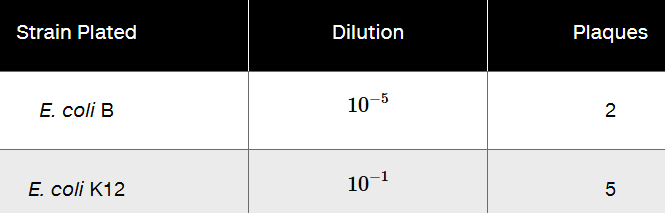
Using mutants 2 and 3 from Problem 19, following mixed infection on E. coli B, progeny viruses were plated in a series of dilutions on both E. coli B and K12 with the following results.
Table showing plaques formed on E. coli B and K12 strains at dilutions 10^-5 and 10^-1 with counts of 2 and 5 respectively.
What is the recombination frequency between the two mutants?

검증된 단계별 안내
1
Step 1: Understand the problem. The goal is to calculate the recombination frequency between two mutants based on the given plaque counts on two strains of E. coli (B and K12) at specific dilutions. Recombination frequency is calculated as the number of recombinant plaques divided by the total number of plaques, expressed as a percentage.
Step 2: Identify the total number of plaques. For E. coli B, the dilution is 10⁻⁵, and the number of plaques is 2. For E. coli K12, the dilution is 10⁻¹, and the number of plaques is 5. These values represent the observed plaques at the respective dilutions.
Step 3: Adjust the plaque counts to the same dilution factor. Since the dilutions are different (10⁻⁵ for E. coli B and 10⁻¹ for E. coli K12), scale the plaque counts to the same dilution factor. Use the formula: Adjusted Plaques = Observed Plaques × (Dilution Factor Adjustment).
Step 4: Determine the number of recombinant plaques. Recombinant plaques are those that grow on E. coli K12 but not on E. coli B. After adjusting the plaque counts to the same dilution factor, subtract the plaques observed on E. coli B from those observed on E. coli K12 to find the recombinant plaques.
Step 5: Calculate the recombination frequency. Use the formula: Recombination Frequency = (Number of Recombinant Plaques / Total Plaques) × 100. The total plaques are the sum of the adjusted plaques for E. coli B and E. coli K12. Express the result as a percentage.

비슷한 문제에 대한 검증된 영상 답변:

이 영상 해법은 위 문제에 도움이 된다고 튜터들이 추천한 것입니다.
영상 길이:
35s
도움이 되었나요?

주요 개념

질문에 올바르게 답하기 위해 반드시 이해해야 하는 핵심 개념들은 다음과 같습니다.

Recombination Frequency

Recombination frequency is a measure of the likelihood that two alleles will be separated during meiosis due to crossing over. It is calculated as the number of recombinant offspring divided by the total number of offspring, often expressed as a percentage. In the context of viral genetics, it helps determine the genetic distance between two mutants based on their progeny.
추천 영상:
가이드 코스
03:51
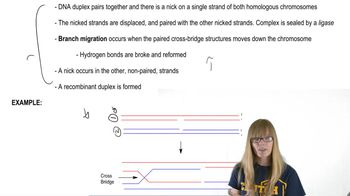
Recombination after Single Strand Breaks

Mutants in Genetics

Mutants are organisms that have undergone a change in their DNA sequence, resulting in a new phenotype. In the context of the question, mutants 2 and 3 refer to specific strains of viruses that have distinct genetic variations. Studying these mutants allows researchers to understand genetic interactions and the mechanisms of recombination.
추천 영상:
가이드 코스
11:43
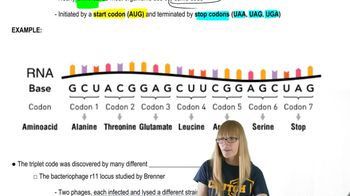
The Genetic Code

Plaque Assay

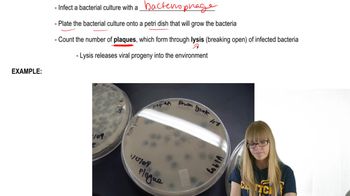
A plaque assay is a method used to quantify the number of viral particles in a sample. It involves infecting a layer of host cells with diluted virus and observing the formation of plaques, which are clear zones indicating cell lysis due to viral infection. The number of plaques can be used to calculate viral titers and assess the effects of recombination between different viral mutants.
추천 영상:
가이드 코스
03:44
Plaques and Experiments
관련 실천
교과서 질문

Using mutants 2 and 3 from Problem 19, following mixed infection on E. coli B, progeny viruses were plated in a series of dilutions on both E. coli B and K12 with the following results.

Another mutation, 6, was tested in relation to mutations 1 through 5 from Problems 18–20. In initial testing, mutant 6 complemented mutants 2 and 3. In recombination testing with 1, 4, and 5, mutant 6 yielded recombinants with 1 and 5, but not with 4. What can you conclude about mutation 6?

539
views
교과서 질문

During the analysis of seven rII mutations in phage T4, mutants 1, 2, and 6 were in cistron A, while mutants 3, 4, and 5 were in cistron B. Of these, mutant 4 was a deletion overlapping mutant 5. The remainder were point mutations. Nothing was known about mutant 7. Predict the results of complementation (+ or -) between 1 and 2; 1 and 3; 2 and 4; and 4 and 5.

614
views
교과서 질문

In an analysis of rII mutants, complementation testing yielded the following results:

1090
views
교과서 질문
In studies of recombination between mutants 1 and 2 from Problem 21, the results shown in the following table were obtained. Strain Dilution Plaques Phenotypes E. coli B 10⁻⁷ 4 r E. coli K12 10⁻² 8 + Mutant 7 (Problem 21) failed to complement any of the other mutants (1–6). Define the nature of mutant 7.
507
views
교과서 질문

If further testing of the mutations in Problem 18 yielded the following results, what would you conclude about mutant 5?

503
views
교과서 질문

In recombination studies of the rII locus in phage T4, what is the significance of the value determined by calculating phage growth in the K12 versus the B strains of E. coli following simultaneous infection in E. coli B? Which value is always greater?

890
views