Ch. 7 - Sex Determination and Sex Chromosomes
Klug - Concepts of Genetics 12th Edition
Klug12th EditionConcepts of GeneticsISBN: 9780135564776당신이 사용하는 게 아니라요?교과서 변경
7장, 문제 19

Predict the potential effect of the Lyon hypothesis on the retina of a human female heterozygous for the X-linked red-green color blindness trait.

검증된 단계별 안내
1
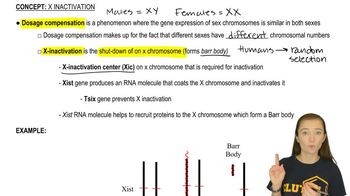
Understand the Lyon hypothesis, which states that in female mammals, one of the two X chromosomes in each cell is randomly inactivated during early embryonic development, leading to a mosaic pattern of X-linked gene expression.
Recognize that the female in question is heterozygous for the X-linked red-green color blindness trait, meaning she has one X chromosome with the normal allele and one X chromosome with the allele for red-green color blindness.
Consider that due to random X-inactivation, some retinal cells will express the normal allele (from the active X chromosome with the normal gene), while others will express the allele for color blindness (from the active X chromosome carrying the mutation).
Predict that this mosaic expression in the retina could lead to a patchy or mixed population of cone cells, some functioning normally and others deficient in red-green color perception, potentially resulting in a variable or partial color vision phenotype.
Conclude that the overall effect on the female's color vision depends on the proportion and distribution of cells expressing each X chromosome, which can vary between individuals due to the randomness of X-inactivation.

비슷한 문제에 대한 검증된 영상 답변:

이 영상 해법은 위 문제에 도움이 된다고 튜터들이 추천한 것입니다.
영상 길이:
3m

주요 개념

질문에 올바르게 답하기 위해 반드시 이해해야 하는 핵심 개념들은 다음과 같습니다.

Lyon Hypothesis (X-Chromosome Inactivation)

The Lyon hypothesis explains that in female mammals, one of the two X chromosomes in each cell is randomly inactivated during early embryonic development. This process creates a mosaic pattern of gene expression, where some cells express genes from the maternal X and others from the paternal X, affecting traits linked to the X chromosome.
추천 영상:

X-Linked Red-Green Color Blindness

Red-green color blindness is a common X-linked recessive trait caused by mutations in genes coding for photopigments in the retina. Males with the mutation on their single X chromosome express the trait, while females must be homozygous to be fully color blind; heterozygous females are typically carriers with normal vision but can show mosaic expression.
추천 영상:

Mosaicism in Retinal Cells

Due to X-chromosome inactivation, heterozygous females for X-linked traits like red-green color blindness have retinal cells expressing either the normal or mutant allele. This mosaicism can lead to patches of retina with normal color vision and patches with deficient color perception, potentially affecting overall color discrimination.
추천 영상:
가이드 코스
03:52
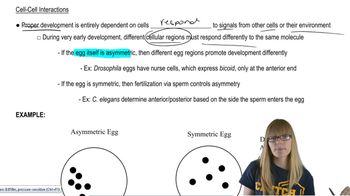
Cell-cell interactions
관련 실천
교과서 질문

Cat breeders are aware that kittens expressing the X-linked calico coat pattern and tortoiseshell pattern are almost invariably females. Why are they certain of this?

493
views
교과서 질문

Indicate the expected number of Barr bodies in interphase cells of individuals with Klinefelter syndrome, Turner syndrome, and karyotypes 47, XYY, 47, XXX, and 48, XXXX.

977
views
교과서 질문

Define the Lyon hypothesis.

1146
views
교과서 질문

Can the Lyon hypothesis be tested in a human female who is homozygous for one allele of the X-linked G6PD gene? Why, or why not?

574
views
교과서 질문

In mice, the Sry gene is located on the Y chromosome very close to one of the pseudoautosomal regions that pairs with the X chromosome during male meiosis. Given this information, propose a model to explain the generation of unusual males who have two X chromosomes (with an Sry-containing piece of the Y chromosome attached to one X chromosome).

1027
views
교과서 질문

The genes encoding the red- and green-color-detecting proteins of the human eye are located next to one another on the X chromosome and probably evolved from a common ancestral pigment gene. The two proteins demonstrate 76 percent homology in their amino acid sequences. A normal-visioned woman (with both genes present on each of her two X chromosomes) has a red-color-blind son who was shown to have one copy of the green-detecting gene and no copies of the red-detecting gene. Devise an explanation for these observations at the chromosomal level (involving meiosis).

597
views