Ch. 7 - Sex Determination and Sex Chromosomes
Klug - Concepts of Genetics 12th Edition
Klug12th EditionConcepts of GeneticsISBN: 9780135564776당신이 사용하는 게 아니라요?교과서 변경
7장, 문제 8

What specific observations (evidence) support the conclusions about sex determination in Drosophila and humans?

검증된 단계별 안내
1
Identify the key differences in sex determination mechanisms between Drosophila and humans. In Drosophila, sex is determined by the ratio of X chromosomes to sets of autosomes (X:A ratio), whereas in humans, sex is determined by the presence or absence of the Y chromosome.
Examine experimental evidence in Drosophila, such as the observation that flies with two X chromosomes and two sets of autosomes (X:A = 1) develop as females, while those with one X chromosome and two sets of autosomes (X:A = 0.5) develop as males. This supports the role of the X:A ratio in sex determination.
Consider genetic studies in humans showing that individuals with XY chromosomes develop as males due to the presence of the SRY gene on the Y chromosome, which triggers male development, while individuals with XX chromosomes develop as females. This highlights the importance of the Y chromosome in human sex determination.
Look at cases of sex reversal or intersex conditions in both species, such as XX males or XY females in humans, and how these cases provide evidence for the genetic basis of sex determination (e.g., translocation of SRY gene). In Drosophila, changes in the X:A ratio can lead to intersex phenotypes, further supporting the ratio model.
Summarize that the specific observations supporting sex determination conclusions include chromosome counts, phenotypic sex outcomes, and genetic manipulations or mutations that alter expected sex development patterns in both Drosophila and humans.

비슷한 문제에 대한 검증된 영상 답변:

이 영상 해법은 위 문제에 도움이 된다고 튜터들이 추천한 것입니다.
영상 길이:
3m

주요 개념

질문에 올바르게 답하기 위해 반드시 이해해야 하는 핵심 개념들은 다음과 같습니다.

Chromosomal Basis of Sex Determination

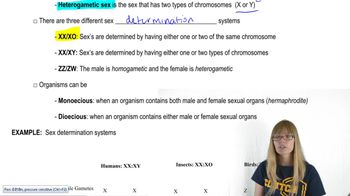
Sex determination in both Drosophila and humans is governed by specific chromosomes, known as sex chromosomes. In humans, the presence of XX chromosomes typically results in females, and XY in males. In Drosophila, the ratio of X chromosomes to sets of autosomes determines sex, with XX being female and XY male. Observations of chromosome patterns in offspring support these mechanisms.
추천 영상:
가이드 코스
04:24
Sex Determination

Genetic Evidence from Mutant and Aneuploid Individuals

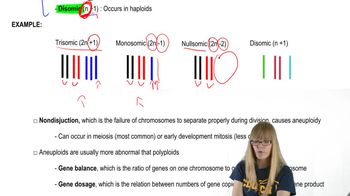
Studies of individuals with abnormal numbers or structures of sex chromosomes, such as Turner syndrome (XO) or Klinefelter syndrome (XXY) in humans, and similar chromosomal variants in Drosophila, provide evidence for how sex chromosomes influence sexual development. These genetic anomalies help clarify the role of specific chromosomes in sex determination.
추천 영상:

Experimental Crosses and Phenotypic Ratios

Controlled breeding experiments in Drosophila and pedigree analyses in humans reveal patterns of inheritance and sex ratios that support chromosomal sex determination. For example, observing the sex ratios in offspring from specific crosses or families helps confirm the role of sex chromosomes and the mechanisms by which they determine sex.
추천 영상:
가이드 코스
10:20
Monohybrid Cross