Ch. 8 - Chromosome Mutations: Variation in Number and Arrangement
Klug - Concepts of Genetics 12th Edition
Klug12th EditionConcepts of GeneticsISBN: 9780135564776당신이 사용하는 게 아니라요?교과서 변경
8장, 문제 27a

A boy with Klinefelter syndrome (47,XXY) is born to a mother who is phenotypically normal and a father who has the X-linked skin condition called anhidrotic ectodermal dysplasia. The mother's skin is completely normal with no signs of the skin abnormality. In contrast, her son has patches of normal skin and patches of abnormal skin.
Which parent contributed the abnormal gamete?

검증된 단계별 안내
1
Step 1: Understand the genetic condition and inheritance pattern. Klinefelter syndrome (47,XXY) means the boy has two X chromosomes and one Y chromosome. The father has an X-linked skin condition (anhidrotic ectodermal dysplasia), which is inherited through the X chromosome.
Step 2: Analyze the mother's genotype and phenotype. The mother is phenotypically normal with no signs of the skin condition, indicating she likely does not carry the mutant allele on either of her X chromosomes.
Step 3: Consider the son's phenotype of patches of normal and abnormal skin. This mosaic pattern suggests X-chromosome inactivation (lyonization) in a female or in this case, a 47,XXY male, where one X chromosome is randomly inactivated in different cells, leading to patches expressing either the normal or mutant allele.
Step 4: Determine which parent contributed the abnormal X chromosome. Since the mother is normal and the son has the condition, the abnormal X chromosome must have come from the father, who has the X-linked skin condition.
Step 5: Conclude that the father contributed the abnormal X chromosome carrying the mutation, while the mother contributed a normal X chromosome, and the Y chromosome came from the father as well, resulting in the 47,XXY karyotype.

비슷한 문제에 대한 검증된 영상 답변:

이 영상 해법은 위 문제에 도움이 된다고 튜터들이 추천한 것입니다.
영상 길이:
4m

주요 개념

질문에 올바르게 답하기 위해 반드시 이해해야 하는 핵심 개념들은 다음과 같습니다.

Klinefelter Syndrome (47,XXY)

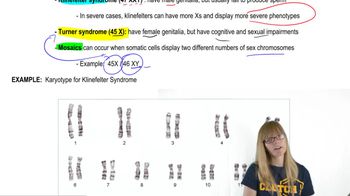
Klinefelter syndrome is a chromosomal condition where a male has an extra X chromosome, resulting in a 47,XXY karyotype. This affects male development and can cause physical and reproductive abnormalities. Understanding this helps explain the genetic background of the boy in the question.
추천 영상:
가이드 코스
10:35
Human Sex Chromosomes

X-linked Inheritance and Mosaicism

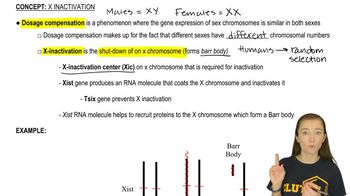
X-linked conditions are caused by mutations on the X chromosome. In males (XY), a single mutated X causes the disease, while females (XX) may be carriers without symptoms due to X-inactivation. Mosaicism, such as patches of normal and abnormal skin, occurs when some cells express the mutated gene and others do not, often due to random X-inactivation.
추천 영상:

Parental Origin of Chromosomes and Gametes

Determining which parent contributed the abnormal X chromosome involves understanding gamete formation. The mother provides one X chromosome, and the father provides either an X or a Y. Since the father has the X-linked condition, his X chromosome carries the mutation, but the son’s extra X could come from either parent, affecting the phenotype.
추천 영상:
가이드 코스
21:21
Gamete Development
관련 실천
교과서 질문

A woman who sought genetic counseling is found to be heterozygous for a chromosomal rearrangement between the second and third chromosomes. Her chromosomes, compared to those in a normal karyotype, are diagrammed to the right.

This woman is phenotypically normal. Does this surprise you? Why or why not? Under what circumstances might you expect a phenotypic effect of such a rearrangement?

628
views
교과서 질문

In a recent cytogenetic study on 1021 cases of Down syndrome, 46 were the result of translocations, the most frequent of which was symbolized as t(14;21). What does this symbol represent, and how many chromosomes would you expect to be present in t(14;21) Down syndrome individuals?

668
views
교과서 질문

A boy with Klinefelter syndrome (47,XXY) is born to a mother who is phenotypically normal and a father who has the X-linked skin condition called anhidrotic ectodermal dysplasia. The mother's skin is completely normal with no signs of the skin abnormality. In contrast, her son has patches of normal skin and patches of abnormal skin.

Using the appropriate genetic terminology, describe the meiotic mistake that occurred. Be sure to indicate in which division the mistake occurred.

1527
views
교과서 질문

A boy with Klinefelter syndrome (47,XXY) is born to a mother who is phenotypically normal and a father who has the X-linked skin condition called anhidrotic ectodermal dysplasia. The mother's skin is completely normal with no signs of the skin abnormality. In contrast, her son has patches of normal skin and patches of abnormal skin.

Using the appropriate genetic terminology, explain the son's skin phenotype.

2491
views
교과서 질문
Most cases of Turner syndrome are attributed to nondisjunction of one or more of the sex chromosomes during gametogenesis, from either the male or female parent. However, some females possess a rare form of Turner syndrome in which some of the cells of the body (somatic cells) lack an X chromosome, while other cells have the normal two X chromosomes. Often detected in blood and/or skin cells, such individuals with mosaic Turner syndrome may exhibit relatively mild symptoms. An individual may be specified as 45,X(20)/46,XX(80) if, for example, 20 percent of the cells examined were X monosomic. How might mitotic events cause such mosaicism, and what parameter(s) would likely determine the percentages and distributions of X0 cells?
1321
views
교과서 질문

The woman in Problem 24 has had two miscarriages. She has come to you, an established genetic counselor, with these questions:

Is there a genetic explanation of her frequent miscarriages?

Should she abandon her attempts to have a child of her own?

If not, what is the chance that she could have a normal child? Provide an informed response to her concerns.

616
views