Ch. 8 - Chromosome Mutations: Variation in Number and Arrangement
Klug - Concepts of Genetics 12th Edition
Klug12th EditionConcepts of GeneticsISBN: 9780135564776당신이 사용하는 게 아니라요?교과서 변경
8장, 문제 12

Human adult hemoglobin is a tetramer containing two alpha (α) and two beta (β) polypeptide chains. The α gene cluster on chromosome 16 and the β gene cluster on chromosome 11 share amino acid similarities such that 61 of the amino acids of the α-globin polypeptide (141 amino acids long) are shared in identical sequence with the β-globin polypeptide (146 amino acids long). How might one explain the existence of two polypeptides with partially shared function and structure on two different chromosomes?

검증된 단계별 안내
1
Step 1: Understand the biological context — human adult hemoglobin is composed of two alpha (α) and two beta (β) polypeptide chains, each encoded by gene clusters located on different chromosomes (α on chromosome 16 and β on chromosome 11).
Step 2: Recognize that the α- and β-globin polypeptides share a significant number of identical amino acids (61 out of 141 in α-globin and 146 in β-globin), indicating a degree of sequence similarity and possibly a common evolutionary origin.
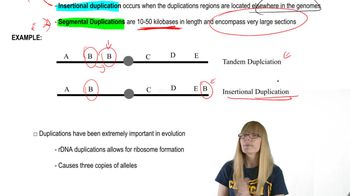
Step 3: Consider the concept of gene duplication and divergence, where an ancestral globin gene duplicated in the genome, and over time, the copies evolved separately on different chromosomes, leading to related but distinct polypeptides.
Step 4: Explain that this evolutionary process can result in paralogous genes—genes related by duplication within a genome—that retain some structural and functional similarities but also acquire unique features to fulfill specialized roles.
Step 5: Conclude that the presence of two polypeptides with partially shared function and structure on different chromosomes is best explained by gene duplication followed by divergence, which allows the organism to produce hemoglobin with subunits adapted for cooperative oxygen binding.

비슷한 문제에 대한 검증된 영상 답변:

이 영상 해법은 위 문제에 도움이 된다고 튜터들이 추천한 것입니다.
영상 길이:
2m
도움이 되었나요?

주요 개념

질문에 올바르게 답하기 위해 반드시 이해해야 하는 핵심 개념들은 다음과 같습니다.

Gene Duplication and Divergence

Gene duplication is an evolutionary process where a gene is copied in the genome, allowing one copy to maintain the original function while the other accumulates mutations. Over time, this can lead to related genes with similar sequences but distinct functions, explaining the presence of α- and β-globin genes on different chromosomes with shared amino acid sequences.
추천 영상:

Homologous Genes and Protein Families

Homologous genes arise from a common ancestral gene and often encode proteins with similar structures and functions. The α- and β-globin genes belong to the globin gene family, sharing sequence similarities due to their evolutionary relationship, which results in polypeptides with partially overlapping roles in oxygen transport.
추천 영상:

Chromosomal Localization and Gene Clusters

Genes encoding related proteins are often organized in clusters on different chromosomes, reflecting their evolutionary history and regulation. The α-globin cluster on chromosome 16 and the β-globin cluster on chromosome 11 illustrate how gene families can be distributed across the genome yet maintain coordinated expression and functional similarity.
추천 영상:
가이드 코스
11:19
Segmentation Genes