Ch. 8 - Chromosome Mutations: Variation in Number and Arrangement
Klug - Concepts of Genetics 12th Edition
Klug12th EditionConcepts of GeneticsISBN: 9780135564776당신이 사용하는 게 아니라요?교과서 변경
8장, 문제 20

The mutations called bobbed in Drosophila result from variable reductions (deletions) in the number of amplified genes coding for rRNA. Researchers trying to maintain bobbed stocks have often documented their tendency to revert to wild type in successive generations. Propose a mechanism based on meiotic recombination which could account for this reversion phenomenon. Why would wild-type flies become more prevalent in Drosophila cultures?

검증된 단계별 안내
1
Understand that the bobbed mutation in Drosophila is due to deletions in rRNA gene copies, which are essential for ribosome function and thus for protein synthesis.
Recognize that during meiosis, homologous chromosomes can undergo recombination, a process where segments of DNA are exchanged between homologous chromosomes.
Consider that if a bobbed chromosome (with deletions) pairs with a wild-type chromosome (with normal rRNA gene copies) during meiosis, recombination can occur between these homologous regions.
Propose that recombination could result in a crossover event where the bobbed chromosome receives a segment from the wild-type chromosome, restoring the deleted rRNA gene copies.
Conclude that over successive generations, this recombination and restoration process could lead to an increase in wild-type flies, as they have a selective advantage due to more efficient protein synthesis.

비슷한 문제에 대한 검증된 영상 답변:

이 영상 해법은 위 문제에 도움이 된다고 튜터들이 추천한 것입니다.
영상 길이:
3m
도움이 되었나요?

주요 개념

질문에 올바르게 답하기 위해 반드시 이해해야 하는 핵심 개념들은 다음과 같습니다.

Meiotic Recombination

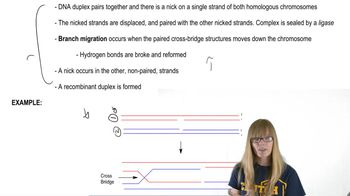
Meiotic recombination is a process during meiosis where homologous chromosomes exchange genetic material. This results in new allele combinations in gametes, which can lead to genetic diversity in offspring. In the context of Drosophila, recombination can facilitate the restoration of wild-type alleles, counteracting the effects of mutations like bobbed.
추천 영상:
가이드 코스
03:51
Recombination after Single Strand Breaks

Genetic Drift

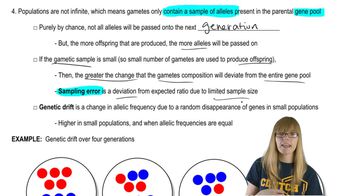
Genetic drift is a mechanism of evolution that refers to random changes in allele frequencies within a population. In small populations, such as those of Drosophila, genetic drift can lead to the loss of mutant alleles over generations, allowing wild-type alleles to become more prevalent. This phenomenon can explain the observed reversion to wild type in bobbed stocks.
추천 영상:

Selection Pressure

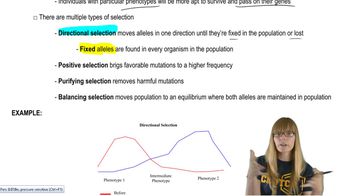
Selection pressure refers to environmental factors that favor certain phenotypes over others, influencing the survival and reproduction of individuals. In Drosophila, if wild-type flies have a reproductive advantage or better survival rates compared to bobbed mutants, natural selection will increase the frequency of wild-type alleles in the population, leading to their prevalence over time.
추천 영상:
가이드 코스
05:54
Natural Selection
관련 실천
교과서 질문

Mendelian ratios are modified in crosses involving autotetraploids. Assume that one plant expresses the dominant trait green seeds and is homozygous (WWWW). This plant is crossed to one with white seeds that is also homozygous (wwww). If only one dominant allele is sufficient to produce green seeds, predict the F₁ and F₂ results of such a cross. Assume that synapsis between chromosome pairs is random during meiosis.

710
views
교과서 질문

Drosophila may be monosomic for chromosome 4, yet remain fertile. Contrast the F₁ and F₂ results of the following crosses involving the recessive chromosome 4 trait, bent bristles:

monosomic IV, normal bristles x diploid, bent bristles.

538
views
교과서 질문

A couple planning their family are aware that through the past three generations on the husband's side a substantial number of stillbirths have occurred and several malformed babies were born who died early in childhood. The wife has studied genetics and urges her husband to visit a genetic counseling clinic, where a complete karyotype-banding analysis is performed. Although the tests show that he has a normal complement of 46 chromosomes, banding analysis reveals that one member of the chromosome 1 pair (in group A) contains an inversion covering 70 percent of its length. The homolog of chromosome 1 and all other chromosomes show the normal banding sequence.

What can you predict about the probability of abnormality/normality of their future children?

430
views
교과서 질문

The outcome of a single crossover between nonsister chromatids in the inversion loop of an inversion heterozygote varies depending on whether the inversion is of the paracentric or pericentric type. What differences are expected?

541
views
교과서 질문

Having correctly established the F₂ ratio in Problem 18, predict the F₂ ratio of a 'dihybrid' cross involving two independently assorting characteristics (e.g., P₁ = WWWWAAAA x wwwwaaaa).

641
views
교과서 질문

A couple planning their family are aware that through the past three generations on the husband's side a substantial number of stillbirths have occurred and several malformed babies were born who died early in childhood. The wife has studied genetics and urges her husband to visit a genetic counseling clinic, where a complete karyotype-banding analysis is performed. Although the tests show that he has a normal complement of 46 chromosomes, banding analysis reveals that one member of the chromosome 1 pair (in group A) contains an inversion covering 70 percent of its length. The homolog of chromosome 1 and all other chromosomes show the normal banding sequence.

How would you explain the high incidence of past stillbirths?

653
views