Ch. 9 - Extranuclear Inheritance
Klug - Concepts of Genetics  12th Edition
Klug12th EditionConcepts of Genetics ISBN: 9780135564776당신이 사용하는 게 아니라요?교과서 변경
9장, 문제 1c

In the discussion, we focused on extranuclear inheritance and how traits can be determined by genetic information contained in mitochondria and chloroplasts, and we discussed how expression of maternal genotypes can affect the phenotype of an organism. At the same time, we found many opportunities to consider the methods and reasoning by which much of this information was acquired. From the explanations given in the chapter, what answers would you propose to the following fundamental questions?
What observations support the endosymbiotic theory?

검증된 단계별 안내
1
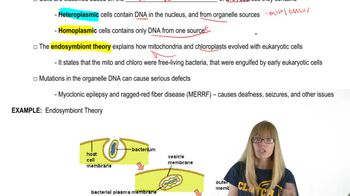
Understand the endosymbiotic theory: This theory proposes that mitochondria and chloroplasts originated from free-living prokaryotic organisms that were engulfed by ancestral eukaryotic cells, forming a symbiotic relationship.
Examine the structural evidence: Mitochondria and chloroplasts have double membranes, which is consistent with the engulfing process described in the theory. Their inner membrane resembles that of prokaryotes, while the outer membrane resembles the host cell's membrane.
Analyze genetic evidence: Both mitochondria and chloroplasts contain their own circular DNA, similar to bacterial genomes, and they replicate independently of the host cell's nucleus. This supports their prokaryotic origin.
Consider ribosomal evidence: The ribosomes found in mitochondria and chloroplasts are similar in size and structure to bacterial ribosomes, rather than eukaryotic ribosomes, further supporting the theory.
Review biochemical and functional evidence: Mitochondria and chloroplasts perform processes (e.g., oxidative phosphorylation and photosynthesis) that are similar to those carried out by certain prokaryotes, indicating a shared evolutionary history.

비슷한 문제에 대한 검증된 영상 답변:

이 영상 해법은 위 문제에 도움이 된다고 튜터들이 추천한 것입니다.
영상 길이:
2m
도움이 되었나요?

주요 개념

질문에 올바르게 답하기 위해 반드시 이해해야 하는 핵심 개념들은 다음과 같습니다.

Endosymbiotic Theory

The endosymbiotic theory posits that certain organelles, specifically mitochondria and chloroplasts, originated from free-living prokaryotic organisms that were engulfed by ancestral eukaryotic cells. This theory explains how these organelles have their own DNA, which is similar to bacterial DNA, and how they replicate independently of the cell's nuclear DNA, supporting the idea of a symbiotic relationship that led to the evolution of complex cells.
추천 영상:
가이드 코스
04:11
Organelle DNA Characteristics

Extranuclear Inheritance

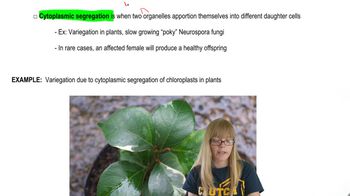
Extranuclear inheritance refers to the transmission of genetic material that occurs outside the nucleus, primarily through organelles like mitochondria and chloroplasts. This type of inheritance is typically maternal, meaning that offspring inherit these organelles and their associated genetic information exclusively from the mother, which can significantly influence traits and phenotypes in the progeny.
추천 영상:
가이드 코스
05:13
Organelle Inheritance

Maternal Effect

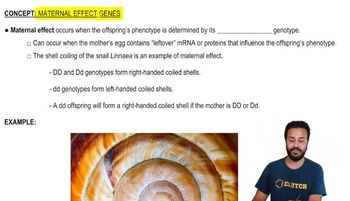
The maternal effect is a phenomenon where the genotype of the mother directly influences the phenotype of her offspring, regardless of the offspring's own genotype. This effect is particularly relevant in the context of extranuclear inheritance, as maternal genotypes can determine the characteristics of organelles passed to the offspring, thereby affecting traits such as metabolism, growth, and development.
추천 영상:
가이드 코스
03:38
Maternal Effect
관련 실천
교과서 질문

Write a short essay that distinguishes between organelle heredity and maternal effect.

506
views
교과서 질문

In the discussion, we focused on extranuclear inheritance and how traits can be determined by genetic information contained in mitochondria and chloroplasts, and we discussed how expression of maternal genotypes can affect the phenotype of an organism. At the same time, we found many opportunities to consider the methods and reasoning by which much of this information was acquired. From the explanations given in the chapter, what answers would you propose to the following fundamental questions?

What findings demonstrate a maternal effect as the basis of a mode of inheritance?

546
views
교과서 질문

In the discussion, we focused on extranuclear inheritance and how traits can be determined by genetic information contained in mitochondria and chloroplasts, and we discussed how expression of maternal genotypes can affect the phenotype of an organism. At the same time, we found many opportunities to consider the methods and reasoning by which much of this information was acquired. From the explanations given in the chapter, what answers would you propose to the following fundamental questions?

What key observations in crosses between dextrally and sinistrally coiled snails support the explanation that this phenotype is the result of maternal-effect inheritance?

440
views
교과서 질문

How was it established that particular phenotypes are inherited as a result of genetic information present in the chloroplast rather than in the nucleus?

424
views
교과서 질문

In the discussion, we focused on extranuclear inheritance and how traits can be determined by genetic information contained in mitochondria and chloroplasts, and we discussed how expression of maternal genotypes can affect the phenotype of an organism. At the same time, we found many opportunities to consider the methods and reasoning by which much of this information was acquired. From the explanations given in the chapter, what answers would you propose to the following fundamental questions?

How did the discovery of three categories of petite mutations in yeast lead researchers to postulate extranuclear inheritance of colony size?

575
views