Ch. 9 - Extranuclear Inheritance
Klug - Concepts of Genetics 12th Edition
Klug12th EditionConcepts of GeneticsISBN: 9780135564776당신이 사용하는 게 아니라요?교과서 변경
9장, 문제 19c

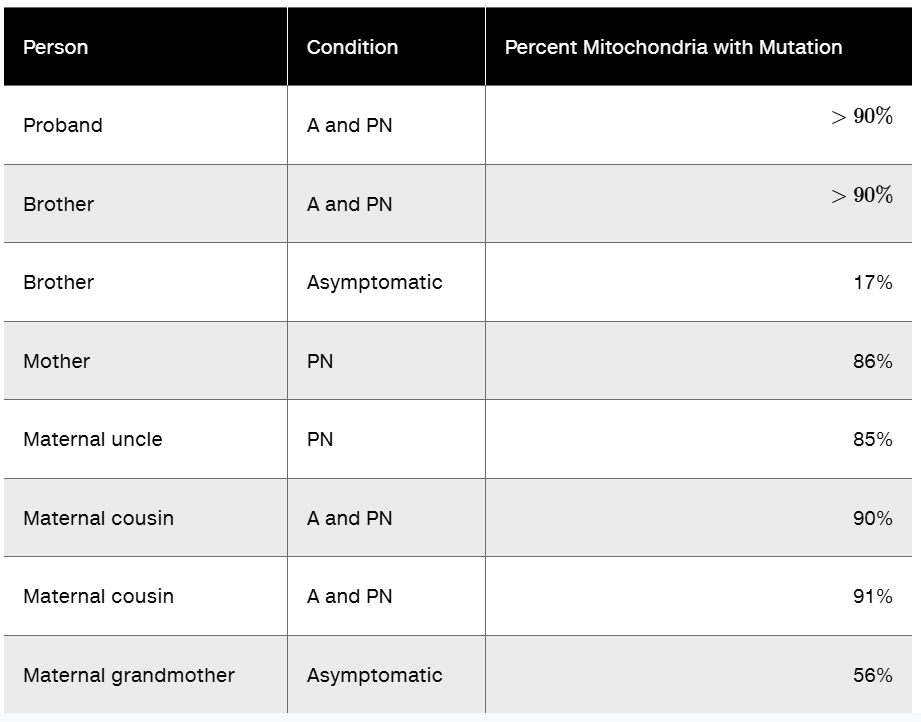
Researchers examined a family with an interesting distribution of Leigh syndrome symptoms. In this disorder, individuals may show a progressive loss of motor function (ataxia, A) with peripheral neuropathy (PN, meaning impairment of the peripheral nerves). A mitochondrial DNA (mtDNA) mutation that reduces ATPase activity was identified in various tissues of affected individuals. The accompanying table summarizes the presence of symptoms in an extended family.
Table showing family members with Leigh syndrome symptoms and varying mitochondrial DNA mutation levels from 17% to over 90%.
How can some individuals in the same family show such variation in symptoms? What term, as related to organelle heredity, describes such variation?

검증된 단계별 안내
1
Understand that the problem involves mitochondrial DNA (mtDNA), which is inherited maternally and can exhibit variability in symptoms among family members due to differences in the proportion of mutated mtDNA.
Recognize that the term describing this variation in symptoms is 'heteroplasmy,' which refers to the coexistence of both normal and mutated mtDNA within the same cell or organism.
Note that the severity of symptoms in mitochondrial disorders like Leigh syndrome is often correlated with the percentage of mutated mtDNA present in an individual's cells. For example, individuals with >90% mutated mtDNA (proband and brother) show severe symptoms, while those with lower percentages (e.g., 17% in the asymptomatic brother) may not exhibit symptoms.
Explain that heteroplasmy arises because mitochondria are distributed randomly during cell division, leading to variable proportions of mutated mtDNA in different tissues and individuals. This random distribution can result in a wide range of symptom severity within the same family.
Conclude that the variation in symptoms among family members is due to heteroplasmy and the threshold effect, where a certain proportion of mutated mtDNA must be exceeded for symptoms to manifest. This explains why some individuals are asymptomatic while others are severely affected.

비슷한 문제에 대한 검증된 영상 답변:

이 영상 해법은 위 문제에 도움이 된다고 튜터들이 추천한 것입니다.
영상 길이:
3m
도움이 되었나요?

주요 개념

질문에 올바르게 답하기 위해 반드시 이해해야 하는 핵심 개념들은 다음과 같습니다.

Mitochondrial Inheritance

Mitochondrial inheritance refers to the transmission of genetic material found in mitochondria, which is inherited exclusively from the mother. This type of inheritance can lead to variable expression of mitochondrial disorders, as seen in Leigh syndrome, where different individuals may exhibit varying symptoms despite sharing the same mtDNA mutation. The severity of symptoms can depend on the proportion of mutated mitochondria present in different tissues.
추천 영상:
가이드 코스
05:13
Organelle Inheritance

Heteroplasmy

Heteroplasmy is the presence of a mixture of more than one type of mitochondrial DNA within a cell or individual. In the context of mitochondrial diseases, such as Leigh syndrome, individuals may have varying levels of mutated mtDNA, leading to differences in symptom severity. This variation can explain why some family members are symptomatic while others remain asymptomatic, depending on the percentage of mutated mitochondria in their cells.
추천 영상:
가이드 코스
04:11
Organelle DNA Characteristics

Penetrance and Expressivity

Penetrance refers to the proportion of individuals with a specific genotype that actually express the associated phenotype, while expressivity describes the degree to which a genotype is expressed in an individual. In the case of Leigh syndrome, the differences in symptoms among family members can be attributed to incomplete penetrance and variable expressivity of the mitochondrial mutation, resulting in a range of clinical manifestations from severe symptoms to asymptomatic individuals.
추천 영상:
가이드 코스
02:09
Penetrance and Expressivity
관련 실천
교과서 질문

Payne, B. A. et al. (2013) present evidence that a low level of heteroplasmic mtDNA exists in all tested healthy individuals.

What genetic conditions within a given mitochondrion are likely to contribute to such a variable pool of mitochondria?

411
views
교과서 질문

Payne, B. A. et al. (2013) present evidence that a low level of heteroplasmic mtDNA exists in all tested healthy individuals.

What are two likely sources of such heteroplasmy?

359
views
교과서 질문

Researchers examined a family with an interesting distribution of Leigh syndrome symptoms. In this disorder, individuals may show a progressive loss of motor function (ataxia, A) with peripheral neuropathy (PN, meaning impairment of the peripheral nerves). A mitochondrial DNA (mtDNA) mutation that reduces ATPase activity was identified in various tissues of affected individuals. The accompanying table summarizes the presence of symptoms in an extended family.

Develop a pedigree that summarizes the information presented in the table.

519
views
교과서 질문

Researchers examined a family with an interesting distribution of Leigh syndrome symptoms. In this disorder, individuals may show a progressive loss of motor function (ataxia, A) with peripheral neuropathy (PN, meaning impairment of the peripheral nerves). A mitochondrial DNA (mtDNA) mutation that reduces ATPase activity was identified in various tissues of affected individuals. The accompanying table summarizes the presence of symptoms in an extended family.

In what way does a condition caused by mtDNA differ in expression and transmission from a mutation that causes albinism?

480
views
교과서 질문

Researchers examined a family with an interesting distribution of Leigh syndrome symptoms. In this disorder, individuals may show a progressive loss of motor function (ataxia, A) with peripheral neuropathy (PN, meaning impairment of the peripheral nerves). A mitochondrial DNA (mtDNA) mutation that reduces ATPase activity was identified in various tissues of affected individuals. The accompanying table summarizes the presence of symptoms in an extended family.

Provide an explanation for the pattern of inheritance of the disease. What term describes this pattern?

475
views
교과서 질문

Mutations in mitochondrial DNA appear to be responsible for a number of neurological disorders, including myoclonic epilepsy and ragged-red fiber disease, Leber's hereditary optic neuropathy, and Kearns-Sayre syndrome. In each case, the disease phenotype is expressed when the ratio of mutant to wild-type mitochondria exceeds a threshold peculiar to each disease, but usually in the 60 to 95 percent range.

Compared with the vast number of mitochondria in an embryo, the number of mitochondria in an ovum is relatively small. Might such an ooplasmic mitochondrial bottleneck present an opportunity for therapy or cure? Explain.

860
views