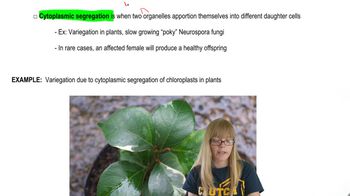
You have isolated two petite mutants, pet1 and pet2, in Saccharomyces cerevisiae. When pet1 is mated with wild-type yeast, the haploid products following meiosis segregate 2:2 (wild type : petite). In contrast, when pet2 is mated with wild type, all haploid products following meiosis are wild type. To what class of petite mutations does each of these petite mutants belong? What types of progeny do you expect from a pet1 × pet2 mating?

A 50-year-old man has been diagnosed with MELAS syndrome. His wife is phenotypically normal, and there is no history of MELAS syndrome in either of their families. The couple is concerned about whether their children will develop the disease. As a genetic counselor, what will you tell them? Would your answer change if it were the mother who exhibited disease symptoms rather than the father?
검증된 단계별 안내
비슷한 문제에 대한 검증된 영상 답변:
주요 개념
Mitochondrial Inheritance
Penetrance and Expressivity
Risk Assessment in Genetic Counseling
The first person in a family to exhibit Leber hereditary optic neuropathy (LHON) was II-3 in the pedigree shown below, and all of her children also exhibited the disease. Provide two possible explanations as to why II-3's mother (I-1) did not exhibit symptoms of LHON.
Consider this human pedigree for a vision defect.
What is the most probable mode of inheritance of the disease? Identify any discrepancies between the pedigree and your proposed mode of transmission, and provide possible explanations for these exceptions.
What is the most likely mode of inheritance for the trait depicted in the following human pedigree?
The following pedigree shows a family in which several individuals exhibit symptoms of the mitochondrial disease MERRF. Two siblings (II-2 and II-5) approach you to inquire about whether their children will also be afflicted with MERRF. What do you tell them?
You have isolated (1) a streptomycin-resistant mutant (strᴿ) of Chlamydomonas that maps to the chloroplast genome and (2) a hygromycin-resistant mutant (hygᴿ) of Chlamydomonas that maps to the mitochondrial genome. What types of progeny do you expect from the following reciprocal crosses?
mt⁺ strᴿ hygˢ× mt⁻ strˢ hygᴿ
mt⁺ strˢ hygᴿ× mt⁻ strᴿ hygSˢ
