Ch. 9 - The Molecular Biology of Translation
Sanders - Genetic Analysis: An Integrated Approach 3rd Edition
Sanders3rd EditionGenetic Analysis: An Integrated ApproachISBN: 9780135564172당신이 사용하는 게 아니라요?교과서 변경
9장, 문제 35b

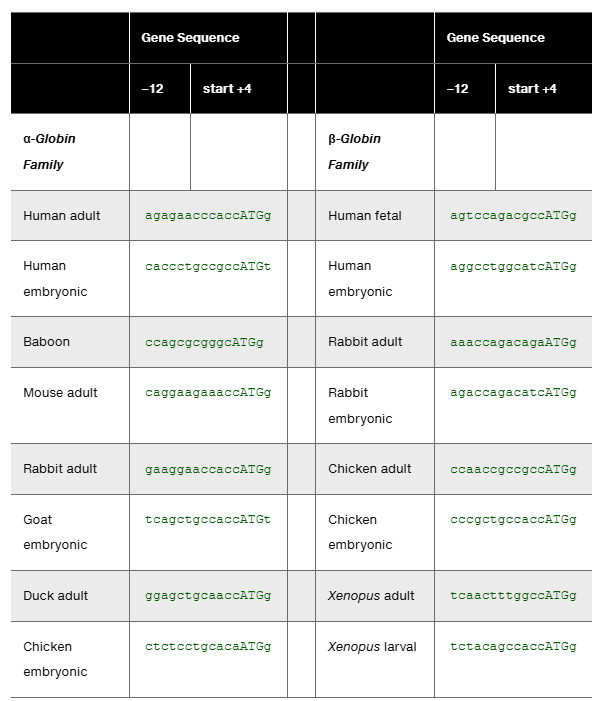
Table D lists α-globin and β-globin gene sequences for the 11 or 12 nucleotides preceding the start codon and the first nucleotide following the start codon (see Problem 34). The data are for 16 vertebrate globin genes reported by Kozak (1987). The sequences are written from -12 to +4 with the start codon sequence in capital letters. Use the data in this table to:
Compare the consensus sequence for these globin genes to the consensus sequence derived from the larger study of 699 vertebrate genes in Problem 34. 
Table showing α-globin and β-globin gene sequences from -12 to +4 nucleotides around the start codon in various vertebrates.

검증된 단계별 안내
1
Step 1: Understand the context of the problem by reviewing the sequences given for the α-globin and β-globin genes, specifically focusing on the nucleotides from positions -12 to +4 relative to the start codon. The start codon itself is at positions +1 to +3 and is written in capital letters.
Step 2: Identify the consensus sequence for the 16 vertebrate globin genes by aligning all the sequences from the table and determining the most common nucleotide at each position from -12 to +4. This involves counting the frequency of each nucleotide at every position and selecting the one with the highest occurrence.
Step 3: Recall or retrieve the consensus sequence derived from the larger study of 699 vertebrate genes (from Problem 34). This sequence represents a broader dataset and serves as a reference for comparison.
Step 4: Compare the consensus sequence obtained from the 16 globin genes to the consensus sequence from the larger study by examining each nucleotide position. Note similarities and differences, especially in key regions such as the Kozak sequence around the start codon, which is important for translation initiation.
Step 5: Interpret the biological significance of any differences or similarities observed. Consider how the conservation or variation in these sequences might affect gene expression or translation efficiency in globin genes compared to the general vertebrate gene population.

비슷한 문제에 대한 검증된 영상 답변:

이 영상 해법은 위 문제에 도움이 된다고 튜터들이 추천한 것입니다.
영상 길이:
2m
도움이 되었나요?

주요 개념

질문에 올바르게 답하기 위해 반드시 이해해야 하는 핵심 개념들은 다음과 같습니다.

Consensus Sequence

A consensus sequence represents the most common nucleotides found at each position in a set of aligned DNA or RNA sequences. It highlights conserved regions important for biological function, such as gene regulation or translation initiation. Comparing consensus sequences helps identify critical motifs shared across different genes or species.
추천 영상:
가이드 코스
08:55
Sequencing Overview

Start Codon and Flanking Regions

The start codon (usually AUG) signals the beginning of translation in mRNA. The nucleotides immediately upstream (-12 to -1) and downstream (+1 to +4) of the start codon influence the efficiency of translation initiation. These flanking sequences often contain conserved motifs, such as the Kozak sequence, which affect ribosome binding.
추천 영상:
가이드 코스
00:30
Regions of X Chromosomes

Comparative Sequence Analysis

Comparative sequence analysis involves examining multiple gene sequences to identify similarities and differences. By comparing the α- and β-globin gene sequences to a larger dataset, one can determine how conserved the initiation region is across vertebrates and infer evolutionary or functional significance of sequence variations.
추천 영상:
가이드 코스
08:55
Sequencing Overview
관련 실천
교과서 질문

In terms of the polycistronic composition of mRNAs and the presence or absence of Shine–Dalgarno sequences, compare and contrast bacterial, archaeal, and eukaryotic mRNAs.

602
views
교과서 질문

The six nucleotides preceding the start codon and the first nucleotide after the start codon in eukaryotes exhibit strong sequence conservation as determined by the percentages of nucleotides in the  to  positions and the  position (see Problem 34). Use the data given in the table for Problem 35 to determine the seven nucleotides that most commonly surround the start in vertebrates.

433
views
교과서 질문

Organisms of all three domains of life usually use the mRNA codon AUG as the start codon.

Do organisms of the three domains use the same amino acid as the initial amino acid in translation? Identify similarities and differences.

583
views
교과서 질문

Diagram a eukaryotic gene containing three exons and two introns, the pre-mRNA and mature mRNA transcript of the gene, and a partial polypeptide that contains the following sequences and features. Carefully align the nucleic acids, and locate each sequence or feature on the appropriate molecule.

a. The AG and GU dinucleotides corresponding to intron-exon junctions
b. The +1 nucleotide
c. The 5' UTR and the 3' UTR
d. The start codon sequence
e. A stop codon sequence
f. A codon sequence for the amino acids Gly-His-Arg at the end of exon 1 and a codon sequence for the amino acids Leu-Trp-Ala at the beginning of exon 2

912
views
교과서 질문

Table C contains DNA-sequence information compiled by Marilyn Kozak (1987). The data consist of the percentage of A, C, G, and T at each position among the 12 nucleotides preceding the start codon in 699 genes from various vertebrate species and at the first nucleotide after the start codon. (The start codon occupies positions +1 to +3 and the first nucleotide immediately after the start codon occupies position +4) Use the data to determine the consensus sequence for the 13 nucleotides ( -12 to -1 and +4) surrounding the start codon in vertebrate genes.

645
views
교과서 질문

Table D lists α-globin and β-globin gene sequences for the 11 or 12 nucleotides preceding the start codon and the first nucleotide following the start codon (see Problem 34). The data are for 16 vertebrate globin genes reported by Kozak (1987). The sequences are written from -12 to +4 with the start codon sequence in capital letters. Use the data in this table to:

Determine the consensus sequence for the 16 selected α-globin and β-globin genes.

549
views