Ch. 9 - The Molecular Biology of Translation
Sanders - Genetic Analysis: An Integrated Approach 3rd Edition
Sanders3rd EditionGenetic Analysis: An Integrated ApproachISBN: 9780135564172당신이 사용하는 게 아니라요?교과서 변경
9장, 문제 36

The six nucleotides preceding the start codon and the first nucleotide after the start codon in eukaryotes exhibit strong sequence conservation as determined by the percentages of nucleotides in the  to  positions and the  position (see Problem 34). Use the data given in the table for Problem 35 to determine the seven nucleotides that most commonly surround the start in vertebrates.

검증된 단계별 안내
1
Identify the start codon in eukaryotes, which is typically 'AUG'.
Examine the table provided in Problem 35 to find the nucleotide frequencies for the six positions preceding the start codon and the first position after it.
For each of the six positions before the start codon, select the nucleotide with the highest percentage from the table.
For the position immediately following the start codon, select the nucleotide with the highest percentage from the table.
Combine the selected nucleotides to form the sequence of seven nucleotides surrounding the start codon.

비슷한 문제에 대한 검증된 영상 답변:

이 영상 해법은 위 문제에 도움이 된다고 튜터들이 추천한 것입니다.
영상 길이:
3m
도움이 되었나요?

주요 개념

질문에 올바르게 답하기 위해 반드시 이해해야 하는 핵심 개념들은 다음과 같습니다.

Start Codon

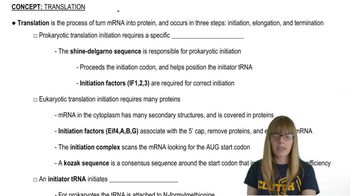
The start codon is a specific sequence of nucleotides in mRNA that signals the beginning of translation. In eukaryotes, the most common start codon is AUG, which codes for the amino acid methionine. Understanding the location and function of the start codon is crucial for analyzing gene expression and protein synthesis.
추천 영상:
가이드 코스
07:58
Translation initiation

Nucleotide Sequence Conservation

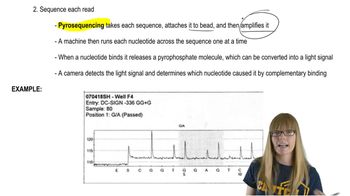
Nucleotide sequence conservation refers to the preservation of specific sequences of nucleotides across different species or within a species over time. High conservation indicates that these sequences are functionally important, often involved in critical biological processes such as initiation of translation. Analyzing conserved sequences can provide insights into evolutionary relationships and gene function.
추천 영상:
가이드 코스
08:55
Sequencing Overview

Vertebrate Genomic Data

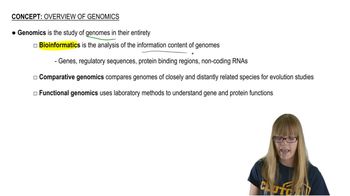
Vertebrate genomic data encompasses the genetic information derived from vertebrate species, which can be analyzed to identify common patterns in nucleotide sequences surrounding start codons. This data is essential for understanding evolutionary biology and the mechanisms of gene regulation. By examining this data, researchers can determine which nucleotides are most frequently found in specific positions relative to the start codon.
추천 영상:
가이드 코스
02:48
Genomics Overview
관련 실천
교과서 질문

In terms of the polycistronic composition of mRNAs and the presence or absence of Shine–Dalgarno sequences, compare and contrast bacterial, archaeal, and eukaryotic mRNAs.

602
views
교과서 질문

Organisms of all three domains of life usually use the mRNA codon AUG as the start codon.

Despite AUG being the most common start codon sequence, very few proteins have methionine as the first amino acid. Why is this the case?

393
views
교과서 질문

Organisms of all three domains of life usually use the mRNA codon AUG as the start codon.

Do organisms of the three domains use the same amino acid as the initial amino acid in translation? Identify similarities and differences.

583
views
교과서 질문

Table D lists α-globin and β-globin gene sequences for the 11 or 12 nucleotides preceding the start codon and the first nucleotide following the start codon (see Problem 34). The data are for 16 vertebrate globin genes reported by Kozak (1987). The sequences are written from -12 to +4 with the start codon sequence in capital letters. Use the data in this table to:

Compare the consensus sequence for these globin genes to the consensus sequence derived from the larger study of 699 vertebrate genes in Problem 34. 

553
views
교과서 질문

Table C contains DNA-sequence information compiled by Marilyn Kozak (1987). The data consist of the percentage of A, C, G, and T at each position among the 12 nucleotides preceding the start codon in 699 genes from various vertebrate species and at the first nucleotide after the start codon. (The start codon occupies positions +1 to +3 and the first nucleotide immediately after the start codon occupies position +4) Use the data to determine the consensus sequence for the 13 nucleotides ( -12 to -1 and +4) surrounding the start codon in vertebrate genes.

645
views
교과서 질문

Table D lists α-globin and β-globin gene sequences for the 11 or 12 nucleotides preceding the start codon and the first nucleotide following the start codon (see Problem 34). The data are for 16 vertebrate globin genes reported by Kozak (1987). The sequences are written from -12 to +4 with the start codon sequence in capital letters. Use the data in this table to:

Determine the consensus sequence for the 16 selected α-globin and β-globin genes.

549
views