How many liters of HNO3 gas, measured at 28.0 ºC and 780 torr, are required to prepare 2.30 L of 4.15 M solution of nitric acid?
A
56 L
B
62 L
C
189 L
D
230 L
E
262 L
0 댓글
검증된 단계별 안내
1
First, calculate the number of moles of HNO3 needed using the molarity formula: \( M = \frac{n}{V} \), where \( M \) is the molarity, \( n \) is the number of moles, and \( V \) is the volume in liters. Rearrange to find \( n = M \times V \). Substitute \( M = 4.15 \text{ M} \) and \( V = 2.30 \text{ L} \) to find the moles of HNO3 required.
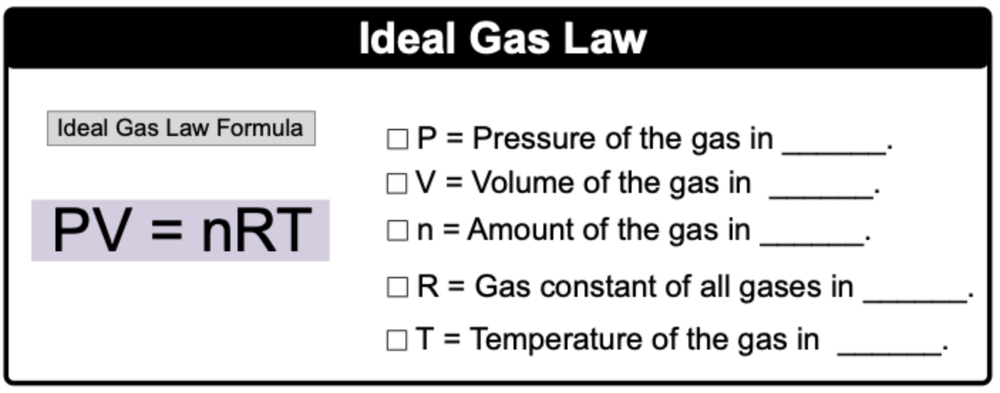
Next, use the ideal gas law to find the volume of HNO3 gas needed. The ideal gas law is \( PV = nRT \), where \( P \) is pressure, \( V \) is volume, \( n \) is the number of moles, \( R \) is the ideal gas constant (0.0821 L·atm/mol·K), and \( T \) is temperature in Kelvin.
Convert the given temperature from Celsius to Kelvin by using the formula \( T(K) = T(°C) + 273.15 \). For 28.0 ºC, calculate \( T(K) \).
Convert the pressure from torr to atm, since the ideal gas constant \( R \) is in terms of atm. Use the conversion factor \( 1 \text{ atm} = 760 \text{ torr} \). Calculate the pressure in atm.
Substitute the values of \( n \) (from step 1), \( P \) (in atm), \( R \), and \( T \) (in Kelvin) into the ideal gas law equation to solve for \( V \), the volume of HNO3 gas required in liters.


 검증된 단계별 안내