Skip to main content
GOB Chemistry
나의 코스
배우기
시험 준비
AI 튜터
학습 가이드
교과서적 해결책
플래시카드
탐험해 보세요
앱을 사용해 보세요
나의 코스
배우기
시험 준비
AI 튜터
학습 가이드
교과서적 해결책
플래시카드
탐험해 보세요
앱을 사용해 보세요
뒤로
Bond Angles (Simplified) definitions
카드를 뒤집기 위해 탭할 수 있습니다.
Bond Angle
카드를 뒤집기 위해 탭할 수 있습니다.
👆
Bond Angle
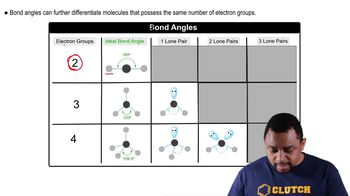
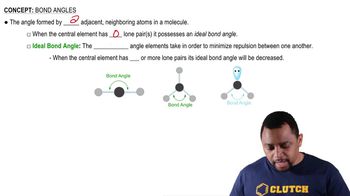
Angle formed by two adjacent atoms connected to a central atom within a molecule, influenced by electron group arrangement.
진행 상황 추적
컨트롤 버튼이 '내비게이션' 모드로 변경되었습니다.
1/14
관련 플래시카드
관련 실천
추천 영상
Bond Angles (Simplified) quiz
Bond Angles (Simplified)
15 용어
Bond Angles (Simplified)
4. Molecular Compounds
2 문제점
주제
Jules
Dipole Moment (Simplified)
4. Molecular Compounds
7 문제점
주제
Jules
4. Molecular Compounds - Part 1 of 3
8 주제
13 문제점
장
Jules
4. Molecular Compounds - Part 2 of 3
8 주제
14 문제점
장
Jules
4. Molecular Compounds - Part 3 of 3
1 주제
2 문제점
장
VideoThumbView.guidedCourse
01:24
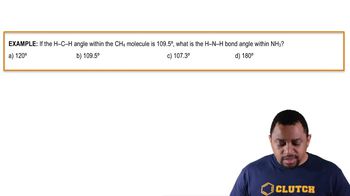
Bond Angles (Simplified) Example 1
3407
views
5
rank
VideoThumbView.guidedCourse
02:14
Bond Angles (Simplified) Concept 2
3265
views
7
rank
VideoThumbView.guidedCourse
01:24
Bond Angles (Simplified) Concept 1
3516
views
9
rank
이 집합의 용어 (14)
하이드의 정의
Bond Angle
Angle formed by two adjacent atoms connected to a central atom within a molecule, influenced by electron group arrangement.
Central Atom
Atom in a molecule to which other atoms are bonded and around which electron groups are arranged.
Lone Pair
Non-bonding pair of electrons on the central atom that increases electron repulsion and reduces bond angles.
Ideal Bond Angle
Optimal angle between bonds when the central atom has zero lone pairs, resulting in minimal electron repulsion.
Electron Group
Region of electron density around a central atom, including both bonding pairs and lone pairs.
Bonding Group
Set of electrons shared between the central atom and a surrounding atom, forming a chemical bond.
Repulsion
Force between electron groups that pushes them apart, affecting the spatial arrangement and bond angles.
Decreased Bond Angle
Angle smaller than the ideal value due to the presence of one or more lone pairs on the central atom.
180 Degrees
Ideal bond angle for a central atom with two electron groups and no lone pairs, resulting in a linear arrangement.
120 Degrees
Ideal bond angle for a central atom with three electron groups and no lone pairs, forming a trigonal planar shape.
109.5 Degrees
Ideal bond angle for a central atom with four electron groups and no lone pairs, characteristic of a tetrahedral geometry.
Spatial Arrangement
Three-dimensional positioning of atoms and electron groups around a central atom, determining bond angles.
Bonding Electron Pair
Pair of electrons shared between the central atom and a surrounding atom, contributing to molecular shape.
Molecular Geometry
Overall shape of a molecule as determined by the arrangement of electron groups around the central atom.
 뒤로뒤로
뒤로뒤로
 01:24
01:24